
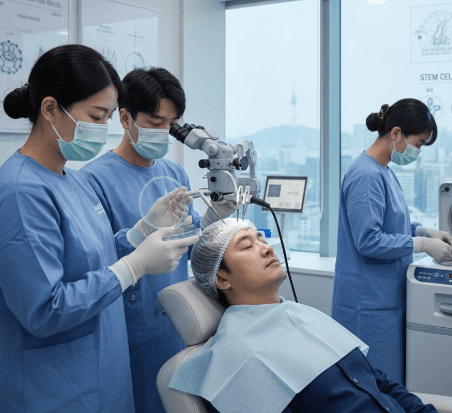
Treatment Overview
The DHI with Stem Cell / Regenerative Therapy is one of the most advanced hair restoration procedures in the world. It combines the Direct Hair Implantation (DHI) technique — known for precision and density — with stem cell–based regenerative therapy, which rejuvenates hair follicles, accelerates healing, and enhances long-term results.
This innovative combination uses autologous stem cells (derived from your own fat or blood plasma) or exosome growth factors to boost follicular regeneration and scalp vitality. Korea leads this field globally, integrating medical biotechnology, DHI precision tools, and regenerative dermatology for unmatched results.
Purpose & Benefits
The main purpose of combining DHI with stem cell therapy is to increase graft survival, stimulate native hair growth, and improve scalp health, achieving thicker, stronger, and more natural results.
Key Benefits
- Enhanced graft survival (up to 99%)
- Accelerated recovery and minimal downtime
- Revives weak or dormant hair follicles
- Increases overall hair thickness and vitality
- Reduces inflammation and improves scalp circulation
- 100% biocompatible and natural — no foreign substances
Ideal Candidates
You may be an ideal candidate for DHI with Stem Cell / Regenerative Therapy if you:
- Have early to moderate hair thinning or receding hairlines
- Want maximum graft survival and density
- Are looking for natural, biologically enhanced results
- Have weak or damaged hair follicles from previous transplants
- Prefer non-chemical, regenerative solutions
Possible Risks & Complications
The procedure is extremely safe because it uses your body’s own stem cells or plasma. Temporary effects may include:
- Mild redness or swelling for 1–2 days
- Slight tenderness at the injection or donor site
- Minimal temporary shedding (shock phase)
Korean clinics maintain the highest medical standards with sterile processing systems and FDA-approved regenerative equipment, minimizing any risk.
Techniques & Technology Used
Korean specialists integrate biotechnology and precision implantation to create a regenerative, natural result.
Advanced Techniques Used in Korea
- Micro DHI Implanter Pens (0.6–0.8 mm): Enables scar-free, high-density implantation.
- Autologous Stem Cell Extraction: Obtained from patient’s adipose tissue or PRP plasma.
- Exosome or Growth-Factor Therapy: Delivers cellular signals that promote new hair formation.
- Digital Density Mapping: Ensures balanced graft distribution.
- Regenerative PRP Enhancement: Combined with stem cells for accelerated scalp recovery.
This integration of cellular science and aesthetic precision sets Korean clinics apart globally.
Treatment Process in Korea
- Consultation & Analysis: Digital scalp imaging and density planning.
- Stem Cell Collection: Small sample taken from blood or fat tissue (painless).
- DHI Extraction: Hair follicles gently extracted using micro punches.
- Implantation: Direct placement of grafts with DHI pens — no incisions needed.
- Stem Cell / Exosome Application: Injected into scalp and donor zones to promote regeneration.
- Aftercare: Cooling therapy and regenerative scalp serums provided.
International patients receive personalized treatment plans, translator support, and luxury aftercare packages, ensuring a comfortable, premium medical experience.
Recovery & After-Care
Recovery is faster than standard DHI procedures due to regenerative healing:
- Mild redness fades in 1–3 days
- Resume daily activities within 2–4 days
- Hair washing allowed after 3 days
- Visible growth begins within 3–4 months
- Full, dense results seen after 10–12 months
Most clinics include post-procedure PRP boosters and low-level laser therapy (LLLT) to maintain healthy, long-term growth.
Results & Longevity
DHI with Stem Cell / Regenerative Therapy produces results that are denser, stronger, and more natural than conventional methods.
- 98–99% graft survival rate
- Stronger follicles with enhanced volume and shine
- Rejuvenation of existing hair follicles
- Lifelong results with improved scalp health
Because stem cells continue to activate follicle regeneration, results improve over several months, leading to progressively thicker and healthier hair.
Why Korea Is a Top Destination
Korea is a global pioneer in regenerative dermatology and advanced DHI technology, offering unmatched expertise in biologically enhanced hair restoration.
Why Choose Korea for DHI with Stem Cell / Regenerative Therapy
- Global leaders in regenerative medicine and hair restoration
- Integration of biotechnology and DHI precision
- Highly experienced surgeons and dermatologists
- Affordable premium pricing for international patients
- Comprehensive medical tourism and post-care services
Cost Range
The DHI with Stem Cell / Regenerative Therapy in Korea typically costs:
- Small area (1,000–1,500 grafts): USD 3,500–4,800
- Medium area (2,000–3,000 grafts): USD 4,800–6,000
- Large session (3,500+ grafts): USD 6,000–7,500
This includes consultation, surgery, stem cell extraction, PRP, and aftercare, offering cutting-edge treatment at competitive global prices.
Popular Clinics in Korea
- FORHAIR Clinic Korea – Seoul
- ID Hospital Hair Center – Seoul
- DA Plastic Surgery Clinic – Seoul
- Moohan Clinic – Seoul
- Seoul Hair Clinic – Gangnam
These top-rated clinics are leaders in stem cell hair regeneration, combining precision DHI techniques with cellular rejuvenation therapy for superior outcomes.


