
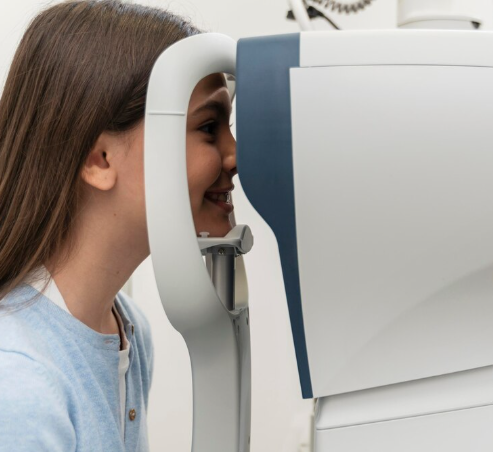
Treatment Overview
Diffractive Trifocal IOL Implantation in Korea is a premium cataract and lens replacement procedure designed to deliver seamless, clear vision at near, intermediate, and far distances. This advanced optical system uses a diffractive design that distributes light across three focal points, allowing patients to see clearly at multiple distances without glasses.
Korea is globally recognised for excellence in premium cataract surgery, combining AI-driven IOL selection, femtosecond laser-assisted precision, and digital centration systems. These innovations ensure perfect alignment, high visual performance, and rapid recovery for patients seeking full visual freedom.
The diffractive trifocal lens represents the peak of presbyopia and cataract correction technology, offering exceptional results for both refractive lens exchange (RLE) and cataract procedures.
Purpose & Benefits
Purpose
- Replace the natural or cataract-clouded lens with a diffractive trifocal IOL that enables clear vision across all focal ranges.
- Correct presbyopia, myopia, hyperopia, and astigmatism in a single operation (if using a toric trifocal variant).
- Provide a continuous visual transition for reading, computer use, and distance activities.
- Minimise dependence on glasses and bifocals.
- Deliver bright, high-contrast vision in multiple lighting environments.
Benefits
- Full-Range Vision: Seamless clarity for reading, digital use, and driving.
- Spectacle Independence: Significantly reduces the need for glasses or contact lenses.
- High Optical Quality: Diffractive design ensures even light distribution across near, intermediate, and distance focal points.
- Excellent Contrast Sensitivity: Maintains visual sharpness in both bright and dim conditions.
- Smooth Adaptation: Modern diffractive profiles minimise halos and glare common in older multifocal lenses.
- Long-Term Clarity: Premium biocompatible materials prevent lens opacity and ensure durable optical performance.
Ideal Candidates
Diffractive Trifocal IOL Implantation in Korea is suitable for:
- Patients with cataracts seeking premium, spectacle-free vision at all distances.
- Individuals over 40 with presbyopia who want full visual correction through Refractive Lens Exchange (RLE).
- Patients with healthy corneas, retina, and ocular structures.
- Those who frequently engage in diverse visual tasks (reading, digital work, driving, outdoor activities).
- Motivated individuals who want lifelong vision correction with minimal dependence on external lenses.
Possible Risks & Complications
The procedure is extremely safe in Korea’s modern eye-care centres, but as with all advanced surgeries, mild side effects may occur:
- Glare or Halos: Temporary light phenomena during night vision that typically reduce after adaptation.
- Temporary Blurring: Common in the first few days as the eye adjusts to new optical zones.
- Dry Eye or Irritation: Easily managed with medicated and lubricating eye drops.
- Residual Refractive Error: Rare and can be refined with laser enhancement if necessary.
- Posterior Capsular Opacification (PCO): May develop months later, treated effectively with Nd:YAG laser.
Korean ophthalmologists minimise risks through AI-based lens calculations, femtosecond precision, and postoperative monitoring for neuroadaptation and visual stability.
Techniques & Technology Used
Core Surgical Techniques
- AI-Guided Ocular Biometry: Determines lens power and centration with micrometric accuracy.
- Femtosecond Laser-Assisted Cataract Surgery (FLACS): Creates perfect incisions, capsulotomy, and lens fragmentation for precise trifocal placement.
- Micro-Incision Phacoemulsification: Enables minimal tissue disruption and rapid recovery.
- Intraoperative Aberrometry: Verifies IOL power and alignment in real time.
- Digital Centration Systems: Align the trifocal lens precisely along the visual axis using AI tracking.
- OCT-Guided Imaging: Provides three-dimensional verification of lens placement during surgery.
Optical Design Features
- Diffractive Trifocal Optics: Use micro-structured rings to divide light between near, intermediate, and distance foci for balanced clarity.
- Aspheric Surface Design: Reduces spherical aberration for sharper focus.
- Enhanced Light Transmission: Delivers clear, contrast-rich vision even in low-light environments.
- Neuroadaptive Comfort: Lens optics designed for quick brain adaptation and natural vision transition.
Treatment Process in Korea
Step-by-Step Workflow
Step 1 – Comprehensive Eye Examination:
Includes visual acuity testing, corneal mapping, axial length measurement, macular OCT, and AI-based IOL simulation to determine ideal trifocal power.
Step 2 – Surgical Planning:
Custom lens design and target refraction planning for balanced distance, intermediate, and near focus.
Step 3 – Cataract Removal or Lens Extraction:
Performed via femtosecond-assisted phacoemulsification or micro-incision extraction for minimal trauma.
Step 4 – IOL Implantation:
The foldable diffractive trifocal IOL is inserted and centred precisely in the capsular bag under real-time digital imaging.
Step 5 – Postoperative Monitoring:
Follow-up visits confirm visual stability, lens centration, and neuroadaptation to new optics.
Treatment Duration: 15–25 minutes per eye
Setting: Outpatient, same-day procedure
Recovery & After-Care
After-Care Guidelines
- Use prescribed antibiotic and anti-inflammatory eye drops for 2–4 weeks.
- Avoid rubbing eyes, swimming, or intense activity for one week.
- Wear UV-protective sunglasses outdoors.
- Use lubricating drops if dryness occurs.
- Attend follow-ups at Day 1, Week 1, and Month 1 for optimal monitoring.
Recovery Timeline
- Days 1–3: Vision becomes brighter and clearer with mild light sensitivity.
- Week 1: Distance and intermediate vision stabilise; near focus sharpens.
- Weeks 2–4: Full trifocal clarity achieved with reduced glare or halos.
- 1–3 Months: Complete neural adaptation and maximum comfort.
Results & Longevity
Expected Results
- High-definition vision at near, intermediate, and distance ranges.
- Greater than 90% patient satisfaction for spectacle-free living.
- Natural contrast and vivid colour perception.
- Comfortable focus transitions for all daily activities — reading, screen use, and driving.
Longevity
- Diffractive Trifocal IOLs are permanent, lifetime implants that maintain optical clarity and stability for decades.
- Korean clinical data show 95–98% long-term satisfaction rates and sustained visual precision beyond 20 years.
- Premium lens materials resist yellowing, glistening, or mechanical degradation, ensuring lifelong clarity.
Why Korea Is a Top Destination
- Global Leader in Premium Vision Surgery: Korea integrates the latest surgical technologies with precision expertise.
- AI-Enhanced Planning: Personalised IOL design for every eye using advanced biometric algorithms.
- Femtosecond Laser Systems: Provide unmatched incision precision and lens centration accuracy.
- Digital Tracking Systems: Ensure real-time axis and centration control for trifocal implantation.
- Integrated Eye-Care Facilities: Complete diagnostic, surgical, and postoperative services under one roof.
- Proven Excellence: Korean surgeons are internationally recognised for premium cataract and presbyopia correction.
Unique Korean Innovations
- AI-Based Trifocal Power Customisation and Visual Target Programming.
- Hybrid Femtosecond + OCT Guidance for precise lens placement.
- Intraoperative Digital Centration with Axis-Tracking Systems.
- Wavefront-Optimised Optical Calibration to minimise halos and glare.
- Postoperative Neuroadaptation Training for accelerated visual comfort.
These innovations place Korea among the world’s top destinations for trifocal lens surgery, offering patients superior vision quality and lifelong stability.
Cost Range (Indicative Estimate)
| Treatment Package | Price (KRW) | Approx. USD | Inclusions |
|---|---|---|---|
| Standard Diffractive Trifocal IOL Surgery | ₩6,000,000 – ₩8,000,000 | ~$4,300 – $5,800 | Premium trifocal IOL implantation with AI-guided biometry and postoperative care |
| Femtosecond-Assisted Premium Vision Package | ₩8,500,000 – ₩10,000,000 | ~$6,100 – $7,200 | Laser-assisted cataract extraction with diffractive trifocal IOL and digital centration |
| Luxury Hybrid Vision Program (Trifocal + EDOF) | ₩10,500,000 – ₩12,000,000+ | ~$7,500 – $8,600+ | Hybrid diffractive-EDOF lens, AI-guided planning, OCT verification, extended follow-up |
Note: Cost may vary depending on the lens model, technology platform, and clinic location.
Popular Clinics in Korea
- B&VIIT Eye Center (Seoul): Experts in trifocal implantation with AI biometry and femtosecond laser precision.
- Dream Eye Center (Seoul): Pioneers in FLACS and advanced presbyopia correction with diffractive optics.
- BGN Eye Clinic (Busan & Seoul): Renowned for hybrid trifocal-EDOF systems and rapid adaptation programs.
- Glory Seoul Eye Clinic: Specialists in digital centration and postoperative neuroadaptation techniques.
- K-Cure Vision Center (Gangnam): Leaders in AI-calibrated trifocal lens selection and hybrid optical design optimisation.


