
Treatment Overview
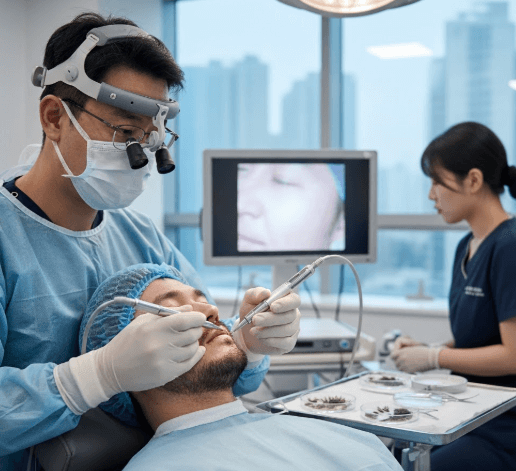
The Direct Implantation Beard Transplant (DHI Style) is a cutting-edge facial hair restoration procedure that uses a pen-type implanter device to precisely place each follicle at the correct angle, depth, and direction.
Unlike traditional beard transplant methods, the DHI technique does not require incisions or channel creation. Each graft is extracted and implanted directly into the beard area using micro-implanter pens — allowing for maximum control, minimal trauma, and ultra-natural results.
Korean surgeons are global leaders in DHI beard artistry, combining medical precision with aesthetic facial design, resulting in perfectly symmetrical, natural-looking beards customized for every patient’s facial features.
Purpose & Benefits
The Direct Implantation (DHI Style) Beard Transplant is designed to provide dense, natural, and permanent facial hair that enhances definition and masculinity.
Key Benefits
- Precise, direct implantation using pen-implanter technology
- No incisions, no sutures, and minimal downtime
- Perfect hair angle, depth, and direction for realistic results
- Ideal for shaping mustache, goatee, or full beard areas
- Fast healing and natural-looking density
- Lifelong, low-maintenance outcome
Ideal Candidates
You may be a perfect candidate for the DHI Beard Transplant if you:
- Have patchy or sparse beard growth
- Want a well-defined, natural-looking beard or mustache
- Prefer a scar-free, minimally invasive technique
- Have a healthy donor area on the scalp or under the chin
- Seek a custom beard style designed for your face shape
Possible Risks & Complications
The DHI technique is one of the safest procedures available, but mild, short-term effects can occur:
- Slight swelling or redness for 1–3 days
- Temporary sensitivity or tightness in the implant area
- Minimal shedding (shock loss) before regrowth
Korean clinics use regenerative PRP or stem-cell therapy, cooling systems, and nutrient-rich aftercare to minimize these effects and speed up recovery.
Techniques & Technology Used
The success of the DHI method lies in microsurgical precision and digital hair design tools, both of which are widely adopted by Korean clinics for facial hair transplantation.
Advanced Techniques Used in Korea
- Micro DHI Implanter Pens (0.6–0.8 mm): Allows direct, high-density implantation with perfect control.
- Digital Facial Hair Design: Customizes the beard shape, density, and direction.
- PRP (Platelet-Rich Plasma) Therapy: Improves graft survival and accelerates recovery.
- No-Shave DHI Option: Discreet procedure with no visible signs post-surgery.
- Regenerative Boosters: Optional exosome or stem-cell therapy enhances growth and thickness.
This fusion of technology and artistry ensures that the beard blends naturally with existing facial contours and hairlines.
Treatment Process in Korea
- Consultation & Facial Mapping: Digital design to define your ideal beard pattern and density.
- Extraction: Individual follicles harvested from the donor area (usually scalp or under-chin) using micro-punch tools.
- Implantation: Each graft is implanted directly with a DHI pen, controlling the exact depth, angle, and direction.
- PRP / Stem Cell Application: Strengthens grafts and promotes rapid healing.
- Aftercare: Detailed post-procedure instructions and recovery treatments provided.
International patients receive VIP consultation services, multilingual staff support, and private, luxury recovery accommodations for a smooth medical tourism experience.
Recovery & After-Care
Recovery after a DHI beard transplant is quick and comfortable:
- Mild swelling or redness for 2–3 days
- Resume work within 2–4 days
- Avoid trimming or shaving for 10–14 days
- Gentle washing after 3 days
- Visible new growth begins in 3–4 months
- Final results appear within 10–12 months
Korean clinics often offer laser scalp therapy and PRP boosters to enhance density and texture.
Results & Longevity
The Direct Implantation Beard Transplant (DHI Style) delivers dense, natural, and permanent results that complement your facial structure.
- 95–99% graft survival rate
- No visible scars or patchiness
- Realistic growth direction and density
- Lifelong, natural results that can be styled freely
Beard hair grows naturally, can be trimmed, shaped, and maintained like regular facial hair.
Why Korea Is a Top Destination
Korea is a global leader in precision hair restoration and aesthetic technology, offering DHI expertise unmatched by most countries. Korean surgeons blend medical excellence and facial design artistry, ensuring both functionality and beauty.
Why Choose Korea for DHI Beard Transplant
- Specialists trained in DHI beard and mustache restoration
- Advanced pen-implanter systems and regenerative care
- Gender-specific and customized beard designs
- Affordable premium packages for global patients
- Comprehensive aftercare and tourism support
Cost Range
The Direct Implantation Beard Transplant (DHI Style) in Korea typically costs:
- Partial beard or mustache (1,000–1,500 grafts): USD 2,800–3,800
- Medium beard (2,000–3,000 grafts): USD 3,800–5,000
- Full high-density beard (3,500+ grafts): USD 5,000–6,800
These packages generally include consultation, DHI procedure, PRP therapy, and post-care support.
Popular Clinics in Korea
- FORHAIR Clinic Korea – Seoul
- ID Hospital Hair Center – Seoul
- DA Plastic Surgery Clinic – Seoul
- Moohan Clinic – Seoul
- Seoul Hair Clinic – Gangnam
These premier Korean clinics are globally recognized for DHI beard design excellence, high graft survival rates, and fully customized aesthetic solutions.


