
Treatment Overview
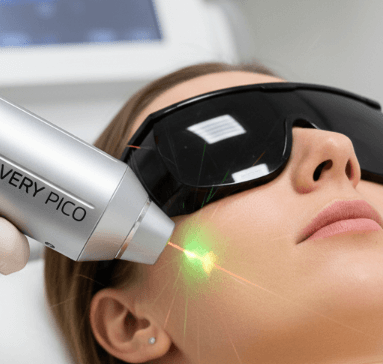
The Discovery Pico Laser is a high-performance picosecond laser system used in Korea for treating stubborn pigmentation issues. It delivers ultra-short laser pulses (in the picosecond range) that break pigment into microscopic fragments via a photoacoustic (mechanical) effect rather than purely thermal damage. This allows for more efficient pigment removal with lower risk of heat-related injury—very important for Asian skin types.
In Seoul and other Korean dermatology clinics, Discovery Pico is frequently used alone or in combination with toning lasers, brightening serums, and regenerative boosters to treat sunspots, freckles, melasma, post-inflammatory hyperpigmentation (PIH), and generally uneven skin tone.
Purpose & Benefits
- Fast Pigment Clearance: Breaks down melanin very efficiently, leading to quicker fading of dark spots and freckles.
- Minimal Thermal Damage: Because pulses are extremely short, adjacent skin is less affected, reducing risk of PIH.
- Improved Skin Tone & Glow: Promotes overall brightening and radiance.
- Texture & Pore Refinement: Stimulates collagen, helping reduce roughness and pores.
- Versatility: Works on multiple pigment depths (superficial to some deeper layers).
Ideal Candidates
Discovery Pico Laser in Korea is especially good for:
- People with freckles, sunspots, or age spots.
- Those with melasma or mixed-type pigmentation (both epidermal and some dermal components).
- Patients who experienced minimal results from traditional lasers or toning treatments.
- Anyone wanting faster visible results with lower downtime.
- Individuals with Asian or darker skin tones concerned about pigmentation rebound.
Possible Risks & Complications
- Redness & Warmth: Mild, usually subsides within hours to 1–2 days.
- Pigmented Spot Darkening: Darkening of spots before they flake or slough off.
- Mild Swelling: Temporary, particularly in more sensitive areas.
- Dryness or Flaking: As pigment sheds.
- Rare Risks: Post-inflammatory hyperpigmentation (if aftercare or sun protection is neglected), or hypopigmentation in very rare cases.
Surgical Techniques Used
- Picosecond Pulsed Energy: Ultra-short bursts to fracture pigment particles.
- Multiple Wavelength Options: Clinics may use different wavelengths depending on depth of pigment (e.g. 532 nm for superficial, 1064 nm for deeper).
- Full-face Toning Passes: After spot targeting, a gentle full-face pass may be done for overall brightening.
- Combination Therapy: Often paired with skin boosters, serums, whitening/brightening treatments, or LED recovery.
- Protocol: Generally 3–6 sessions, spaced around 3–4 weeks apart. Additional maintenance sometimes annually or every 6-12 months.
Recovery & Aftercare
- Immediately: Minor redness or mild warmth, perhaps tingling.
- 1-2 Days: Redness fades; pigment may darken.
- 3-5 Days: Crusting or flaking of treated spots.
- 1-2 Weeks: Pigment visibly lighter; tone improving.
Aftercare Tips:
- Use SPF 50+ sunscreen daily without fail.
- Avoid direct sun exposure, tanning, saunas, or vigorous activity for 48 hours (or more depending on clinic).
- Use soothing, hydrating creams (look for ingredients like Centella, CICA, hyaluronic acid).
- Avoid exfoliants, retinoids, or strong actives for several days as advised.
- Do not pick or scratch at darkened or crusted areas.
Results & Longevity
- After 1 Session: Often a noticeable brightening and fresher glow. Some dark spots may lighten somewhat.
- After 2–3 Sessions: More obvious reduction in freckles, sunspots; improvement in evenness of tone.
- After 4-6 Sessions: Significant pigment clearance, more even texture, pores often appear smaller.
- Long-Term: With good sun protection and maintenance, results can last many months; occasional touch-up sessions (every 6-12 months) are common.
Treatment Process in Korea
- Consultation & Skin Analysis
- Dermatologist examines type, depth, and pattern of pigmentation (freckles, melasma, sun damage, PIH).
- High-resolution imaging tools (VISIA, OBSERV etc.) are often used.
- Preparation
- Double cleansing to remove makeup, sunscreen, oils.
- Degreasing solution if needed.
- Application of numbing cream (often 15-30 min before treatment).
- Protective eyewear for patient and staff.
- Discovery Pico Session
- Spot-by-spot treatment: Laser focused on pigmented lesions.
- Full-face toning pass: Lower intensity over large areas to even tone and improve texture.
- Optional add-ons: brightening serums, whitening agents, sometimes skin boosters (e.g. Rejuran, exosomes).
- Cooling between or after pulses as required.
- Duration: ~ 15-30 mins depending on area.
- Post-Treatment Care in Clinic
- Cooling masks, antioxidant serums or skin calming agents applied.
- Initial instructions for wound care / soothing creams.
- Follow-Up
- Scheduled sessions: usually 3-6 sessions with intervals of 3-4 weeks.
- Skin evaluation each session to adjust energy settings based on response.
- Possible maintenance or booster treatments.
Unique Korean Advantages
- Clinics are experienced with Asian Fitzpatrick skin types (III-V), so protocols are adapted to minimize hyperpigmentation risk.
- Access to high-end Pico platforms (such as Discovery Pico) with multiple wavelengths and power settings.
- Strong integration of laser treatment with skincare, regenerative boosters, LED, serums for enhanced healing.
- Clinics that cater to international patients, offering multilingual consultations, medical tourism packages.
Cost Range (Estimated)
- Single Session (Full Face): ~ USD 200 – USD 400
- 3-Session Package: ~ USD 550 – USD 1,200
- 5-6 Session Package: ~ USD 900 – USD 1,800
- Premium Program (Discovery Pico + boosters/exosomes + brightening serums): ~ USD 1,500 – USD 3,000
Additional Costs:
- Consultation / Skin Analysis: USD 20 – USD 50
- Numbing cream / prep: may be included or small extra (USD 20 – 50)
- Add-ons (Exosomes, regenerative boosters, whitening drips, LED therapy): USD 100 – USD 500 per session depending on clinic
- Aftercare (special creams, mask, follow-ups): small extras depending on protocol
Popular Clinics in Seoul / Korea
- Banobagi Dermatology – often features Pico + boosters for pigmentation and glow.
- Oracle Dermatology – known to treat melasma, freckles, sunspots with pico laser protocols.
- Renewme Skin Clinic – uses Discovery Pico and other pico lasers for both pigment & textural clarity.
- View Plastic & Dermatology – Pico treatments & brightening packages.
- Chaum Anti-Aging Center – premium clinics offering advanced laser + regenerative therapy combinations.


