
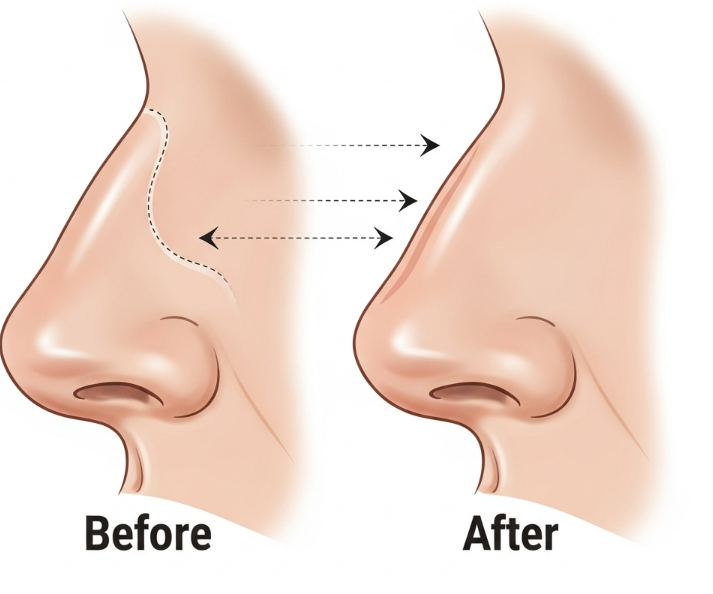
Treatment Overview
Dorsal Hump Reduction is a rhinoplasty technique that smooths and refines the nasal bridge by removing or reshaping the hump caused by excess bone and cartilage. Many patients seek this procedure to achieve a straighter, more balanced nasal profile that harmonizes with their facial features.
In Korea, dorsal hump reduction is performed with advanced surgical techniques such as rasping, cartilage preservation, en bloc resection, or push-down/preserve methods, ensuring both aesthetics and functionality. Korean surgeons specialize in tailoring the approach to the patient’s unique anatomy while maintaining nasal breathing and natural proportions.
Purpose & Benefits
- Creates a smooth, straight nasal bridge.
- Improves overall facial balance and harmony.
- Corrects dorsal humps caused by genetics, trauma, or previous surgery.
- Enhances self-confidence with a refined nose profile.
- Can be combined with tip refinement, alar reduction, or augmentation for full nasal reshaping.
- Korean techniques often prioritize preserving natural structures to maintain stability and avoid long-term collapse.
Ideal Candidates
- Individuals with a prominent nasal hump (bony, cartilaginous, or mixed).
- Patients seeking a straighter bridge for aesthetic purposes.
- Those with trauma-related dorsal irregularities.
- Individuals with no severe breathing issues (or combined with functional rhinoplasty if needed).
- Patients who desire subtle, natural-looking refinement rather than an artificial or overly small nose.
Possible Risks & Complications
- Swelling and bruising around the nose and eyes.
- Temporary nasal congestion.
- Over- or under-correction if not performed precisely.
- Risk of irregularities on the nasal bridge if healing is uneven.
- Revision surgery may be needed in rare cases.
Surgical Techniques Used
- Rasping Technique: Fine filing of small dorsal humps.
- Cartilage Preservation Hump Reduction: Maintains nasal function while reshaping.
- En Bloc Hump Removal: Removal of both bone and cartilage in one piece for large humps.
- Push-Down/Preserve Method: Reduces hump by repositioning nasal structures rather than removing them.
- Open vs. Closed Approach: Open allows greater visibility for complex cases; closed offers minimal scarring and quicker healing.
Recovery & Aftercare
- Initial Recovery: 7–10 days of swelling and bruising.
- Splint/Cast Removal: Usually after 5–7 days.
- Return to Work/School: Within 1–2 weeks.
- Exercise & Heavy Activity: Avoid for 4–6 weeks.
- Full Healing: 6–12 months for swelling to fully subside and results to refine.
- Korean clinics provide swelling reduction therapies, scar care, and detailed follow-ups to ensure optimal recovery.
Results & Longevity
- Permanent results with a straighter, refined nasal bridge.
- Improved side-profile balance and natural appearance.
- Long-lasting outcomes when performed with cartilage-preserving methods.
- Boosted self-confidence with a more elegant facial harmony.
Treatment Process in Korea
Korean rhinoplasty clinics follow a step-by-step treatment approach for dorsal hump reduction:
- Consultation & 3D Simulation: Surgeons analyze facial balance, nasal anatomy, and hump severity using 3D imaging.
- Customized Surgical Plan: Choice between open/closed technique, rasping, en bloc, or preservation methods.
- Surgery Day: Performed under local anesthesia with sedation or general anesthesia (depending on complexity).
- Post-Op Care: Splint applied for stabilization, anti-swelling treatments provided, and follow-up appointments scheduled.
- Ongoing Support: Clinics offer English-speaking coordinators, detailed recovery plans, and long-term monitoring for international patients.
Why Korea?
- Specialized in Dorsal Hump Reduction: Surgeons refine hundreds of noses annually, ensuring precision.
- Cartilage-Preservation Trend: Avoids long-term complications and ensures natural-looking bridges.
- Advanced Technology: 3D scanning and simulation for accurate pre-surgery planning.
- Medical Tourism Support: International patients benefit from translators, airport pickup, and recovery packages.
Cost Range
The cost of Dorsal Hump Reduction in Korea varies depending on the technique and surgeon’s expertise:
- Minor Hump Rasping (Closed): ₩4,500,000 – ₩6,000,000 KRW ($3,500 – $4,600 USD)
- Moderate Hump Removal (Open/Closed): ₩6,500,000 – ₩9,000,000 KRW ($5,000 – $7,000 USD)
- En Bloc or Cartilage-Preservation Surgery: ₩9,000,000 – ₩12,000,000 KRW ($7,000 – $9,200 USD)
- Complex or Revision Hump Reduction: ₩10,000,000 – ₩15,000,000 KRW ($7,700 – $11,500 USD)
Popular Clinics in Korea for Dorsal Hump Reduction
- ID Hospital (Seoul): Leading in dorsal hump reduction and complex revision cases.
- Banobagi Plastic Surgery: Expertise in natural, balanced nose reshaping.
- JW Plastic Surgery: Advanced preservation rhinoplasty techniques.
- View Plastic Surgery: Strong focus on 3D analysis and profile harmony.
- MINE Plastic Surgery: Popular for international patients seeking elegant, natural results.


