
Treatment Overview
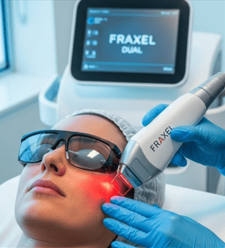
Dual Fraxel Laser is an advanced fractional non-ablative laser treatment widely offered in Korean dermatology clinics for acne scars, post-acne pigmentation, and skin texture improvement. Unlike traditional CO₂ lasers, Fraxel delivers microscopic columns of laser energy into the skin while leaving surrounding tissue intact, which accelerates healing.
The “dual” refers to its two wavelengths:
- 1550 nm: Targets deeper layers for collagen remodeling, acne scar repair, and pore tightening.
- 1927 nm: Targets superficial layers for pigmentation, PIH (post-inflammatory hyperpigmentation), and overall tone correction.
In Korea, Dual Fraxel is often recommended after active acne is controlled, focusing on scar revision and skin quality enhancement with less downtime than fully ablative lasers.
Purpose & Benefits
- Acne Scar Treatment: Improves rolling, boxcar, and shallow scars.
- Pigmentation Correction: Fades dark spots and PIH from acne.
- Collagen Stimulation: Restores elasticity and smoothness.
- Pore Refinement: Minimizes enlarged pores.
- Dual Action: Treats both deep and superficial skin concerns in one session.
Ideal Candidates
Dual Fraxel Laser in Korea is recommended for:
- Patients with mild to moderate acne scars.
- Individuals with post-acne pigmentation and uneven tone.
- Those with enlarged pores or rough skin texture.
- Patients seeking effective scar treatment with manageable downtime.
Possible Risks & Complications
Dual Fraxel is considered safe under Korean dermatology standards, but side effects may include:
- Redness & Swelling: Typically lasts 2–3 days.
- Dryness & Flaking: Skin renewal occurs over 5–7 days.
- PIH Risk: Possible in Asian skin if treated too aggressively (minimized with Korean low-energy, multi-session protocols).
- Rare Risks: Blistering or infection if aftercare is neglected.
Surgical Techniques Used
- Fractional Non-Ablative Lasers (1550 & 1927 nm): Penetrate at different depths for comprehensive treatment.
- Fractional Microthermal Zones: Promote controlled healing and collagen production.
- Multi-Pass Method: Gentle, repeated passes reduce risk of PIH.
- Protocol: Typically 3–5 sessions, spaced 4–6 weeks apart.
Recovery & Aftercare
Immediately: Redness, warmth, and mild swelling.
2–3 Days: Skin feels tight, redness decreases.
5–7 Days: Flaking and peeling as pigmentation lifts.
1–2 Weeks: Noticeable improvement in tone and texture.
Aftercare Tips:
- Apply healing ointments and hydrating creams.
- Use SPF 50+ daily to prevent PIH.
- Avoid scrubs, retinoids, and acids for at least 1 week.
- Follow dermatologist’s instructions carefully for best results.
Results & Longevity
- After 1 Session: Brighter skin, smoother texture.
- After 2–3 Sessions: Noticeable fading of scars and pigmentation.
- After 4–5 Sessions: Significant scar reduction, pore refinement, and long-term collagen remodeling.
Results are long-lasting, but maintenance sessions every 12–18 months may be recommended.
Treatment Process in Korea
Consultation & Skin Analysis
Dermatologist evaluates acne scars and pigmentation type.
Preparation
Topical numbing cream applied for comfort.
Fraxel Session
- Step 1: Dual Fraxel laser applied with customized settings.
- Step 2: Multiple passes for deep (1550 nm) and superficial (1927 nm) concerns.
- Step 3: Cooling serum or mask applied after treatment.
Duration: 30–45 minutes.
Post-Treatment Care
Healing creams and sunscreen applied.
Patients advised on strict sun protection.
Follow-Up
3–5 sessions recommended for optimal results.
Unique Korean Advantages
- Gentle, Safe Protocols: Korean clinics specialize in low-fluence Fraxel for Asian skin.
- Combination Packages: Dual Fraxel often paired with PRP, Rejuran, or subcision for deeper scars.
- Focus on PIH: Korean dermatologists carefully balance scar repair with pigment control.
- Affordable Packages: Multi-session treatments are cost-effective compared to the West.
Cost Range (Estimated)
- Single Fraxel Session: USD 300 – 600
- Dual Fraxel + PRP/Booster: USD 600 – 1,000
- Premium Scar Package (Fraxel + Subcision + Rejuran/Exosome Therapy): USD 1,200 – 2,000
Example Korean Packages:
- Standard Dual Fraxel (per session): USD 300–500
- Scar Care Program (3 sessions): USD 900–1,300
- Premium Package (Fraxel + Boosters): USD 1,500–2,200
Popular Clinics in Seoul
- Oracle Dermatology: Dual Fraxel for acne scars and pigmentation.
- Banobagi Dermatology: Fraxel + PRP combination for scar repair.
- Renewme Skin Clinic: Dual Fraxel with pigmentation-focused protocols.
- View Dermatology: Scar revision programs using Fraxel + subcision.
- Chaum Anti-Aging Center: Premium Fraxel programs with regenerative boosters.


