
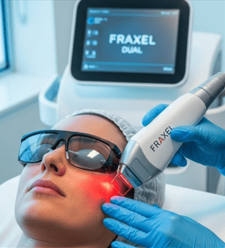
Treatment Overview
Dual Wavelength Fractional Laser is a next-generation acne scar therapy offered in Korean dermatology clinics that combines two different laser wavelengths—commonly CO₂ (10,600 nm) and Er:Glass (1,550 nm) or Er:YAG (2,940 nm)—to simultaneously target surface texture and deep dermal remodeling.
This dual approach allows dermatologists to:
- Use the ablative wavelength (CO₂ or Er:YAG) for resurfacing rough, scarred skin.
- Use the non-ablative wavelength (Er:Glass or similar) for deep collagen stimulation without damaging the surface.
The result is comprehensive scar repair with improved safety for Asian skin, reduced downtime, and stronger outcomes than single-wavelength fractional lasers.
Purpose & Benefits
- Comprehensive Scar Remodeling: Treats both surface irregularities and deep dermal scars.
- Dual Action: Ablative wavelength smooths texture; non-ablative wavelength stimulates collagen.
- Improved Safety: Balanced energy delivery lowers PIH (post-inflammatory hyperpigmentation) risk.
- Texture Refinement: Smoothens rough skin, reduces enlarged pores.
- Pigmentation Control: Helps fade post-acne pigmentation and redness.
- Skin Tightening: Improves firmness and elasticity while repairing scars.
Ideal Candidates
Dual Wavelength Fractional Laser in Korea is recommended for:
- Patients with moderate to severe acne scars (rolling, boxcar, and combined scars).
- Individuals with Asian or sensitive skin, where traditional ablative lasers may cause PIH.
- Patients who want dramatic results with shorter downtime.
- Those seeking both resurfacing and deep remodeling in one treatment.
- Individuals undergoing multi-step scar care programs.
Possible Risks & Complications
This procedure is safer than traditional CO₂ lasers alone, but temporary side effects may include:
- Redness & Swelling (2–5 days).
- Mild Peeling or Flaking as skin resurfaces.
- Pinpoint Scabs in treated zones.
- Rare PIH (Post-Inflammatory Hyperpigmentation) – minimized with Korean laser protocols.
Surgical Techniques Used
- Fractional Laser System: Combines two wavelengths (ablative + non-ablative).
- Energy Customization: Depth and density adjusted per scar type and skin sensitivity.
- Dual Treatment Strategy: One pass for resurfacing, one pass for deep collagen induction.
- Combination Therapy: Often paired in Korea with subcision, RF microneedling, PRP, or PDRN boosters for enhanced outcomes.
Protocol: Typically 2–3 sessions, spaced 2–3 months apart.
Recovery & Aftercare
Immediately: Redness, warmth, and mild swelling.
2–5 Days: Redness fades; light scabbing or flaking may occur.
1–2 Weeks: Skin appears smoother, scars begin to soften.
1–6 Months: Collagen remodeling continues for progressive results.
Aftercare Tips:
- Avoid makeup for at least 48 hours.
- Use gentle cleansers and barrier-repair creams.
- Avoid harsh actives (retinoids, acids, scrubs) for 7–10 days.
- Apply SPF 50+ sunscreen daily to prevent pigmentation.
Results & Longevity
- After 1 Session: Smoother texture and brighter tone.
- After 2 Sessions: Significant scar depth reduction and pore refinement.
- After 3 Sessions: Long-term remodeling, firmer and healthier skin.
- Longevity: Results last 2–3 years, with optional maintenance every 1–2 years.
Treatment Process in Korea
Consultation & Scar Assessment
Dermatologist evaluates scar types (rolling, boxcar, icepick) and chooses settings for both wavelengths.
Preparation
Topical numbing applied; protective eyewear used.
Dual Wavelength Fractional Laser Session
- Step 1: Ablative wavelength applied for surface texture and scar edges.
- Step 2: Non-ablative wavelength applied for deep collagen stimulation.
- Step 3: Cooling therapy or regenerative booster (PDRN, exosomes, PRP) applied post-laser.
Duration: 40–60 minutes.
Why Korea is a Top Destination
- Cutting-Edge Devices: Korean clinics use the latest dual-wavelength fractional laser systems.
- Safer for Asian Skin: Lower PIH risk compared to single ablative lasers.
- Comprehensive Programs: Often integrated with subcision, microneedling RF, or injectables.
- Regenerative Add-Ons: PRP, exosomes, or PDRN commonly included to shorten downtime.
- Affordable High-Tech Care: Advanced laser technology at competitive prices compared to Western clinics.
Cost Range (Estimated)
- Single Dual Wavelength Fractional Session: USD 400 – 700
- Laser + Booster Infusion + LED Therapy: USD 600 – 1,000
- Comprehensive Scar Program (Dual Wavelength Laser + Subcision/Boosters): USD 1,200 – 2,800 per session
Example Korean Packages:
- Standard Program (2 sessions): USD 900 – 1,500
- Advanced Program (3 sessions with boosters): USD 1,800 – 2,800
- Premium Program (3 sessions with exosomes/Rejuran + subcision): USD 3,000 – 4,800
Popular Clinics in Seoul
- Oracle Dermatology: Dual-wavelength fractional protocols for scar remodeling.
- Banobagi Dermatology: Acne scar resurfacing with ablative + non-ablative lasers.
- Renewme Skin Clinic: Dual fractional laser combined with PRP or exosomes.
- View Dermatology: Multi-step programs with dual fractional lasers + subcision.
- Chaum Anti-Aging Center: Premium dual-wavelength laser resurfacing with regenerative boosters.


