
Treatment Overview
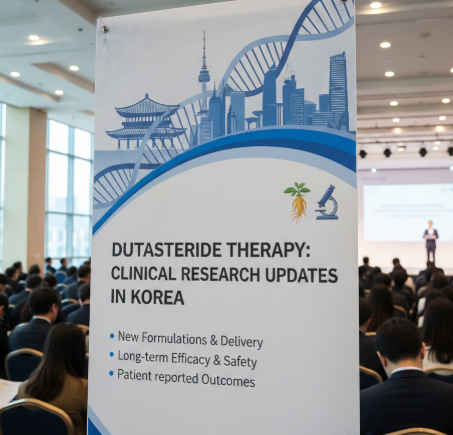
Dutasteride therapy has long been a leading medical treatment for androgenetic alopecia (AGA) in Korea. But beyond its clinical use, extensive research — both old and new — has helped define how safe and effective it is in the Korean population. Recent studies are also exploring lower doses and long-term safety in more detail, helping doctors optimize treatment protocols.
Purpose & Benefits of Clinical Research
Clinical research on Dutasteride in Korea serves several important purposes:
- To establish long-term safety in Korean patients (since genetics, lifestyle, and health factors can affect drug response)
- To determine the effectiveness of lower doses to reduce side effects while maintaining efficacy
- To compare Dutasteride with other hair-loss medications like Finasteride in real-world settings
- To gather post-marketing surveillance data and monitor adverse events in routine clinical practice
These studies benefit patients by informing optimized dosing strategies, minimizing risks, and confirming sustained efficacy.
Key Research Studies in Korea
1. 5‑Year Long-Term Study (Kyung Hee University)
One of the most important Korean clinical studies was conducted at Kyung Hee University Hospital. Researchers followed 99 male AGA patients who took 0.5 mg dutasteride daily for at least 5 years.
- Effectiveness: After 5 years, 89.9% (89/99) of patients showed improvement, and 93.9% (93/99) at least prevented progression, based on IGA (Investigator Global Assessment).
- BASP classification results: Using this hair-loss classification system, 52.5% of patients with “basic” type, 75% with “F” type, and 82.2% with “V” type showed clinical improvement.
- Safety: The study reported sustained safety over 5 years, making a strong case for long-term Dutasteride use in Korean men.
This long-term data is critical because it demonstrates that the drug remains effective and safe over many years — not just in short-term trials.
2. Phase III Randomized Trial — Standard Dose (0.5 mg)
Seoul National University conducted a randomized, double-blind, placebo-controlled Phase III trial involving 153 men aged 18–49.
- Efficacy: After 6 months, the Dutasteride group saw a +12.2 hairs/cm² increase in hair count, versus +4.7 hairs/cm² in the placebo group.
- Tolerability: Adverse events were reported, but there were no major safety issues or significant differences in serious side effects between the Dutasteride and placebo groups.
- Conclusion: The standard 0.5 mg daily dose is clearly effective and relatively well tolerated in a controlled clinical setting.
3. Low-Dose (0.2 mg) Dutasteride Trial
A recent study explored whether lower doses of Dutasteride can still work effectively with fewer risks. In a multicenter, double-blind phase III trial, 139 men received 0.2 mg, 0.5 mg, or placebo daily for 24 weeks.
- Hair Count Increase: At week 24, the 0.2 mg group gained 21.53 hairs/cm², significantly more than placebo (5.96 hairs/cm²).
- Comparative Efficacy: The 0.2 mg dose was nearly as effective as the 0.5 mg dose for all efficacy measures.
- Safety Profile: Adverse event rates were low and statistically similar to placebo, indicating that the lower-dose regimen might offer a safer alternative.
This trial is influential — it could lead to more personalized dosing and lower side-effect risk.
4. Post-Marketing Safety Study (Real-World Data)
Researchers conducted a post-marketing surveillance study using data from multiple Korean clinics.
- Participants: 712 men (aged 18–41) newly started on 0.5 mg Dutasteride.
- Adverse Events (AE): About 15.4% reported any AE; serious AEs (SAEs) were very rare (~0.6%).
- Common ADRs: Reduced libido (1.3%), dyspepsia (~1.1%), erectile issues (1.0%), fatigue (~0.7%).
- Effectiveness: 78.6% of patients showed overall improvement, aligning real-world benefits with clinical trials.
This validates the safety profile of Dutasteride in routine clinical practice.
5. Comparative Real‑World Study: Dutasteride vs Finasteride
A multicentre retrospective chart review in South Korea compared long-term Dutasteride and Finasteride use among 600 men.
- Effectiveness: Dutasteride-treated patients showed greater improvement in hair growth than Finasteride patients.
- Safety/EAS: Adverse event rates were similar (dutasteride 7.6% vs finasteride 10.5%), suggesting stronger efficacy doesn’t increase risk.
- Implication: In real-world practice, Korean doctors may favor Dutasteride for patients needing stronger regrowth without large tradeoffs in tolerability.
Emerging Trends & Future Directions
- Personalized or Low Dosing: Low-dose 0.2 mg protocols are being tested to minimize side effects.
- Long-Term Use Confidence: Five-year data supports sustained safety and efficacy.
- Real-World Evidence: Post-marketing studies confirm clinical trial outcomes in daily practice.
- Comparative Effectiveness: Head-to-head studies with Finasteride guide optimal therapy selection.
- Broadening Indications: Potential future studies on carefully monitored use in women, especially post-menopausal.
Implications for Medical Tourists
- Strong long-term data backs 0.5 mg Dutasteride for Korean men.
- Low-dose options (0.2 mg) may be safer for side-effect-sensitive patients.
- Adverse-event profiles are relatively low in real-world settings.
- Korean clinics base treatment on locally generated data, ensuring safe and effective care.
Research Gaps & What’s Next
- Women’s AGA: More trials needed for female patients.
- Combination Therapy Trials: Limited randomized data for combinations with PRP, laser, or microneedling.
- Quality of Life Metrics: More studies on patient-reported outcomes.
- Pharmacogenomics: Genetic influences on Dutasteride metabolism and response could refine dosing.


