
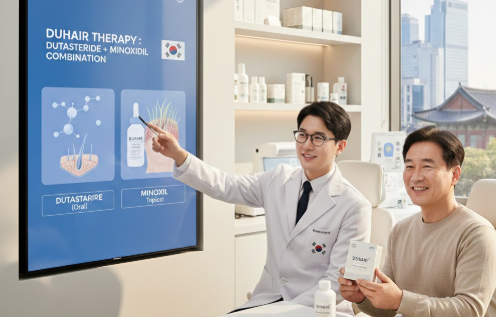
Treatment Overview
Combining Dutasteride therapy with Minoxidil has become a popular and highly effective approach for treating androgenetic alopecia (AGA) in Korea. Dutasteride reduces DHT (dihydrotestosterone) levels in the scalp, preventing follicle miniaturization, while Minoxidil stimulates blood circulation and follicle activity to promote hair growth.
Korean clinics offer personalized combination therapy plans that integrate oral or injection-based Dutasteride with topical Minoxidil, often enhanced with PRP or laser therapy for optimal hair restoration outcomes. This combined approach is particularly suitable for patients with moderate to severe hair loss or those who have not achieved results with monotherapy.
Purpose & Benefits
The main purpose of combining Dutasteride with Minoxidil is to maximize hair regrowth by addressing hair loss through multiple mechanisms:
- Dutasteride blocks DHT, preventing further follicle shrinkage
- Minoxidil improves scalp circulation and stimulates follicle activity
- Combination therapy provides synergistic effects for faster and more noticeable results
Benefits of this combined therapy include:
- Enhanced hair density and thickness
- Faster visible improvement compared to monotherapy
- Potential to treat both frontal and crown areas effectively
- Safe and monitored by experienced dermatologists in Korea
Ideal Candidates
Ideal candidates for combined Dutasteride and Minoxidil therapy in Korea include:
- Men with moderate to severe androgenetic alopecia
- Post-menopausal women with androgen-sensitive hair loss
- Patients who did not respond sufficiently to Minoxidil or Dutasteride alone
- Individuals willing to commit to daily topical application and oral therapy
- Medical tourists seeking comprehensive and advanced hair restoration treatments
Possible Risks & Complications
Even when administered under professional supervision, combination therapy may carry some risks:
- Sexual side effects: Dutasteride may cause decreased libido or erectile dysfunction
- Scalp irritation: Minoxidil may cause itching, redness, or mild dermatitis
- Initial hair shedding: Common in the first few months as follicles transition
- Allergic reactions: Rare but possible, particularly with topical Minoxidil
- Systemic effects: Dutasteride may affect hormonal balance in rare cases
Korean clinics mitigate these risks through patient screening, monitoring, and education on proper application techniques.
Techniques & Technology Used
Leading Korean clinics employ advanced techniques to optimize combination therapy:
- Digital Scalp Imaging: Tracks hair density and follicle activity over time
- Trichoscopy: Evaluates follicle health for precise therapy planning
- Hormonal & Blood Testing: Monitors systemic safety during oral Dutasteride use
- Combination Therapy Protocols: Integrates PRP, laser therapy, and scalp mesotherapy
- Telemedicine Support: Facilitates follow-up for international patients
- AI-assisted Progress Tracking: Provides predictive insights for therapy adjustment
These technologies ensure patients receive safe, personalized, and effective combination therapy.
Treatment Process in Korea
- Initial Consultation: Hair loss assessment, medical history review, and suitability evaluation
- Baseline Testing: Blood tests and scalp analysis for safe therapy initiation
- Treatment Planning: Customized schedule for oral Dutasteride and topical Minoxidil, with optional adjunct therapies
- Therapy Initiation: Education on oral dosing and topical application
- Regular Monitoring: Follow-up every 1–3 months for hair density evaluation and safety checks
- Adjustments: Therapy may be modified based on hair regrowth progress and patient tolerance
Recovery & After-Care
Since Dutasteride is oral and Minoxidil is topical, recovery is minimal, but proper aftercare ensures optimal results:
- Apply Minoxidil consistently as prescribed
- Take Dutasteride daily at the recommended dose
- Avoid harsh shampoos, excessive heat, or scalp trauma
- Maintain regular follow-up appointments for monitoring progress
- Report side effects immediately to the dermatologist
- Consider supportive therapies like PRP or low-level laser therapy if recommended
Results & Longevity
With proper combination therapy and adherence to clinic guidance:
- 3–6 months: Reduction in hair shedding and early signs of regrowth
- 6–9 months: Noticeable increase in hair thickness and coverage
- 9–12 months: Significant improvement in crown and frontal areas
- Long-term: Sustained therapy maintains hair density and prevents further thinning
Combination therapy tends to deliver faster and more robust results than monotherapy, particularly in moderate-to-severe cases.
Why Korea Is a Top Destination
- Expert Dermatologists: Specialists in hair restoration and combination therapies
- Advanced Technology: Digital imaging, AI tracking, and trichoscopy ensure precise monitoring
- Structured Protocols: Clinics provide safe, standardized therapy for international patients
- Combination Therapy Expertise: Safe integration of Dutasteride, Minoxidil, PRP, and laser therapy
- Medical Tourism-Friendly: Language support, telemedicine follow-up, and accommodation guidance
Korean clinics provide world-class hair restoration services, making it a preferred destination for medical tourists seeking combination therapy.
Cost Range
- Initial Consultation & Testing: ₩50,000–₩150,000
- Oral Dutasteride (1-month supply): ₩25,000–₩60,000
- Topical Minoxidil (1-month supply): ₩30,000–₩70,000
- Combination Therapy Packages (PRP + Laser): ₩400,000–₩1,200,000
- Follow-Up Visits: ₩20,000–₩50,000 per visit
Costs vary based on clinic, treatment type, and inclusion of adjunct therapies. Most expenses are out-of-pocket for medical tourists.
Popular Clinics in Korea for Combination Therapy
- Dr. FORHAIR Clinic: Expert in combined Dutasteride and Minoxidil protocols with digital monitoring
- Wonjin Dermatology Center: Offers combination therapy with PRP and laser supervision
- MODE A Hair Loss Clinic: Uses AI-assisted progress tracking for personalized treatment
- Seoul Skin & Hair Clinics: Provides medical tourism support with structured follow-up
- Jivaka Hair Restoration Clinic: Specialized in regenerative combination therapies
These clinics are recognized for safe, effective, and comprehensive hair restoration care.


