
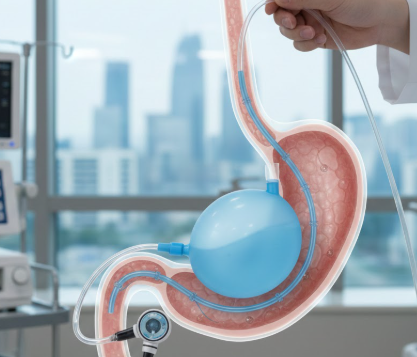
Treatment Overview
The Endoscopic Gastric Balloon is a minimally invasive, non-surgical weight loss procedure specifically designed for patients with BMI ≥30 kg/m². A soft silicone balloon is placed into the stomach via endoscopy and filled with saline or air, reducing stomach capacity and promoting early satiety. The balloon is temporary, usually in place for 6 months, and is removed endoscopically.
→ Endoscopic placement under mild sedation.
→ Temporary intragastric balloon for 6 months.
→ Part of a structured weight management program including diet, exercise, and behavioral guidance.
Korea is a preferred destination due to advanced endoscopic technology, experienced specialists, and internationally tailored weight loss programs.
Purpose & Benefits
The procedure offers several advantages for patients with BMI ≥30:
→ Non-surgical, minimally invasive option for obesity management.
→ Reduces hunger and portion size, supporting effective weight loss.
→ Improves metabolic conditions such as type 2 diabetes, hypertension, and fatty liver.
→ Enhances quality of life, energy, and physical fitness.
→ Temporary and reversible, ideal for patients not ready for surgery.
This procedure is ideal for patients seeking safe and effective weight loss without surgery.
Ideal Candidates
Ideal candidates include adults who:
→ Have a BMI of 30 kg/m² or higher.
→ Struggle to achieve weight loss through diet and exercise alone.
→ Want a non-surgical, temporary obesity treatment.
→ Are motivated to follow dietary, exercise, and follow-up guidance for optimal results.
Comprehensive evaluation ensures patient safety and suitability.
Possible Risks & Complications
Though generally safe, potential risks include:
→ Nausea, vomiting, or mild abdominal discomfort in the first few days.
→ Bloating or acid reflux.
→ Balloon deflation or migration, which may require early removal.
→ Ulcer formation or irritation of the stomach lining.
→ Rare complications related to endoscopy.
Korean clinics provide expert monitoring and guidance to minimize these risks.
Techniques & Technology Used
Endoscopic gastric balloon procedures for BMI ≥30 in Korea utilize:
→ Advanced endoscopic equipment for safe and precise balloon placement and removal.
→ Silicone balloon filled with saline or air, optimized for comfort and effective weight loss.
→ Sedation and monitoring systems to ensure patient safety.
→ Multidisciplinary support including dietitians, nutritionists, and lifestyle coaches.
→ Regular follow-ups to monitor weight, nutrition, and balloon status.
Korean clinics combine modern technology with structured care programs to maximize safety and results.
Treatment Process in Korea
The typical process includes:
→ Initial Consultation → Assessment of BMI, medical history, and weight loss goals.
→ Pre-Procedure Evaluation → Lab tests, imaging, and endoscopic assessment.
→ Balloon Placement → Endoscopic insertion under mild sedation (20–30 minutes).
→ Post-Procedure Observation → Short hospital or clinic stay for monitoring.
→ Follow-Up Care → Regular check-ins for diet, exercise, and lifestyle coaching.
→ Balloon Removal → Endoscopic removal after 6 months.
Korean clinics provide structured programs combining procedure, diet, and lifestyle coaching.
Recovery & After-Care
Recovery is typically straightforward:
→ Mild nausea, vomiting, or abdominal discomfort may occur initially.
→ Gradual diet progression: liquids → soft foods → solids.
→ Hydration and adherence to dietary guidance are essential.
→ Regular follow-ups to monitor weight and nutrition.
→ Exercise and behavioral coaching to support long-term weight management.
Patients typically resume normal activities within 1–2 days, with gradual weight loss observed over weeks.
Results & Longevity
Expected outcomes for patients with BMI ≥30 include:
→ Average weight loss of 10–20% of total body weight over 6 months.
→ Improvement in obesity-related conditions, such as type 2 diabetes and hypertension.
→ Sustained behavioral changes for long-term weight management.
→ Increased energy, mobility, and overall quality of life.
Success depends on adherence to diet, exercise, and follow-up programs.
Why Korea Is a Top Destination
Korea is a preferred destination for endoscopic gastric balloon treatment due to:
→ Highly experienced gastroenterologists.
→ Advanced endoscopic technology and minimally invasive procedures.
→ Structured weight loss programs combining diet, exercise, and behavioral support.
→ Affordable, high-quality care compared to Western countries.
→ Comprehensive international patient support, including language assistance and follow-up care.
Patients benefit from expert care, modern facilities, and structured post-procedure guidance.
Cost Range
Costs vary depending on clinic and program:
→ Standard Endoscopic Gastric Balloon Procedure: $3,500 – $5,500 USD
→ Comprehensive Weight Loss Program with Diet & Lifestyle Support: $5,500 – $8,000 USD
International packages may also include pre-travel coordination and post-procedure guidance.
Popular Clinics in Korea
Top clinics offering endoscopic gastric balloon treatment for BMI ≥30:
→ Seoul National University Hospital, Bariatric & Endoscopy Unit – Balloon placement and follow-up.
→ Asan Medical Center, Obesity & Metabolic Surgery Unit – Multidisciplinary weight loss programs.
→ Samsung Medical Center, Endoscopy Department – Advanced technology and monitoring.
→ JK Plastic & Obesity Clinic, Seoul – Personalized obesity programs with intragastric balloon therapy.
→ Medi-Weight Clinic, Seoul – International patient support and structured follow-up.
These clinics provide high-quality, safe, and structured programs for endoscopic gastric balloon therapy.


