
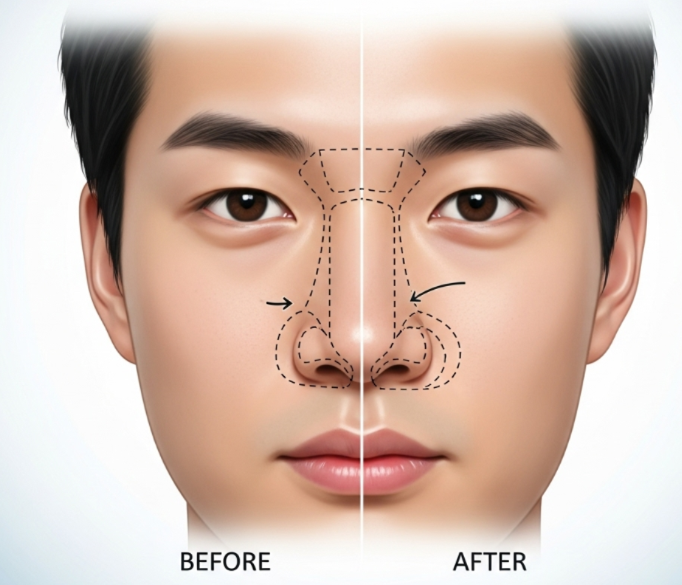
Treatment Overview
Ethnic Short Nose Correction in Korea is a specialized rhinoplasty procedure tailored to address short noses commonly found in various ethnic groups, particularly East Asian and Southeast Asian patients. The surgery focuses on lengthening the nasal tip, refining the nostrils, and enhancing bridge projection while preserving the patient’s unique ethnic features. Korean surgeons are globally renowned for combining advanced cartilage grafting, tip plasty, and alar base reduction techniques to achieve a natural, balanced, and culturally sensitive outcome.
Purpose & Benefits
- Lengthens and proportionally enhances the nasal tip in short noses.
- Refines nostrils and alar base to improve symmetry and balance.
- Elevates and augments the nasal bridge for a harmonious facial profile.
- Preserves ethnic identity while achieving aesthetic improvement.
- Minimizes visible scarring through closed or minimally invasive techniques.
- Enhances confidence by achieving a natural, culturally harmonious nasal appearance.
Ideal Candidates
- Patients with a short nose and low tip projection common in certain ethnicities.
- Individuals seeking a natural enhancement without losing ethnic identity.
- Candidates with nostril flaring, wide alar base, or upturned tip.
- Men and women desiring subtle, proportional corrections.
- Those who have had prior rhinoplasty and require revision or refinement for short nose issues.
Possible Risks & Complications
- Temporary swelling, bruising, or tenderness around the nose.
- Minor asymmetry or uneven tip projection (usually correctable).
- Rare risk of infection, bleeding, or delayed healing.
- Scarring risk (low with Korean minimally invasive techniques).
- Revision surgery may be required in rare cases.
Surgical Techniques Used
- Tip Plasty and Columellar Lengthening: To improve tip projection and nasal length.
- Alar Base Reduction: To refine wide nostrils and improve proportion.
- Dorsal Augmentation: Using cartilage grafts or implants to elevate the bridge.
- Closed or Open Rhinoplasty Approaches: Depending on complexity and patient preference.
- Cartilage Grafting: Septal, ear, or rib cartilage used to support structural changes.
- Hybrid Techniques: Combining tip, bridge, and base adjustments for optimal results.
Recovery & Aftercare
- Downtime: 7–10 days for swelling and bruising to subside.
- Sutures removal: Usually within 5–7 days.
- Return to normal activities: 1–2 weeks; avoid strenuous activity for 3–4 weeks.
- Final results: Visible after 3–6 months as tissues settle and swelling resolves.
- Korean aftercare programs include:
- Anti-swelling laser therapy
- Scar management and taping guidance
- Regular follow-ups with patient coordinators
- Remote consultations for international patients
Results & Longevity
- Achieves a longer, proportionate nose while preserving ethnic characteristics.
- Long-lasting results with stable cartilage grafts and precise surgical techniques.
- Maintains natural appearance, avoiding over-projection or artificial look.
- Enhances overall facial balance and harmony.
- Aging minimally affects structural improvements.
Treatment Process in Korea
Korea is a global leader in ethnic short nose correction due to precision techniques and aesthetic expertise:
- Preoperative planning: 3D imaging and measurements to maintain ethnic facial harmony.
- Cartilage grafting and tip refinement: Provides structural stability and proportional results.
- Integration with alar base and dorsal augmentation: Creates balanced outcomes for short noses.
- Scar-minimizing approaches: Closed or minimally invasive techniques reduce visible marks.
- International patient support: Includes translation, accommodation, and post-operative monitoring.
Why Korea is a Top Destination:
- Expertise in subtle, culturally sensitive nasal correction.
- Advanced grafting and minimally invasive techniques ensure natural results.
- High patient satisfaction for both primary and revision short nose surgeries.
- World-class clinics with comprehensive aftercare programs for international patients.
Cost Range
The cost of Ethnic Short Nose Correction in Korea varies by procedure complexity:
- Basic short nose refinement: ₩5,000,000 – ₩7,500,000 KRW ($3,800 – $5,700 USD)
- With tip plasty, dorsal augmentation, or alar base adjustment: ₩8,000,000 – ₩11,000,000 KRW ($6,100 – $8,500 USD)
- Complex or revision ethnic short nose correction: ₩11,500,000 – ₩14,500,000 KRW ($8,800 – $11,000 USD)
Packages generally include:
- Surgeon and anesthesia fees
- Hospital/facility costs
- Cartilage harvesting if required
- Post-operative care (laser, anti-swelling therapy, scar management)
- Multilingual support for international patients
Popular Clinics in Korea
- ID Hospital (Seoul): Known for ethnic short nose correction with natural, culturally harmonious results.
- Banobagi Plastic Surgery (Seoul): Specializes in tip, bridge, and base refinement for ethnic noses.
- JW Plastic Surgery (Seoul): Offers advanced cartilage grafting and dorsal augmentation for ethnic noses.
- View Plastic Surgery (Seoul): Popular for international patients seeking ethnic short nose correction.
- The PLUS Plastic Surgery (Seoul): Focused on natural, balanced, and scar-minimized ethnic nose surgeries.


