
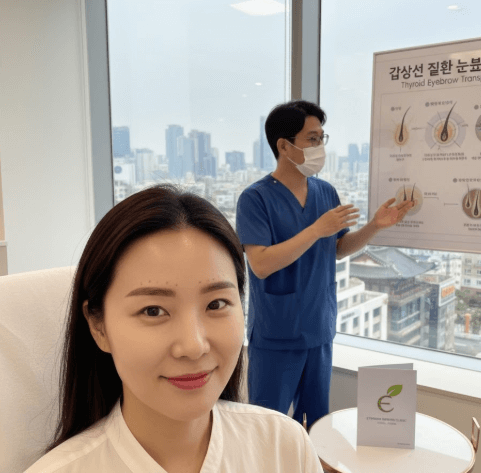
Treatment Overview
The Eyebrow Transplant for Thyroid-Related Brow Loss is a specialized restoration procedure designed for individuals who experience thinning or disappearance of eyebrow hair due to thyroid disorders such as hypothyroidism, Hashimoto’s disease, or hyperthyroidism.
Korean clinics use advanced FUE (Follicular Unit Extraction) and micro-grafting techniques to rebuild natural eyebrow density, address outer-brow thinning (a common thyroid symptom), and create balanced, permanent eyebrows.
Purpose & Benefits
Thyroid conditions often cause thinning of the outer third of the eyebrows, patchy loss, or a generally sparse brow look. This treatment aims to restore natural fullness and symmetry.
Key benefits include:
- Restores fullness lost due to thyroid imbalance.
- Rebuilds the outer brow tail and arch area, commonly affected by thyroid disorders.
- Provides permanent results once thyroid levels are stable.
- Natural texture using fine, single-hair grafts.
- Reduces dependency on makeup, microblading, or temporary fillers.
- Creates natural, balanced eyebrows tailored to your face.
Ideal Candidates
You may be a great candidate if you:
- Experience eyebrow thinning due to hypothyroidism or Hashimoto’s disease.
- Have stable thyroid levels under medical supervision.
- Want a permanent solution instead of frequent makeup or microblading.
- Have patchy or uneven brows that do not grow back even after thyroid treatment.
- Prefer natural hair over pigments or cosmetic techniques.
- Have sufficient donor hair available.
Possible Risks & Complications
The procedure is safe, but minor temporary effects may include:
- Mild swelling or scabbing for 3–5 days.
- Itching during the healing phase.
- Temporary shedding of transplanted hairs (normal).
- Rare misdirection of hairs — manageable with trimming.
- Important: results depend on stable thyroid levels; uncontrolled conditions may affect long-term brow density.
Techniques & Technology Used
- Micro-FUE Extraction: 0.6–0.8 mm tools harvest soft, thin hairs ideal for eyebrows.
- Angle-Precision Implantation: Hairs placed at natural, shallow angles (10–15 degrees).
- Density Zoning: Special focus on outer brow tails, arch region, and mid-brow, which are most affected by thyroid issues.
- Natural Brow Mapping: Customized to your facial symmetry and desired shape.
- Optional PRP Therapy: Supports faster healing and stronger early growth.
Treatment Process in Korea
- Consultation & Shape Design: Surgeon analyzes brow loss pattern and designs a natural restoration plan.
- Donor Hair Selection: Fine hairs are chosen from behind the ear or lower scalp for natural texture.
- FUE Extraction: Single follicles are removed gently using ultra-fine tools.
- Recipient Site Creation: Tiny incisions created with accurate brow angle and direction.
- Graft Implantation: Hairs are placed individually to rebuild density and shape.
- Post-Care Guidance: Medication, soothing creams, and grooming instructions provided.
Recovery & After-Care
- Light scabs fall off within 3–5 days.
- Avoid touching, rubbing, or applying makeup for 1 week.
- Keep brows dry for 48 hours.
- Transplanted hairs shed in the first month — normal “shock loss.”
- New growth appears at 2–3 months.
- Full, natural results by 6–10 months.
- Clinical advice: Maintain thyroid stability for best long-term results.
Results & Longevity
- Restored eyebrow fullness even in areas heavily affected by thyroid-related thinning.
- Natural hair growth that lasts permanently.
- Soft, realistic texture that can be shaped or groomed normally.
- Balanced, defined eyebrows that enhance facial expression and confidence.
- Once transplanted, new hairs grow even if thyroid levels fluctuate slightly (but stability is recommended for maximum longevity).
Why Korea Is a Top Destination
- Korean clinics excel in fine, natural eyebrow restoration, especially for medical hair loss conditions.
- Surgeons understand thyroid-related brow patterns and specialize in tailored correction.
- Advanced micro-tools ensure minimal scarring and fast healing.
- Korean brow aesthetics focus on soft, natural, and balanced designs.
- High success rates with excellent safety standards.
- Full support for international patients, including after-care and follow-ups.
Cost Range
The cost of an Eyebrow Transplant for Thyroid-Related Brow Loss in Korea typically ranges based on severity and density:
- Partial outer-third restoration: ₩1,500,000 – ₩2,500,000 (≈ USD 1,200 – 2,000)
- Full brow restoration: ₩2,500,000 – ₩4,000,000 (≈ USD 2,000 – 3,200)
- High-density reconstruction: ₩4,000,000 – ₩6,000,000 (≈ USD 3,200 – 4,800)
Packages usually include consultation, design, procedure, anesthesia, medication, and follow-up.
Popular Clinics in Korea
- Dream Hairline Clinic (Seoul): Specializes in medical-related eyebrow restoration.
- Moaman Hair Transplant Clinic (Seoul): Known for natural correction of thyroid-related brow loss.
- Woomchan Hair Transplant Clinic (Gangnam): Offers customized brow repairs for conditions like hypothyroidism.


