
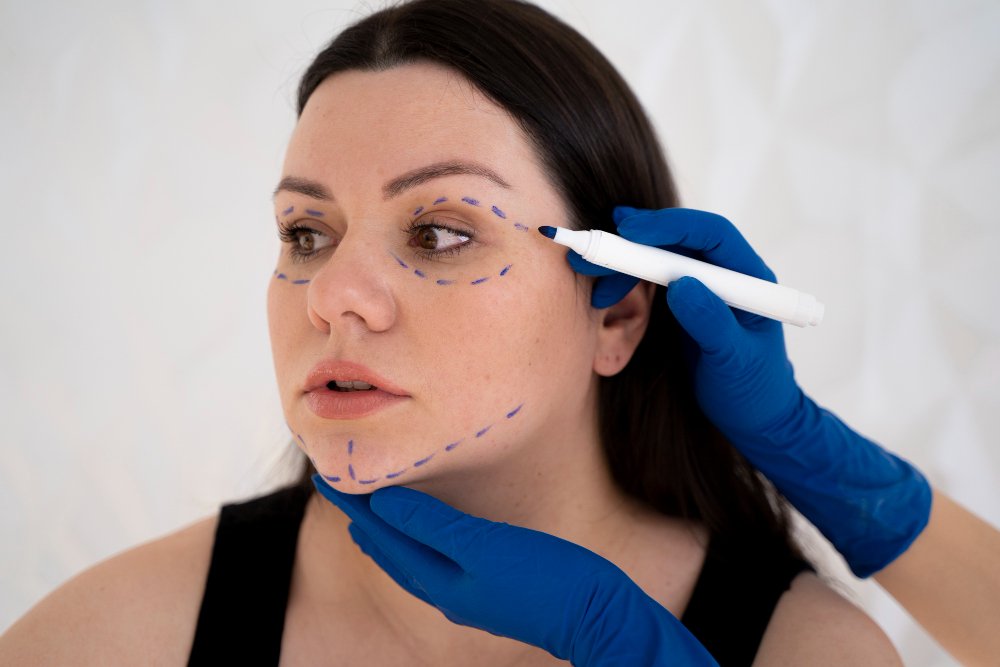
Treatment Overview
Fat Grafting with Under-Eye Fat Repositioning is a combined lower eyelid rejuvenation procedure that smooths eye bags and hollows by redistributing existing orbital fat and adding micro-grafted fat (typically harvested from the abdomen or thighs). This dual approach corrects puffiness, tear trough depressions, and shadowing while preserving youthful volume. In Korea, surgeons specialize in micro- and nano-fat techniques, using scar-minimizing access (often transconjunctival) for natural, long-lasting, and balanced results.
Purpose & Benefits
- Smooths the lid–cheek junction and softens tear troughs
- Reduces puffiness/eye bags without creating a hollow look
- Restores volume and skin quality via micro/nano-fat (stem-cell–rich fraction)
- Produces natural, blended contours versus removal-only surgery
- Minimizes visible scars; often internal (scarless) access
- Longer-lasting than fillers; integrates with your own tissue
Ideal Candidates
- Under-eye bags with concurrent hollowness or deep grooves
- Patients with early to moderate skin laxity (or planning mild skin tightening)
- Individuals who previously used fillers and want a more permanent solution
- Those seeking natural fullness rather than aggressive fat removal
- Healthy adults with stable weight and realistic expectations
Possible Risks & Complications
- Temporary swelling, bruising, and firmness
- Fat resorption/unevenness (may need touch-up grafting)
- Asymmetry in fat repositioning (uncommon with expert technique)
- Rare infection, prolonged edema, or contour irregularity
- Pigment change or edema risk increases with aggressive resurfacing (managed carefully in Korea)
Surgical Techniques Used
- Transconjunctival approach to access and reposition orbital fat over the orbital rim
- Autologous fat harvesting (abdomen/flank/thigh), purification, and micro/nano-fat grafting to tear troughs and malar area
- Layered micro-aliquot injections for smooth integration and lower resorption
- Optional subciliary skin pinch or laser resurfacing/RF for fine wrinkles
- Canthopexy or septal support when needed for eyelid stability
Recovery & Aftercare
- Swelling/bruising typically 7–10 days; most return to routine in 1–2 weeks
- Sleep with head elevated; use prescribed lubricants/antibiotic ointments
- Avoid strenuous activity and eye rubbing for 2–3 weeks
- Expect refinement over 1–3 months as grafted fat settles
- Sun protection and gentle skincare improve longevity and texture
Results & Longevity
- Smoother, brighter under-eyes with restored midface continuity
- Avoids the hollowed outcome of removal-only surgery
- Fat graft survival commonly 60–80%, providing years of improvement
- Skin quality may improve with nano-fat (regenerative effect)
- Aging continues naturally, but results are typically long-lasting (8–10+ years)
Treatment Process in Korea
- Volume-preservation philosophy: Korean surgeons prioritize repositioning + augmentation for youthful fullness
- Micro-precision: Use of microcannulas, fine suturing, and imaging for symmetric contours
- Scar-minimizing methods: Transconjunctival access with selective skin refinement
- Integrated care: Frequent combination with fractional CO₂/erbium lasers, RF microneedling, PRP
- Medical tourism friendly: Coordinators, multilingual staff, structured aftercare—part of why Korea is a top global destination for eyelid rejuvenation
Cost Range
Typical pricing in Korea: ₩3,500,000 – ₩7,500,000 KRW (approx. $2,600 – $5,800 USD)
What affects cost:
- Complexity (extent of fat repositioning + grafting volume)
- Add-ons (laser resurfacing, canthopexy, PRP/nano-fat)
- Surgeon expertise and clinic reputation
- Aftercare packages and follow-up protocols
Popular Clinics
- ID Hospital
- Dream Medical Group
- Banobagi Plastic Surgery
- View Plastic Surgery
- JK Plastic Surgery Center
- TL Plastic Surgery
- The PLUS Plastic Surgery
- Regen Plastic Surgery
- Wonjin Beauty Medical Group
- BIO Plastic Surgery


