
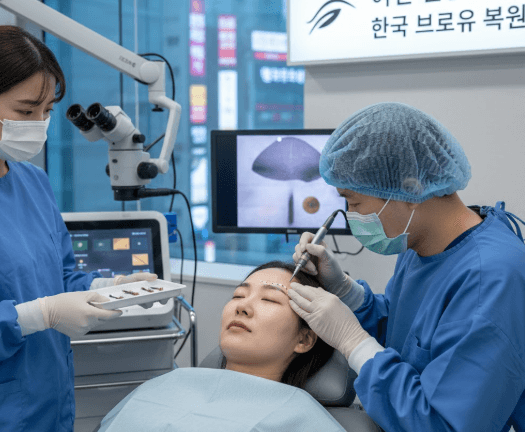
Treatment Overview
The Female Eyebrow Transplant is a highly detailed, natural-focused procedure designed to restore thin, sparse, or uneven eyebrows in women.
Korean clinics specialize in soft, feminine eyebrow design using refined FUE (Follicular Unit Extraction), implanting single-hair grafts that perfectly mimic natural brow texture and direction.
This treatment is ideal for women who want permanent, symmetrical, and beautifully shaped eyebrows without makeup, microblading, or cosmetic tattooing.
Purpose & Benefits
The purpose of this treatment is to create natural, well-shaped eyebrows that enhance feminine facial aesthetics.
Key benefits include:
- Soft, feminine eyebrow shape tailored to facial proportions.
- Fuller, permanent brows that do not fade like microblading.
- Single-hair grafts ensure realistic texture and density.
- Minimal scarring using fine FUE techniques.
- Customizable brow styles (straight, arched, K-beauty soft brows).
- Ideal for women with thin, patchy, or over-plucked eyebrows.
Ideal Candidates
You may be a great candidate if you:
- Have naturally thin, short, or uneven eyebrows.
- Lost eyebrow hair due to over-plucking, cosmetic tattoos, or aging.
- Experienced hair loss from conditions like alopecia or thyroid issues.
- Want a permanent alternative to eyebrow makeup or microblading.
- Prefer natural, real hair instead of pigment-based solutions.
- Want a soft feminine shape created by expert Korean specialists.
Possible Risks & Complications
The treatment is safe, but temporary side effects can include:
- Mild swelling or redness for 2–3 days.
- Tiny scabs for 3–7 days.
- Temporary itching during healing.
- Early shedding of transplanted hairs (normal).
- Rare curling or misdirection if donor hair is thick (managed with grooming).
Techniques & Technology Used
- Fine FUE Extraction: Using 0.7–0.9 mm punches to harvest delicate single hairs.
- Angle-Controlled Incisions: Ensures extremely shallow angles for natural female brow direction.
- Soft-Graft Selection: Only the thinnest, smoothest donor hairs are used.
- Customized Eyebrow Mapping: Based on feminine proportions, face shape, and preferred style.
- Optional PRP Boost: Encourages faster healing and stronger early growth.
Treatment Process in Korea
- Consultation & Design: Surgeon creates a tailored eyebrow shape to fit the patient’s face.
- Donor Area Prep: Fine, soft hairs are taken from behind the ear or scalp sides.
- FUE Extraction: Single follicles are removed with minimal trauma.
- Recipient Site Creation: Ultra-fine incisions made at precise angles to mimic natural brows.
- Implantation: Hair grafts placed one-by-one for perfect symmetry and density.
- After-Care: Soothing treatments, medications, and eyebrow grooming instructions provided.
Recovery & After-Care
- Light scabbing falls off in 3–7 days.
- Keep brows dry for 48 hours and avoid makeup for one week.
- Avoid rubbing brows or using oil-based products during healing.
- Initial shedding occurs at week 2–4 (normal phase).
- New growth at 2–3 months and full results by 6–10 months.
- Hairs can be shaped or trimmed just like natural eyebrows.
Results & Longevity
- Natural, soft, feminine eyebrows that match facial harmony.
- Permanent results — transplanted follicles continue to grow for life.
- Fuller, more youthful eyebrow appearance.
- Eliminates dependency on daily makeup or fading cosmetic tattoos.
- Ideal long-term solution for women seeking natural-looking eyebrow enhancement.
Why Korea Is a Top Destination
- Korean clinics lead in female-specific eyebrow design and soft natural artistry.
- Surgeons are highly experienced with feminine brow angles and density patterns.
- Ultra-fine tools ensure minimal scarring and fast healing.
- Aesthetic outcomes follow K-beauty standards: soft, youthful, and balanced.
- Excellent value, world-class medical safety, and international patient support.
Cost Range
The cost of a Female Eyebrow Transplant in Korea varies by density and design:
- Standard full eyebrow restoration: ₩2,500,000 – ₩4,000,000 (≈ USD 2,000 – 3,200)
- High-density feminine brow design package: ₩4,000,000 – ₩6,000,000 (≈ USD 3,200 – 4,800)
Cost usually includes consultation, design, anesthesia, procedure, medication, and follow-up care.
Popular Clinics in Korea
- Dream Hairline Clinic (Seoul): Experts in feminine eyebrow shaping and soft FUE restoration.
- Moaman Hair Transplant Clinic (Seoul): Known for natural-looking female eyebrow reconstruction.
- Woomchan Hair Transplant Clinic (Gangnam): Specializes in full, balanced female brow restoration for overseas patients.


