
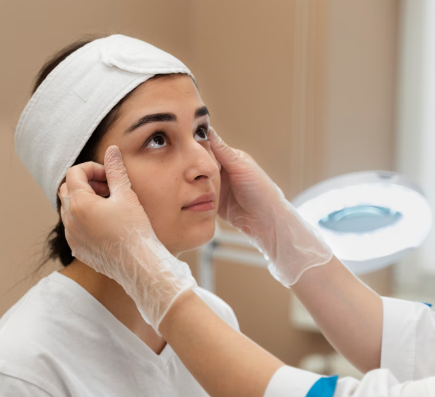
Treatment Overview
Femtosecond Laser Intrastromal Ring Insertion in Korea is a highly precise, minimally invasive procedure designed to reshape and stabilize the cornea in patients with keratoconus, corneal ectasia, or irregular astigmatism. The treatment involves implanting microscopic crescent-shaped corneal rings (Intacs or ICRS) into the corneal stroma to flatten and regularize the corneal curvature, improving both visual acuity and corneal structure.
Korean ophthalmologists enhance this procedure using AI-guided femtosecond laser technology, which creates perfectly centered, uniform corneal tunnels for ring insertion — eliminating the need for manual dissection. This results in greater precision, faster recovery, and lower complication rates.
When combined with corneal cross-linking or regenerative therapy, the treatment offers even greater biomechanical stability and long-term vision improvement.
Femtosecond Laser Intrastromal Ring Insertion in Korea represents the perfect balance between technology and biological preservation — restoring corneal shape, improving vision, and halting keratoconus progression with safety and accuracy.
Purpose & Benefits
Purpose
- Correct corneal cone deformation caused by keratoconus or ectasia.
- Improve visual acuity and reduce optical irregularities.
- Stabilize and reinforce corneal structure.
- Delay or eliminate the need for corneal transplantation.
- Enhance corneal shape symmetry for better lens fitting and vision correction.
Benefits
- Femtosecond Laser Precision: Ensures accurate tunnel creation and perfect ring placement.
- Minimally Invasive: No tissue removal, no stitches, and minimal trauma.
- Customizable Treatment: Ring type, thickness, and position tailored to each cornea.
- Fast Recovery: Most patients resume normal activity within days.
- Compatible with Other Therapies: Can be combined with corneal cross-linking for greater stability.
- Long-Term Results: Provides durable improvement in vision and corneal shape.
Ideal Candidates
Femtosecond Laser Intrastromal Ring Insertion in Korea is ideal for:
- Patients with mild to moderate keratoconus or post-LASIK ectasia.
- Individuals with irregular astigmatism not correctable by glasses or lenses.
- Those with thin or uneven corneas unsuitable for laser reshaping.
- Patients desiring a reversible, structure-preserving treatment option.
- Individuals seeking non-transplant vision correction for keratoconus management.
Possible Risks & Complications
This procedure is extremely safe and effective, though mild, temporary effects may occur:
- Light Sensitivity or Mild Discomfort: Common during the first few days.
- Temporary Vision Fluctuation: Vision improves as cornea stabilizes.
- Dryness or Irritation: Controlled with lubricating eye drops.
- Rare Ring Migration or Infection: Prevented with femtosecond precision and careful postoperative monitoring.
Korean surgeons use AI-assisted laser mapping, real-time imaging, and oxygen-enhanced healing protocols to ensure safety and optimal visual results.
Techniques & Technology Used
Core Techniques
- Femtosecond Laser Tunnel Creation: Generates precise, uniform corneal channels for ring insertion.
- AI-Calibrated Eye Mapping: Customizes ring position, arc length, and depth based on individual corneal shape.
- Intrastromal Ring Implantation: Biocompatible rings are inserted into the corneal stroma to reshape curvature.
- Regenerative Healing Integration: Biologic therapies accelerate recovery and minimize inflammation.
- Combination with Cross-Linking (CXL): Strengthens collagen fibers for added biomechanical stability.
- UV-Protective Recovery Protocols: Maintain long-term clarity and prevent regression.
These advanced technologies make Korea’s laser-assisted ring implantation one of the most precise, safe, and effective solutions for keratoconus management.
Treatment Process in Korea
Step-by-Step Workflow
Step 1 – Diagnostic Evaluation:
Comprehensive corneal topography, tomography, and pachymetry determine ring size and placement parameters.
Step 2 – Surgical Planning:
AI-guided software designs the ideal tunnel depth, diameter, and positioning for maximum vision correction.
Step 3 – Femtosecond Laser Tunnel Creation:
The laser creates perfectly circular intrastromal channels within the cornea in seconds.
Step 4 – Ring Insertion:
The transparent, biocompatible rings are gently placed into the tunnels to reshape the corneal curvature.
Step 5 – Regenerative Aftercare:
Specialized healing drops and biologic therapy promote comfort and rapid stabilization.
Procedure Duration: 20–30 minutes per eye
Recovery Period: Functional vision in 2–3 days; complete stabilization in 4–6 weeks.
Recovery & After-Care
After-Care Guidelines
- Use antibiotic and lubricating eye drops as prescribed.
- Avoid rubbing your eyes for at least one week.
- Wear UV-protective sunglasses outdoors.
- Avoid swimming, heavy exercise, or dusty environments for two weeks.
- Attend follow-up visits to ensure correct ring positioning and healing.
Recovery Timeline
- Days 1–3: Mild discomfort or light sensitivity.
- Week 1: Vision improves as cornea stabilizes.
- Weeks 2–4: Sharpness and contrast steadily increase.
- 1–2 Months: Full vision improvement and stable corneal shape achieved.
Results & Longevity
Expected Results
- Improved visual clarity and reduced distortion.
- Regularized corneal curvature and symmetry.
- Enhanced contact lens tolerance (if used).
- Long-term structural stability and comfort.
Longevity
Femtosecond Laser Ring Insertion offers durable visual and structural improvement, with results lasting for many years.
Korean clinics report over 90–95% patient satisfaction, especially when combined with collagen cross-linking or regenerative aftercare for optimal corneal stability.
Why Korea Is a Top Destination
Korea is internationally recognized for femtosecond laser precision and corneal biomechanics expertise, delivering unmatched safety, customization, and results for keratoconus treatment.
- AI-Guided Femtosecond Laser Systems: Provide perfect tunnel depth and centration.
- Biocompatible Ring Technology: Designed for comfort and long-term clarity.
- Regenerative Healing Integration: Enhances recovery and minimizes scarring.
- Combination Treatment Expertise: Specialists often pair ring insertion with CXL for optimal outcomes.
- Highly Experienced Corneal Surgeons: Trained in advanced intrastromal procedures.
- Comprehensive Eye Care Programs: Include imaging, implantation, and follow-up rehabilitation.
Unique Korean Methods & Technology
- AI-Calibrated Femtosecond Laser Channel Creation
- Customized Intrastromal Ring Geometry & Placement
- Oxygen-Enhanced Collagen Activation
- Regenerative Biologic Eye Therapy
- Real-Time Corneal Imaging & Tracking
- UV-Protective and Long-Term Stability Care
These innovations make Femtosecond Laser Intrastromal Ring Insertion in Korea one of the most effective, safe, and advanced corneal reshaping procedures for keratoconus patients worldwide.
Cost Range
| Treatment Package | Price (KRW) | Approx. USD | Inclusions |
|---|---|---|---|
| Standard Ring Insertion | ₩2,800,000 – ₩3,800,000 per eye | ~$2,000 – $2,700 | Basic femtosecond laser tunnel creation and ring implantation |
| AI-Guided Precision Ring Insertion | ₩4,000,000 – ₩5,500,000 per eye | ~$2,900 – $4,000 | AI-calibrated laser planning with regenerative aftercare |
| Premium Combined Ring & Cross-Linking Package | ₩6,000,000 – ₩8,000,000+ per eye | ~$4,300 – $5,800+ | Femtosecond ring insertion with cross-linking and biologic therapy |
Prices vary by clinic technology, ring type, and surgeon expertise.
Popular Clinics in Korea
- B&VIIT Eye Center (Seoul): Expert in AI-guided femtosecond intrastromal ring procedures with regenerative recovery.
- Dream Eye Center (Seoul): Specializes in precision ring implantation and combination CXL therapies.
- BGN Eye Clinic (Busan & Seoul): Offers advanced femtosecond-assisted corneal ring treatments for keratoconus.
- Glory Seoul Eye Clinic: Renowned for biologic-assisted corneal reshaping and long-term stability programs.
- K-Cure Vision Center (Gangnam): Pioneers in customized ring geometry and regenerative corneal reinforcement.


