
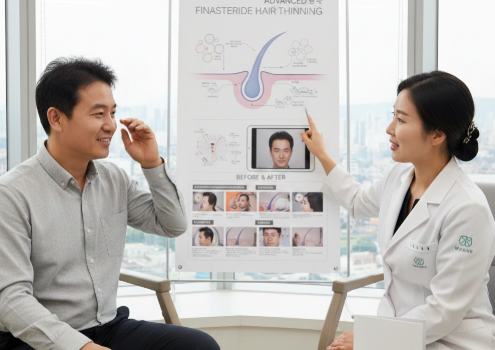
Treatment Overview
Advanced hair thinning, often seen in later stages of androgenetic alopecia, can cause noticeable hair loss on the crown, vertex, and frontal scalp. Finasteride Therapy remains one of the most effective non-surgical treatments to stabilize hair loss and promote regrowth in these areas.
In Korea, clinics offer a structured approach to advanced hair thinning, combining oral or topical Finasteride with advanced diagnostic technology, combination therapies, and continuous monitoring. Patients benefit from high-quality pharmaceutical formulations and integration with supportive treatments like PRP, LED/LLLT, and growth-factor injections to maximize results.
Purpose & Benefits
The main goal of Finasteride Therapy for advanced thinning is to halt further hair loss, strengthen existing follicles, and stimulate regrowth where possible. Key benefits include:
- Slowing progressive hair loss even in advanced cases
- Increasing hair density in thinning areas
- Strengthening weakened follicles to prevent miniaturization
- Enhancing scalp health through combination therapy
- Long-term maintenance for post-hair transplant or ongoing thinning
- Improved confidence by stabilizing visible hair loss
Korean clinics enhance these outcomes with personalized combination programs tailored to each patient’s degree of thinning.
Ideal Candidates
Finasteride Therapy is suitable for men experiencing:
- Significant thinning at the crown, vertex, or hairline
- Early balding transitioning to advanced hair loss
- Progressive androgenetic alopecia despite previous treatments
- Post-transplant patients seeking maintenance
- Those seeking non-surgical interventions to delay or avoid future transplant
Korean dermatologists conduct precise scalp mapping and hormonal analysis to ensure therapy is appropriate for advanced-stage patients.
Possible Risks & Complications
Although generally safe, advanced-stage patients should be aware of potential side effects:
- Reduced libido (rare)
- Erectile dysfunction (usually reversible)
- Decreased semen volume
- Breast tenderness (extremely rare)
- Mild mood changes
Korean clinics mitigate these risks with regular monitoring, individualized dosing, and, in some cases, topical Finasteride to reduce systemic exposure.
Techniques & Technology Used
Korean clinics employ state-of-the-art technologies to maximize the efficacy of Finasteride for advanced hair thinning:
- High-resolution scalp imaging to track follicle health
- AI-powered trichoscopy for accurate density measurement
- Customized oral or topical dosing
- Combination therapies including PRP, exosomes, peptides, and LLLT
- Topical micro-encapsulation technology for localized delivery
These technologies allow precise monitoring and optimization of treatment even in areas with severe thinning.
Treatment Process in Korea
- Comprehensive Consultation: Dermatologists assess thinning severity, medical history, and scalp condition.
- Scalp & Follicle Mapping: Digital imaging identifies affected areas and measures follicle health.
- Personalized Treatment Plan: Oral or topical Finasteride is prescribed, sometimes alongside PRP, growth-factor therapy, or laser treatments.
- Initiation & Monitoring: Regular follow-ups every 1–3 months monitor progress and adjust therapy.
- Maintenance Phase: Long-term therapy stabilizes hair density and prevents further loss.
Korean clinics prioritize education, ensuring patients understand the process and expected outcomes.
Recovery & After-Care
Finasteride therapy does not require downtime. Recommended after-care includes:
- Daily adherence to prescribed medication
- Scalp hygiene and care routines
- Combining therapy with supportive treatments as advised
- Reporting any side effects promptly
- Following clinic-recommended nutritional and lifestyle guidelines
Proper care maximizes efficacy and supports hair follicle health, particularly in advanced thinning areas.
Results & Longevity
Results may take longer to appear in advanced thinning cases:
- 2–3 months: Initial reduction in shedding
- 4–6 months: Strengthening of existing hairs
- 6–12 months: Increased density and visible improvement in thinning areas
- 12–18 months: Stabilization and maximum results
Consistency is key. Korean clinics often combine Finasteride with laser or regenerative therapies to enhance outcomes and prolong longevity.
Why Korea Is a Top Destination
Korea is globally recognized for excellence in hair restoration due to:
- Highly specialized dermatologists in advanced-stage hair loss
- State-of-the-art diagnostic and monitoring technology
- Safe, regulated pharmaceutical treatments
- Combination therapy programs that maximize results
- Affordable pricing compared to Western countries
- Multilingual support and medical tourism services
The integration of expertise, technology, and patient-centered care makes Korea an ideal destination for advanced hair thinning treatment.
Cost Range
Costs vary depending on the formulation and combination therapies:
- Oral Finasteride: $15–$40 per month
- Topical Finasteride: $25–$90 per month
- Combination programs (PRP, LLLT, peptides): $200–$600 per month
- Consultation and digital scalp mapping: $20–$80
Korean clinics often provide packages for international patients to streamline treatment and cost.
Popular Clinics in Korea
Some reputable clinics specializing in advanced hair thinning include:
- Motion Clinic
- Dr. For Hair Clinic
- Mojelim Hair Clinic
- Gwangnam Dermatology
- Girin Dermatology
- Dana Dermatology
- Regen Dermatology
These clinics offer advanced diagnostics, personalized plans, and professional care for local and international patients.


