
As a board-certified hair transplant surgeon in Korea, I often meet patients—both local and international—who ask the same important question:
“Should I choose FUE or FUT for my hair transplant?”
The answer isn’t always straightforward because each technique offers distinct advantages depending on your hair type, degree of hair loss, lifestyle, and personal preferences.
In this guide, I’ll walk you through the key differences between FUE (Follicular Unit Extraction) and FUT (Follicular Unit Transplantation) so you can make an informed decision.
🔍 What Are FUE and FUT Hair Transplants?
✅ FUE (Follicular Unit Extraction)
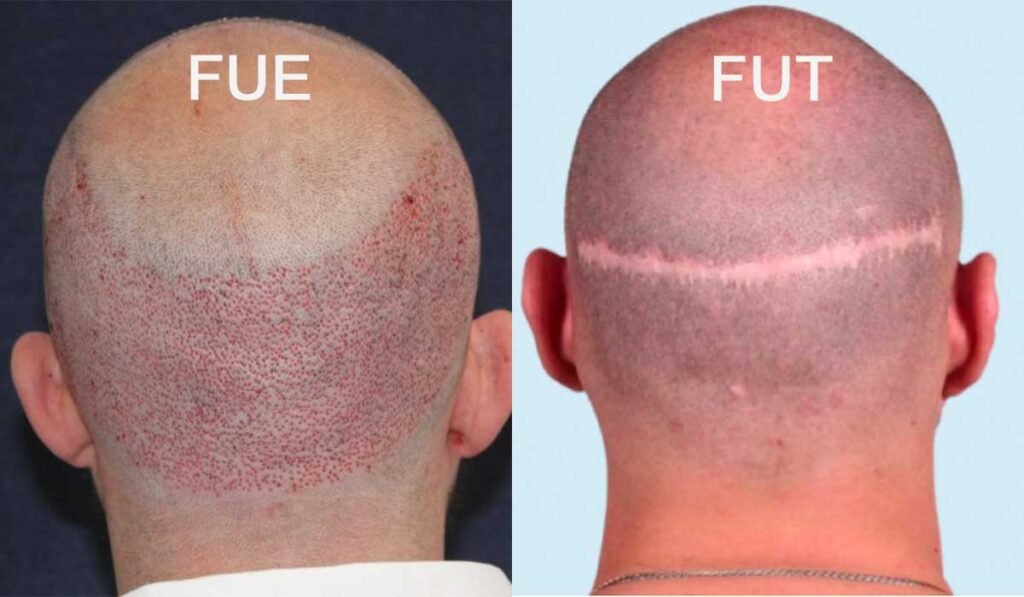
FUE involves extracting individual follicular units (grafts) directly from the donor area (usually the back or sides of the scalp) using a small micro-punch tool, typically less than 1mm in diameter.
- No scalpel or stitches
- Tiny circular scars
- Minimally invasive
- Faster recovery time
✅ FUT (Follicular Unit Transplantation)
FUT, also known as the “strip method,” involves surgically removing a thin strip of scalp from the donor area. This strip is then dissected under a microscope to isolate follicular units for transplantation.
- Involves sutures
- Linear scar left behind
- More grafts can be harvested in one session
- Cost-effective for high graft requirements
📊 Side-by-Side Comparison
| Feature | FUE | FUT |
|---|---|---|
| Technique | Extracts individual follicles | Removes a strip of scalp |
| Scarring | Tiny, dot-like scars | Linear scar |
| Recovery Time | 5–7 days | 10–14 days |
| Graft Survival | Slightly lower yield | Slightly higher yield |
| Session Duration | Longer (up to 8 hours) | Shorter |
| Ideal For | Short hairstyles, minimal downtime | Maximum coverage, high graft demand |
| Pain Level | Minimal | Mild–moderate (from stitches) |
| Cost | Typically higher per graft | More economical per graft |
👨⚕️ What Korean Surgeons Typically Recommend
As surgeons practicing in Korea—where aesthetic precision and natural-looking hairlines are held to the highest standard—we make recommendations based on five key factors:
1. Extent of Hair Loss
- For early to moderate hair loss, FUE is often preferred.
- For advanced baldness, FUT allows us to harvest a higher number of grafts efficiently.
2. Donor Hair Quality
- If the donor area is limited or thinning, FUT may preserve the area better.
- For patients with dense donor zones, FUE works well without creating visible thinning.
3. Hair Style Preferences
- Patients who prefer short hairstyles benefit from FUE, as the scars are tiny and diffuse.
- If you plan to keep longer hair, FUT scars are generally hidden.
4. Time and Downtime
- Medical tourists who need a faster recovery often choose FUE.
- If downtime isn’t an issue and a larger number of grafts are needed, FUT is ideal.
5. Budget
- FUT is more cost-effective when large areas of coverage are needed.
- FUE, while more expensive per graft, may be worth it for patients prioritizing minimal scarring and quick recovery.
🧬 Is It Possible to Combine FUE and FUT?
Yes, in many Korean clinics—especially high-volume or specialty hair transplant centers—we may recommend a combined approach:
“Hybrid FUE + FUT allows us to maximize graft yield while minimizing the visual impact on the donor area.”
This is especially helpful for:
- Patients requiring over 3,000 grafts
- Those with limited donor areas
- Scar revision cases from previous procedures
🌍 For Medical Tourists Visiting Korea
As one of the most popular destinations for hair restoration in Asia, Korean clinics provide international patients with:
- Advanced robotic-assisted FUE options
- Sutureless and scar-minimizing FUT techniques
- Natural, age-appropriate hairline designs
- Translation services and recovery support
We also perform detailed online consultations before you even book your flight. This helps determine whether FUE or FUT is better for your goals, ensuring you have realistic expectations and a personalized plan before arrival.
💬 Final Word from a Korean Surgeon
“No one technique is universally better—the right procedure is the one that best fits your anatomy, hair loss pattern, lifestyle, and goals. Our job as surgeons is to help you choose that path with expert guidance and artistic precision.”
Both FUE and FUT can offer excellent, permanent results in the hands of experienced Korean surgeons. If you’re unsure which one to choose, a personalized consultation with scalp analysis will give you clarity.


