
Treatment Overview
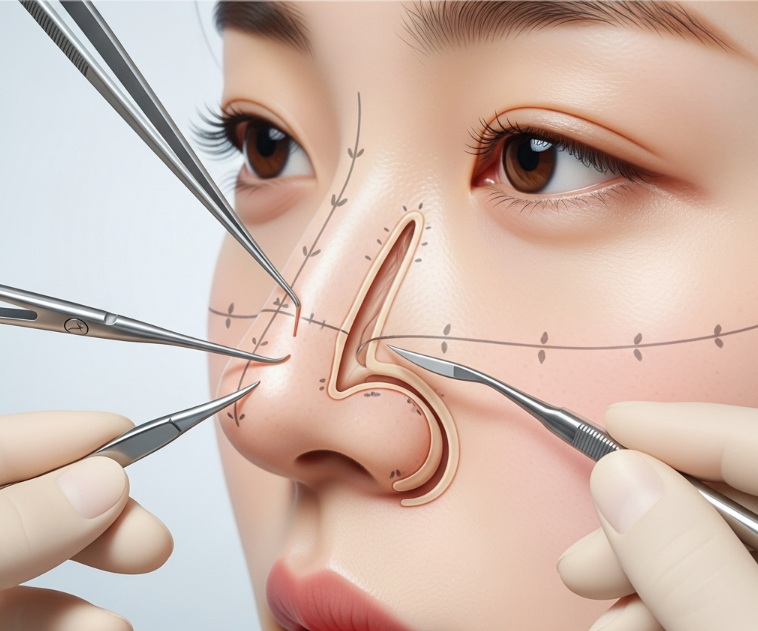
Functional Rhinoplasty for Short Nose in Korea is a specialized surgical procedure designed not only to improve the aesthetic appearance of a short nose but also to enhance nasal function and breathing. This approach addresses issues such as nasal obstruction, weakened tip support, and internal valve collapse while simultaneously refining tip projection, nostril symmetry, and nasal length. Korean surgeons are renowned for combining structural cartilage grafting, advanced tip techniques, and minimally invasive approaches to achieve both functional and aesthetic improvements.
Purpose & Benefits
- Improves breathing and airflow through structural correction of nasal passages.
- Enhances tip projection and rotation in short noses for better facial proportion.
- Corrects internal and external nasal valve collapse.
- Balances nostrils and alar base for symmetrical appearance.
- Reduces the need for future revision by stabilizing nasal structures.
- Provides subtle, natural aesthetic results while restoring function.
Ideal Candidates
- Patients with a short nose experiencing nasal obstruction or breathing difficulties.
- Individuals seeking combined functional and cosmetic improvement.
- Candidates with tip drooping, flared nostrils, or weak columellar support.
- Men and women desiring proportional nasal enhancement while preserving natural appearance.
- Patients requiring revision surgery to correct both functional and aesthetic concerns.
Possible Risks & Complications
- Temporary swelling, bruising, and mild discomfort.
- Minor asymmetry or uneven tip projection (usually correctable).
- Rare risk of infection, bleeding, or cartilage graft displacement.
- Possible need for revision surgery in uncommon cases.
- Temporary numbness or stiffness around nasal tip or columella.
Surgical Techniques Used
- Septal and Tip Cartilage Grafting: Provides structural support to the tip and nasal dorsum.
- Columellar Strut / Septal Extension Graft: Stabilizes tip projection and rotation.
- Alar Base Adjustment: Corrects flared or asymmetrical nostrils.
- Internal Valve Repair: Enhances airflow and prevents collapse during breathing.
- Closed or Open Rhinoplasty Approach: Minimally invasive or open technique depending on complexity.
- Hybrid Functional Techniques: Combines tip, columella, and dorsal modifications for long-lasting functional and aesthetic outcomes.
Recovery & Aftercare
- Downtime: 5–7 days for initial swelling and bruising.
- Sutures removal: Typically 5–7 days post-surgery.
- Return to normal activities: 1–2 weeks; avoid strenuous activity for 3–4 weeks.
- Final results: 3–6 months as swelling resolves and nasal structures stabilize.
- Korean aftercare programs include:
- Anti-swelling therapy and laser treatments
- Scar management and gentle massage guidance
- Follow-ups to monitor breathing function and nasal symmetry
- Remote consultations for international patients
Results & Longevity
- Achieves a natural, proportionate short nose with enhanced nasal function.
- Long-lasting results when proper cartilage support and surgical techniques are applied.
- Maintains both functional efficiency and aesthetic harmony.
- Improves overall facial balance while preserving natural ethnic features.
- Aging minimally affects structural or functional improvements.
Treatment Process in Korea
Korea is globally recognized for functional rhinoplasty in short noses, offering advanced techniques and patient-centered care:
- Preoperative assessment: 3D imaging and airflow analysis to plan functional and aesthetic corrections.
- Customized surgical plan: Tailored cartilage grafting, tip refinement, and valve repair.
- Minimally invasive or open approach: Selected to maximize structural stability and natural appearance.
- Integration with other short nose procedures: Can include dorsal augmentation, columellar lengthening, and alar base reduction.
- International patient services: Translation, accommodation, and post-operative follow-up support.
Why Korea is a Top Destination:
- Surgeons are experts in simultaneous functional and aesthetic rhinoplasty.
- Advanced grafting and minimally invasive techniques ensure long-lasting, natural results.
- High patient satisfaction for complex short nose corrections.
- World-class clinics with comprehensive aftercare and follow-up programs.
Cost Range
The cost of Functional Rhinoplasty for Short Nose in Korea varies based on complexity:
- Basic functional correction: ₩5,500,000 – ₩8,000,000 KRW ($4,200 – $6,100 USD)
- With cartilage grafting and tip refinement: ₩8,500,000 – ₩11,000,000 KRW ($6,500 – $8,500 USD)
- Complex or revision functional rhinoplasty: ₩11,500,000 – ₩14,500,000 KRW ($8,800 – $11,000 USD)
Packages generally include:
- Surgeon and anesthesia fees
- Hospital/facility costs
- Cartilage harvesting if required
- Post-operative care (anti-swelling, laser therapy, scar management)
- Multilingual support for international patients
Popular Clinics in Korea
- ID Hospital (Seoul): Known for combined functional and short nose aesthetic rhinoplasty.
- Banobagi Plastic Surgery (Seoul): Specializes in structural support and natural tip refinement.
- JW Plastic Surgery (Seoul): Offers advanced cartilage grafting and internal valve repair.
- View Plastic Surgery (Seoul): Popular for international patients seeking both functional and aesthetic outcomes.
- The PLUS Plastic Surgery (Seoul): Experts in subtle, proportional, and scar-minimized functional rhinoplasty.


