
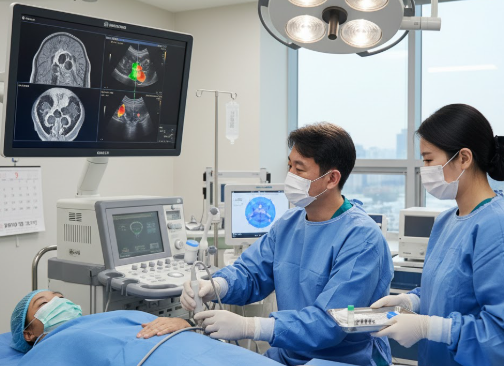
Treatment Overview
A Fusion-Guided Prostate Biopsy is an advanced diagnostic technique that merges high-resolution MRI images with real-time transrectal or transperineal ultrasound (TRUS) imaging to precisely target suspicious lesions in the prostate. This state-of-the-art method improves cancer detection, especially for clinically significant tumors that may not be captured by conventional systematic biopsies.
Korea is recognized as a global leader in prostate cancer diagnostics, offering cutting-edge MRI–ultrasound fusion systems, expert radiologists, and urologists with extensive experience in precision biopsies. The result is an accurate, safe, and patient-friendly biopsy experience tailored for both domestic and international patients seeking advanced diagnostic care.
Purpose & Benefits
Fusion-guided biopsy aims to improve accuracy by targeting the exact lesions identified on MRI scans, rather than relying solely on random sampling. Major benefits include:
- Higher detection rate of clinically significant cancer
- Reduced sampling error by focusing directly on MRI-identified abnormalities
- Fewer unnecessary cores, minimizing discomfort
- More reliable diagnosis, especially after previous negative biopsies
- Improved treatment planning due to precise localization
- Better prediction of tumor aggressiveness
Korean hospitals enhance these benefits with advanced fusion platforms, specialized imaging software, and highly trained doctors who perform large volumes of fusion-guided biopsies every year.
Ideal Candidates
Fusion-guided prostate biopsy is especially recommended for:
- Patients with elevated PSA levels or rapidly changing PSA trends
- Men with abnormal mpMRI findings (PI-RADS 3, 4, or 5 lesions)
- Individuals with previous negative TRUS biopsies but ongoing suspicion of cancer
- Patients planning for robotic surgery, radiation, or focal therapies
- Men seeking a second opinion or more precise diagnostic confirmation
- Individuals with a family history of prostate cancer
Because Korea offers fast scheduling, advanced imaging, and strong patient support systems, it is a preferred destination for patients needing accurate biopsy results without delay.
Possible Risks & Complications
Fusion-guided biopsy is generally safe, but potential risks include:
- Mild pain in the pelvic or rectal area
- Temporary blood in urine, semen, or stool
- Minor urinary discomfort
- Infection (rare due to strict antibiotic and sterilization measures in Korea)
- Rare cases of urinary retention
Korean hospitals maintain extremely low complication rates thanks to high-quality imaging, sterile biopsy protocols, and the option of transperineal biopsy—which further reduces infection risks.
Techniques & Technology Used
Korea uses some of the world’s most advanced prostate fusion systems to ensure accuracy and safety:
- 3T multi-parametric MRI to visualize suspicious lesions
- MRI–ultrasound fusion software to merge MRI and ultrasound images during biopsy
- Real-time needle tracking for precise targeting
- Robotic-assisted biopsy platforms in top hospitals
- Transrectal or transperineal approaches based on the patient’s condition
- Periprostatic nerve block anesthesia for minimal discomfort
These systems display MRI lesions on a detailed prostate map, allowing the doctor to guide the biopsy needle with extreme precision.
Treatment Process in Korea
The fusion-guided biopsy workflow in Korea is smooth, transparent, and optimized for medical tourists:
- Initial Consultation & PSA Review – A urologist reviews PSA levels, symptoms, and medical history.
- Pre-Biopsy MRI Scan – High-resolution 3T MRI identifies suspicious lesions.
- Fusion Setup – The MRI images are uploaded into the fusion software.
- Local Anesthesia – Pain control via periprostatic nerve block or sedation.
- Real-Time Ultrasound Imaging – The doctor positions the probe to align ultrasound and MRI visuals.
- Targeted Biopsy Sampling – The fusion platform guides the biopsy needle directly to suspicious areas.
- Additional Systematic Cores (if needed) – Ensures full sampling coverage.
- Brief Recovery Period – Most patients go home within the same hour.
- Pathology Report – Results are usually ready in 1–3 days.
International patients receive coordinated appointment scheduling, English interpretation services, and digital access to reports.
Recovery & After-Care
Patients typically recover quickly with few side effects:
- Light activity is recommended for 24 hours.
- Slight bleeding in urine or semen may occur for a few days.
- Increased water intake helps ease urinary irritation.
- Avoid heavy exercise or sexual activity for 48 hours.
- Take prescribed antibiotics as instructed.
- Seek help if fever, chills, or difficulty urinating occurs.
Korean hospitals provide clear after-care instructions and convenient follow-up options, including remote consultation.
Results & Longevity
Fusion-guided biopsy yields highly accurate diagnostic results due to direct lesion sampling. Reports include:
- Gleason score
- Grade Group
- Tumor percentage in each core
- Location of cancer within the prostate
These details guide treatment planning with exceptional accuracy.
Because the biopsy targets exact areas of concern, results remain reliable for long-term monitoring. Korean hospitals can further support patients with treatment pathways such as robotic prostatectomy, focal therapies, or active surveillance depending on the results.
Why Korea Is a Top Destination
Korea stands out as a leading destination for fusion-guided prostate biopsy due to:
- World-class urology centers specializing in prostate cancer
- Internationally trained urologists and radiologists
- Cutting-edge MRI and fusion biopsy systems
- Low complication rates and high diagnostic accuracy
- Transparent pricing and medical tourism support
- Fast scheduling and efficient patient flow
Korea’s medical system has a strong reputation for quality, safety, and modern infrastructure—attracting thousands of medical tourists each year.
Cost Range
The cost of a fusion-guided prostate biopsy in Korea typically ranges from:
₩1,800,000 – ₩3,800,000 KRW
(approximately $1,350 – $2,950 USD)
Pricing varies based on:
- Type of MRI performed
- Fusion software or robotic platform used
- Number of biopsy cores collected
- Hospital level (premium private vs. university hospital)
Additional fees may apply for blood tests, pathology, consultations, or imaging scans.
Popular Clinics in Korea
- Seoul National University Hospital (SNUH) – Precision Urology Unit
- Samsung Medical Center – MRI Fusion Biopsy Center
- Asan Medical Center – Prostate Cancer Diagnostics Division
- Gangnam Severance Hospital – Robot-Assisted Fusion Biopsy
- Korea University Anam Hospital – Advanced Imaging & Urology
- JK Urology & Men’s Health Clinics – favored by international patients


