
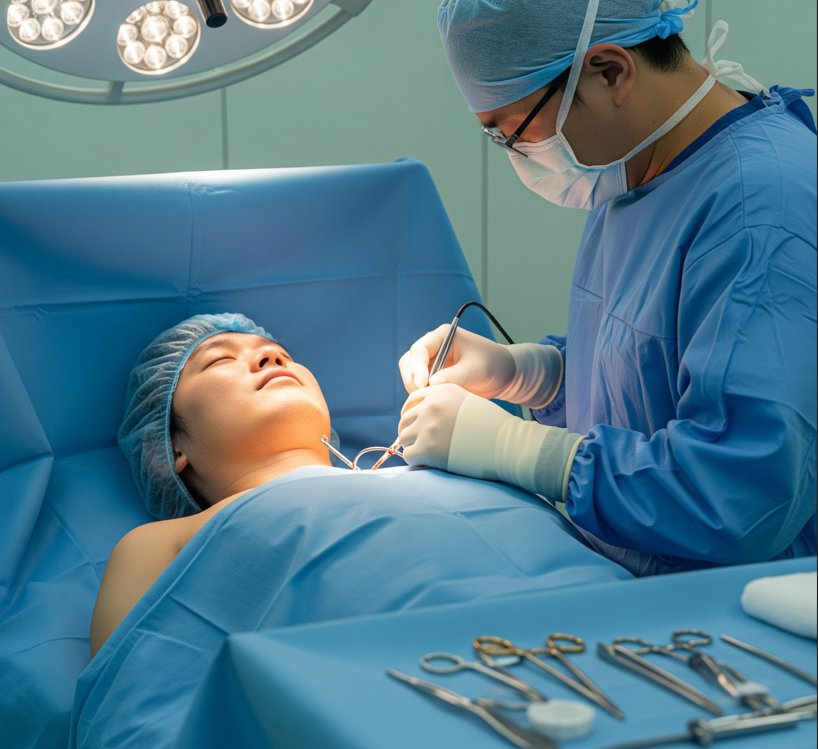
Treatment Overview
Gender-Affirming Breast Augmentation in Korea is a specialized surgical procedure designed to help transgender women (MTF patients) achieve natural, feminine breast contours. The procedure uses silicone implants, autologous fat grafting, or a hybrid of both to enhance breast size, shape, and projection. Korean surgeons are highly experienced in transgender-specific breast surgery, focusing on chest anatomy, symmetry, nipple positioning, and skin elasticity to deliver balanced, long-lasting, and natural results with minimal scarring.
Purpose & Benefits
- Feminine Chest Contour: Creates natural curves tailored to MTF patients.
- Customized Options: Choice of implants, fat grafting, or hybrid augmentation.
- Improved Body Proportion: Balances chest with hips and overall body silhouette.
- Minimally Visible Scars: Strategic incision placement for discreet results.
- Preservation of Sensation: Careful handling of nipple-areola complex to maintain sensitivity.
- Gender Affirmation & Confidence: Enhances psychological well-being and social integration.
Ideal Candidates
- Transgender women (MTF patients) seeking feminine breast contours.
- Individuals with adequate chest tissue or suitable donor fat for grafting.
- Patients desiring natural, long-lasting breast enhancement.
- Those seeking minimal scarring and aesthetically precise outcomes.
- Individuals undergoing or post gender-affirming transition who want chest feminization.
Possible Risks & Complications
- Temporary swelling, bruising, or tenderness.
- Infection or hematoma (rare with proper care).
- Capsular contracture (scar tissue around implant).
- Implant malposition, asymmetry, or rupture.
- Fat resorption (if fat grafting is performed).
- Temporary or permanent changes in nipple sensation.
Surgical Techniques Used
- Implant-Based Augmentation: Silicone implants (round or anatomical) placed via inframammary, periareolar, or transaxillary incision.
- Autologous Fat Grafting: Fat harvested from abdomen, thighs, or flanks, purified, and injected for contouring and softness.
- Hybrid Augmentation: Combination of implants + fat grafting for natural texture and shape.
- Pocket Placement: Subglandular, subpectoral, or dual-plane, depending on chest anatomy.
- Nipple-Areola Adjustment: Repositioning for proportional, feminine aesthetics.
Recovery & Aftercare
- Mild swelling, bruising, and tenderness for 1–2 weeks.
- Return to light activities in 5–7 days; avoid strenuous activity for 4–6 weeks.
- Compression garments and support bras recommended.
- Regular follow-ups to monitor implant position, fat graft survival, and healing.
- Final breast shape achieved within 3–6 months.
Results & Longevity
- Feminine, natural-looking breast contour.
- Long-lasting results with proper care and implant maintenance.
- Smooth and soft breast texture, especially with hybrid augmentation.
- Minimal scarring with advanced surgical approaches.
- Boost in body confidence and self-identity alignment.
Treatment Process in Korea
Initial Consultation & Assessment
- Comprehensive chest evaluation including skin elasticity and donor fat availability.
- Detailed discussion of implant types, sizes, and surgical approaches.
- 3D simulation or digital imaging to preview results.
Customized Surgical Planning
- Implant selection (shape, size, and projection).
- Choice of incision site for minimal scarring.
- Consideration of nipple-areola positioning.
Surgery Day
- Performed under general anesthesia (approx. 2–3 hours).
- Implants placed with precision; fat grafting performed if hybrid augmentation is selected.
- Post-op monitoring for stability and healing.
Post-Operative Monitoring
- Careful follow-up for implant positioning, breast symmetry, and wound healing.
- Instructions on scar care, garment use, and recovery precautions.
Follow-Up & Refinement
- Regular follow-ups to ensure optimal recovery.
- Secondary fat grafting or revision available if needed.
Why Korea is a Top Destination
- Highly experienced surgeons specializing in transgender breast augmentation.
- World-class clinics equipped with advanced imaging and surgical technology.
- Patient-centered approach with customized surgical planning.
- Emphasis on natural, feminine results with minimal downtime.
- High satisfaction rates among international patients seeking gender-affirming care.
Cost Range
The cost of Gender-Affirming Breast Augmentation in Korea varies depending on technique, implant quality, and clinic reputation:
- Implant-Based Augmentation (Standard): USD $6,000 – $10,000
- Autologous Fat Grafting Only: USD $7,000 – $12,000
- Hybrid Augmentation (Implant + Fat Grafting): USD $10,000 – $16,000
- Revision or Secondary Augmentation: USD $5,000 – $9,000
- Premium Clinics with 3D Simulation & Concierge Care: USD $12,000 – $18,000
Popular Clinics
- Banobagi Plastic Surgery Clinic (Seoul): Leading clinic specializing in gender-affirming breast surgery.
- ID Hospital (Seoul): Known for advanced implant and fat graft hybrid techniques.
- JK Plastic Surgery Center (Seoul): Offers personalized augmentation with 3D simulation.
- View Plastic Surgery Clinic (Seoul): Renowned for precise, feminine chest contouring.
- JW Plastic Surgery (Seoul): Experienced in hybrid augmentation and revision procedures.


