
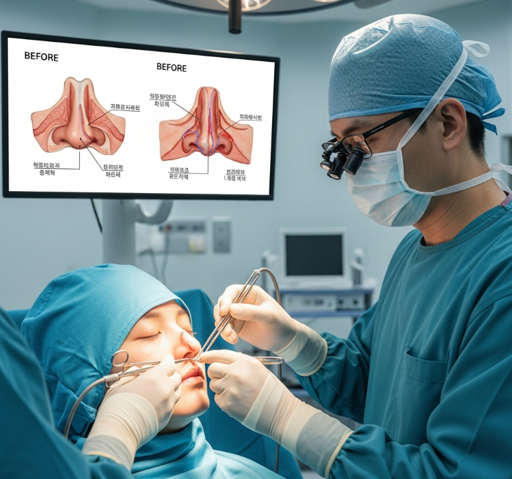
Treatment Overview
Gore-Tex and Cartilage Hybrid Graft in Korea is a cutting-edge rhinoplasty technique that combines the benefits of synthetic Gore-Tex implants with autologous cartilage grafts. This hybrid approach provides optimal nasal support, enhances the bridge and tip, and ensures long-lasting, natural-looking results. Korean surgeons are highly experienced in hybrid grafting, using precise methods that minimize complications while achieving aesthetically pleasing and structurally strong outcomes.
Purpose & Benefits
- Provides durable support for nasal bridge and tip using a combination of Gore-Tex and cartilage.
- Enhances bridge height and tip projection while maintaining natural contours.
- Reduces risk of implant-related complications compared to synthetic-only grafts.
- Allows precise shaping and long-term stability.
- Improves facial harmony and masculine or feminine nasal aesthetics.
Ideal Candidates
- Patients seeking bridge augmentation with stronger tip support.
- Individuals with previous rhinoplasty requiring revision or reinforcement.
- Men or women with low or flat nasal bridges.
- Patients desiring long-lasting structural support with natural-looking results.
- Those in good health with realistic expectations about hybrid graft outcomes.
Possible Risks & Complications
While rare in Korea due to advanced techniques, potential risks include:
- Temporary swelling and bruising
- Minor asymmetry or irregular contours
- Infection or implant exposure (rare with hybrid technique)
- Partial resorption of cartilage (rare, minimized by surgical precision)
- Need for revision surgery in complex or revision cases
Surgical Techniques Used
Korean surgeons use advanced methods for Gore-Tex and cartilage hybrid grafting:
- Autologous Cartilage Harvesting: Septum, ear, or rib cartilage is used for structural reinforcement.
- Gore-Tex Implant Placement: Smooth, biocompatible material is inserted for bridge or tip augmentation.
- Hybrid Technique: Cartilage grafts are layered with Gore-Tex for enhanced stability, support, and natural contour.
- Tip and Bridge Refinement: Combined with tip suturing, columellar strut, or alar grafts for harmonious results.
- Korean Precision Approach: Focused on symmetry, natural aesthetics, and long-term durability.
Recovery & Aftercare
- Downtime: 7–10 days for initial recovery; swelling may last 2–4 weeks.
- Stitch Removal: Typically 5–7 days post-surgery.
- Aftercare: Avoid trauma, strenuous activity, and smoking.
- Structured post-operative care in Korea includes:
- Swelling reduction therapy
- Gentle massage to maintain contour
- Laser therapy for minimal scarring
- Follow-ups to monitor bridge and tip support
Results & Longevity
- Long-lasting enhancement of bridge height and tip support.
- Maintains natural-looking masculine or feminine nasal aesthetics.
- Final outcomes are visible after swelling subsides (2–3 months).
- Durable results due to combined strength of Gore-Tex and cartilage graft.
Treatment Process in Korea
Korea is recognized globally for hybrid graft rhinoplasty:
- 3D Imaging & Pre-Surgery Planning: Patients can visualize realistic outcomes before surgery.
- Precision Cartilage and Gore-Tex Placement: Minimally invasive techniques reduce risk while ensuring optimal support.
- Gender-Specific Design: Maintains masculine or feminine nasal aesthetics while enhancing structure.
- Comprehensive Post-Operative Care: Includes swelling management, contour assessment, and follow-up consultations.
Why Korea is a Top Destination:
- Experienced surgeons specializing in hybrid graft rhinoplasty.
- Advanced surgical technology for precise placement and long-term stability.
- Natural, durable results for both aesthetic and functional improvement.
- Full support for international patients including translators, accommodation, and airport pickup.
Cost Range
The cost of Gore-Tex and Cartilage Hybrid Graft in Korea depends on complexity:
- Bridge or Tip Only Hybrid Grafting: ₩5,000,000 – ₩8,000,000 KRW ($3,800 – $6,100 USD)
- Combined Procedures (Bridge + Tip + Alar): ₩8,000,000 – ₩12,000,000 KRW ($6,100 – $9,200 USD)
- Complex Revision or Multi-Site Hybrid Grafting: ₩12,000,000 – ₩18,000,000 KRW ($9,200 – $13,800 USD)
Inclusions:
- Surgeon’s fee and anesthesia
- Clinic or hospital facilities
- Post-operative care and follow-ups
- Optional medical tourism packages including accommodation and translation
Popular Clinics in Korea
- ID Hospital (Gangnam, Seoul): Expert in hybrid graft techniques with natural, long-lasting results.
- Banobagi Plastic Surgery (Seoul): Specialized in combining Gore-Tex and cartilage for tip and bridge enhancement.
- View Plastic Surgery (Seoul): Advanced 3D imaging and hybrid grafting techniques for optimal outcomes.
- DA Plastic Surgery (Seoul): Focused on structural reinforcement with natural aesthetics.
- JK Plastic Surgery (Seoul): JCI-accredited clinic with high international patient satisfaction and safety.


