
Treatment Overview
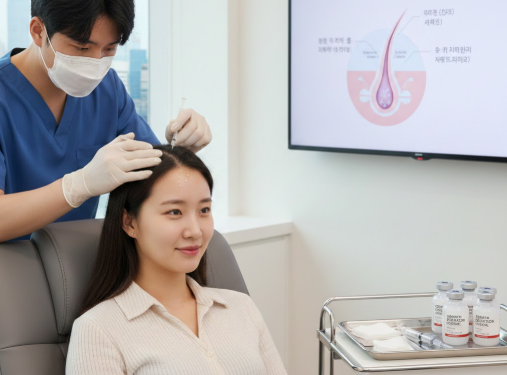
Growth Factor Injection for Postpartum Hair Loss in Korea is a cutting-edge, non-surgical treatment designed to restore hair density and health in women experiencing hair shedding after childbirth. Postpartum hair loss occurs due to hormonal fluctuations, primarily the drop in estrogen levels, which leads to temporary hair shedding and weakened hair follicles.
This treatment delivers bioactive growth factors directly into the scalp to stimulate dormant follicles, improve scalp circulation, and promote the regrowth of strong, healthy hair. Korean clinics use pharmaceutical-grade growth factor formulations derived from stem cells and peptides, ensuring high efficacy with minimal downtime.
Purpose & Benefits
The main purpose of this therapy is to accelerate hair recovery after childbirth and strengthen weakened follicles.
Key benefits include:
- Reactivates dormant or weakened hair follicles affected by postpartum shedding
- Reduces excessive hair loss and promotes regrowth
- Improves hair thickness and overall hair quality
- Enhances scalp microcirculation and nourishment
- Provides anti-inflammatory effects to improve scalp health
- Non-surgical, minimally invasive with fast recovery
- Works synergistically with PRP, microneedling, or nano-growth factor therapies
By addressing follicle health directly, this treatment helps mothers restore their natural hair density faster and more effectively than topical treatments alone.
Ideal Candidates
This therapy is recommended for women who experience:
- Significant hair shedding after childbirth
- Thinning or weak hair caused by hormonal fluctuations
- Scalp sensitivity or mild inflammation
- Early to moderate postpartum hair loss
- Hair loss exacerbated by stress or lack of nutrition during postpartum recovery
- Patients seeking safe, non-surgical hair restoration solutions
Women with prolonged or severe hair loss may require additional regenerative treatments or a combination therapy approach for optimal results.
Possible Risks & Complications
Growth Factor Injection for Postpartum Hair Loss is considered very safe in licensed Korean clinics. Temporary side effects may include:
- Mild redness or swelling at injection sites
- Pinpoint bruising
- Slight tenderness or itching
- Minor scalp irritation
Serious complications are rare due to the use of sterile equipment, pharmaceutical-grade growth factors, and strict hygiene protocols.
Techniques & Technology Used
Korean clinics use advanced methods to maximize treatment efficacy:
1. Pharmaceutical-Grade Growth Factors
Includes VEGF, KGF, FGF, IGF, and cytokines to stimulate follicle regeneration.
2. Micro-Injection or Nano-Needle Delivery
Ensures precise delivery of growth factors into the dermal layer where follicles reside.
3. Optional Combination Therapies
PRP, exosomes, or microneedling may be combined for enhanced regenerative effects.
4. Digital Scalp Analysis
High-resolution dermoscopy evaluates follicle density, hair thickness, and scalp condition before and after treatment.
5. LED or Red-Light Therapy
Applied post-procedure to reduce inflammation, accelerate healing, and stimulate follicles.
This combination of techniques ensures effective absorption of growth factors and promotes faster hair regrowth.
Treatment Process in Korea
The process is streamlined and patient-friendly for medical tourists:
- Consultation & Scalp Assessment
Dermatologists analyze hair thinning patterns, follicle density, and scalp condition using digital imaging. - Customized Growth Factor Formulation
A growth factor solution is tailored to the patient’s scalp and hair recovery needs. - Topical Numbing (Optional)
Numbing cream may be applied to reduce discomfort during injections. - Micro-Injection Procedure
Growth factors are injected precisely into thinning or weakened areas of the scalp. - Optional Post-Therapies
Red-light therapy may be applied to accelerate follicle activation and reduce inflammation. - Post-Care Instructions
Patients receive detailed guidance to optimize results and plan follow-up sessions.
Each session typically lasts 30–60 minutes, and patients can resume normal daily activities immediately.
Recovery & After-Care
Recovery is quick and straightforward:
- Avoid washing the scalp for 12–24 hours
- No heavy sweating, saunas, or swimming for 48 hours
- Use gentle, non-medicated shampoos for the first few days
- Avoid alcohol, smoking, or harsh chemicals immediately after treatment
- Apply clinic-recommended serums or hair boosters
Mild redness, tenderness, or pinpoint bruising may occur but usually resolves within 1–2 days.
Results & Longevity
Results are gradual but visible:
- 2–4 weeks: Reduced shedding and healthier scalp feel
- 4–8 weeks: Hair shafts become stronger and thicker
- 3 months: Noticeable improvement in hair density and volume
- 4–6 months: Fuller, stronger, and healthier hair
Results typically last 6–12 months, and patients usually undergo 3–5 sessions spaced 2–4 weeks apart. Combining this therapy with complementary treatments like PRP or exosomes can enhance results further.
Why Korea Is a Top Destination
Korea is globally recognized for advanced hair restoration therapies, especially for postpartum hair loss:
- High-quality pharmaceutical-grade growth factor formulations
- Experienced dermatologists specializing in hair and scalp regeneration
- State-of-the-art equipment for precision injections and scalp analysis
- Affordable pricing compared to Western countries
- Strict hygiene and safety standards
- Multilingual support for international medical tourists
- Combination therapy options for faster, long-lasting results
- Minimal downtime with natural-looking outcomes
Medical tourists choose Korea for its expertise, innovation, and reliable hair restoration results.
Cost Range
Treatment costs vary depending on clinic, growth factor concentration, and number of sessions:
- Per session: 250,000 – 500,000 KRW (~$190–$380 USD)
- Package of 3–5 sessions: 750,000 – 2,200,000 KRW (~$570–$1,700 USD)
Many clinics provide special discounts or package deals for international patients, especially when combined with other hair restoration therapies.
Popular Clinics in Korea
Some of Korea’s top clinics offering Growth Factor Injection for Postpartum Hair Loss include:
- Oracle Dermatology Clinic (Seoul & Gangnam)
- Wonjin Aesthetic & Dermatology Center
- Renewme Skin Clinic
- Banobagi Dermatology Center
- BioHair Stem Cell & Hair Regeneration Center
- VIP International Clinic
- Cheongdam Hair & Scalp Clinic
These clinics specialize in female hair restoration and provide customized programs for medical tourists.


