
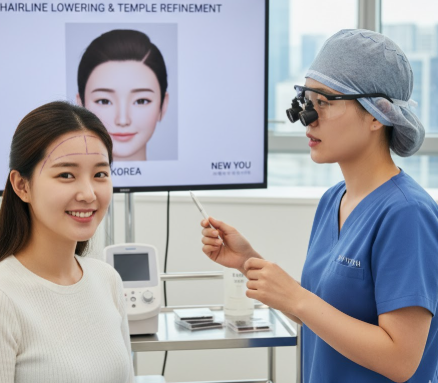
Treatment Overview
Hairline Lowering with Temple and Side-Hairline Refinement in Korea is an advanced cosmetic procedure designed to create a more proportionate, balanced, and aesthetically pleasing hairline. This combined approach not only lowers the central hairline but also addresses the temple and side areas to smoothen the hairline contour. Korean surgeons use micro-incision techniques, high-density hair grafting, and precise forehead advancement to achieve a natural, seamless result. This procedure is popular among medical tourists seeking a harmonious facial proportion and minimal visible scarring.
Purpose & Benefits
The primary purpose of this procedure is to reduce forehead height while refining the temples and side-hairline for a softer, natural-looking frame.
Key Benefits
- Lowers the forehead for improved facial proportion
- Refines temple and side-hairline for a rounded, feminine appearance
- Camouflaged incisions within the hairline
- Enhances overall facial symmetry and balance
- Boosts confidence and self-esteem
- Minimal downtime and rapid recovery
Ideal Candidates
Hairline Lowering with Temple and Side-Hairline Refinement in Korea is suitable for individuals with a high forehead, wide temples, or uneven side-hairline.
Best-Suited Candidates
- Men and women seeking a more balanced forehead and hairline
- Individuals with prominent temple recession or side-hairline gaps
- Patients with sufficient scalp elasticity and healthy hair follicles
- Those desiring natural, hidden-scar results
- People who want overall facial aesthetic improvement
Patients with prior forehead surgery or scarring may need a customized approach, which Korean surgeons are highly experienced in providing.
Possible Risks & Complications
While considered safe, this procedure carries potential risks typical of hairline surgery.
Potential Risks
- Swelling and mild tenderness in forehead and temples
- Temporary numbness in treated areas
- Mild scabbing along the incision lines
- Temporary shock hair shedding
- Slight asymmetry, usually correctable with minor touch-ups
- Rare thickening of scars
Korean clinics minimize risks using advanced micro-incision methods, tension-free sutures, and careful post-operative care.
Techniques & Technology Used
Korea is renowned for its cutting-edge hairline and temple refinement techniques, offering high precision and natural outcomes.
Main Techniques
- Micro-incision hairline lowering
- Temple and side-hairline contouring
- Multi-layered suturing to reduce tension and ensure smooth healing
- High-density graft placement to fill sparse areas
- Combined forehead advancement and micro-FUE grafting for scar concealment
Technology Highlights
- 3D facial mapping for accurate hairline and temple positioning
- Trichoscopy for donor hair assessment
- Microscopic surgical tools for precision incision and grafting
- Low-thermal surgical devices to protect tissue
- LED therapy to accelerate healing and reduce swelling
These advanced methods ensure a natural, smooth hairline that blends with the temple and side-hairline areas.
Treatment Process in Korea
Korean clinics provide a structured process for Hairline Lowering with Temple and Side-Hairline Refinement, ensuring safety and convenience for international patients.
Step-by-Step Procedure
- Consultation and facial analysis to assess hairline, temples, and side-hairline
- Customized hairline and temple design for facial harmony
- Local anesthesia or mild sedation for comfort
- Micro-incisions placed strategically within the hairline, temples, and sides
- Forehead advancement and temple adjustment to refine overall contour
- Micro-FUE grafting to fill sparse areas and camouflage incisions
- Post-operative care including LED therapy, cooling, and follow-up sessions
Korean clinics also provide translators, accommodation, and transport support for medical tourists.
Recovery & After-Care
Recovery is generally smooth due to minimally invasive techniques and meticulous surgical planning.
Recovery Timeline
- Days 1–3: mild swelling and tenderness
- 1 week: sutures removed and initial blending begins
- 2–3 weeks: most swelling resolves, early hair growth visible
- 3–6 months: hair growth fully camouflages incision lines
- 6–12 months: final refined hairline, temples, and sides
After-Care Tips
- Avoid pressure on forehead, temples, and side-hairline areas
- Follow prescribed medications and topical treatments
- Sleep with head elevated for first few nights
- Avoid smoking, alcohol, and heat styling during early recovery
- Attend all follow-ups for optimal results
Clinics may provide PRP therapy or hair-growth boosters to enhance healing and density.
Results & Longevity
Hairline Lowering with Temple and Side-Hairline Refinement in Korea provides permanent and natural-looking results.
Expected Outcomes
- Lower, balanced, and natural hairline
- Smooth temple and side-hairline contour
- Camouflaged incision lines for a seamless look
- Enhanced facial proportion and symmetry
- Long-lasting results that remain stable over time
With proper aftercare, results can last a lifetime, though natural aging may slightly affect hairline density.
Why Korea Is a Top Destination
Korea is a global leader in advanced hairline surgery due to its combination of surgical skill, technology, and medical tourism infrastructure.
Key Advantages
- Surgeons experienced in hairline, temple, and side-hairline refinement
- Advanced micro-incision and grafting techniques
- Natural, aesthetically pleasing outcomes
- Safe, accredited facilities with international standards
- Comprehensive support for international patients
- Post-operative care programs for optimal healing
These factors make Korea the preferred destination for complete hairline refinement procedures.
Cost Range in Korea
The cost of Hairline Lowering with Temple and Side-Hairline Refinement varies depending on the complexity and clinic reputation.
Estimated Cost
USD $5,000 – $10,000
This usually includes consultation, surgery, anesthesia, medication, and follow-up care. Packages for international patients often include hotel, transportation, and translation services.
Popular Clinics in Korea
- ID Hospital
- Banobagi Plastic Surgery
- Motion Clinic
- View Plastic Surgery
- Dr. For Hair Clinic
- The LINE Plastic Surgery
These clinics are recognized for natural hairline outcomes, temple and side-hairline refinement, and full support for medical tourists.


