
Treatment Overview
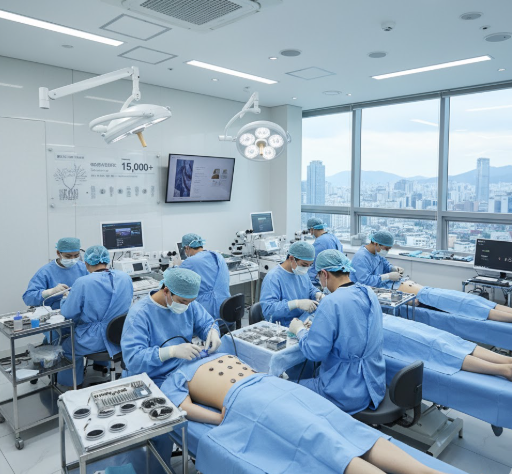
A High-Capacity Body Hair Transplant Session is a large-scale restoration procedure focused on harvesting high volumes of grafts from multiple body donor areas—such as the beard, chest, arms, legs, abdomen, or torso—to achieve maximum coverage and density.
This approach is ideal for patients who require 3,000–7,000+ grafts and cannot rely on scalp donor hair alone.
Korean surgeons are renowned for performing high-capacity sessions safely and efficiently, using advanced micro-FUE technology to maintain graft survival and ensure natural, blended scalp results.
Purpose & Benefits
The purpose of a high-capacity BHT session is to restore large balding areas using expanded donor sources.
Key benefits include:
- Provides thousands of additional grafts beyond scalp donor limits.
- Enables complete transformation for advanced hair loss (Norwood 5–7).
- Ideal for total crown coverage, mid-scalp density, and frontal reinforcement.
- Beard grafts give strong density; body grafts provide natural blending.
- Allows full restoration in fewer sessions compared to standard FUE.
- Excellent for patients with donor depletion or multiple failed transplants.
Ideal Candidates
You may be an ideal candidate if you:
- Have advanced hair loss requiring 3,000–7,000+ grafts.
- Have limited or depleted scalp donor hair.
- Need full-scalp reconstruction (front, mid-scalp, and crown).
- Want robust density in areas that scalp donor hair cannot cover alone.
- Have strong beard/body hair suitable for transplanting.
- Prefer a one-session or two-session mega restoration plan.
Possible Risks & Complications
High-capacity BHT is safe with expert surgeons but can involve:
- Temporary redness and scabbing in multiple donor areas.
- Slight texture differences among graft types.
- Longer procedure time due to multiple donor zones.
- Minor discomfort or tightness after large sessions.
- Slight risk of ingrown hairs, especially in chest or leg donors.
Techniques & Technology Used
- Multi-Donor Micro-FUE Extraction: Ultra-fine (0.6–1.0 mm) punches for minimal scarring.
- Density Allocation Strategy:
- Beard → deepest density zones (crown, mid-scalp)
- Chest/abdomen → medium density coverage
- Legs/arms → soft-texture blending
- Layered Implantation: Ensures natural transition across all scalp regions.
- Precision Graft Sorting: Categorizes follicles by thickness, length, and curl.
- High-Volume Workflow: Optimized team-assisted extraction and implantation.
- Optional PRP / Growth Factor Boost: Enhances recovery and graft survival.
Treatment Process in Korea
- Comprehensive Consultation: Full analysis of scalp and body donor reserves.
- High-Capacity Mapping & Design: Customized plan targeting maximum coverage.
- Multi-Zone Donor Preparation: Beard, chest, legs, and other donors trimmed as needed.
- Sequential Extraction: Performed in phases to avoid donor overuse.
- Graft Sorting & Hydration: Ensures optimal survival throughout the long session.
- Implantation Stage: High-density, natural-direction placement across thinning/bald zones.
- Post-Care Instructions: Specialist guidance for large-session healing.
Recovery & After-Care
- Body donor areas typically heal in 2–5 days.
- Scalp may show scabs for 5–7 days depending on density.
- Avoid intense exercise for one week.
- Temporary shedding of transplanted body hairs occurs within 3–6 weeks.
- New growth begins around 3–4 months.
- Full high-capacity results visible at 10–14 months.
Results & Longevity
- Dramatic improvement in overall density and coverage.
- Natural blending thanks to multi-donor integration.
- Permanent follicle growth once grafts adapt to scalp blood supply.
- Ideal for severe baldness or full-scalp reconstruction.
- Provides long-lasting, high-volume results that appear strong and natural.
Why Korea Is a Top Destination
- Korea leads in large-scale, multi-donor BHT with advanced micro-FUE techniques.
- Surgeons are highly trained in safe, efficient high-capacity extraction.
- Clinics use state-of-the-art equipment for extended sessions.
- Natural, artistic implantation ensures excellent aesthetic outcomes.
- More cost-effective than Western mega-session clinics.
- Highly popular among international patients requiring major restoration.
Cost Range
Pricing varies based on graft volume and donor zones involved:
- Medium high-capacity session (3,000–4,500 grafts): ₩8,000,000 – ₩12,000,000
- Large high-capacity session (4,500–6,000 grafts): ₩12,000,000 – ₩16,000,000
- Mega-session (6,000–7,500+ grafts): ₩16,000,000 – ₩22,000,000
Includes consultation, extraction, implantation, anesthesia, medication, and follow-ups.
Popular Clinics in Korea
- Dream Hairline Clinic (Seoul): Specialists in high-volume, multi-donor transplant cases.
- Moaman Hair Transplant Clinic (Seoul): Known for efficient, high-capacity FUE sessions.
- Woomchan Hair Transplant Clinic (Gangnam): Strong results in severe hair loss repair and mega-session BHT.


