
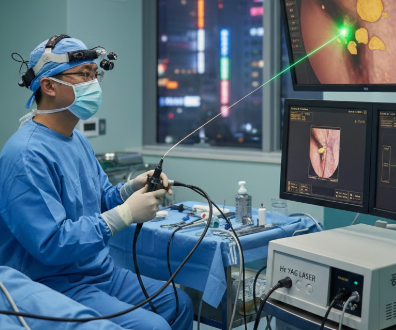
Treatment Overview
Holmium Laser Retrograde Intrarenal Surgery (RIRS) is a minimally invasive kidney stone removal procedure performed using a flexible ureteroscope and advanced Holmium:YAG laser technology. Unlike traditional surgical approaches, RIRS does not require cuts or incisions. Instead, the surgeon enters through the natural urinary pathway—the urethra, bladder, and ureter—to access the kidney and treat stones within the renal pelvis and calyces.
RIRS is one of the most preferred kidney stone treatments in Korea due to its high precision, safety profile, and suitability for a wide range of stone types and sizes. Korean hospitals use cutting-edge laser systems and high-definition scopes that allow precise stone fragmentation with minimal damage to surrounding tissues.
Purpose & Benefits
RIRS aims to safely remove kidney stones using an endoscopic approach that avoids open surgery. Medical tourists in Korea prefer this technique because of:
- No Incisions Required: The procedure is done entirely through the urinary tract.
- High Stone Clearance Rates: Especially effective for stones <2 cm but can treat larger stones depending on complexity.
- Safe for Hard Stones: Holmium laser can break even the densest stones, such as cystine or calcium oxalate.
- Reduced Pain & Faster Recovery: Patients usually return to daily activities within a few days.
- Lower Risk Compared to PCNL: Particularly beneficial for patients who cannot undergo percutaneous procedures.
- Greater Precision: Flexible scopes reach difficult upper-pole and mid-pole kidney stones.
- Minimal Blood Loss: The procedure is extremely gentle on the kidney tissue.
These advantages make RIRS a preferred option for international patients seeking effective and safe kidney stone treatment.
Ideal Candidates
Holmium Laser RIRS is ideal for:
- Patients with kidney stones 0.5–2.5 cm in size
- Individuals with stones located in difficult-to-access kidney regions
- Patients who failed ESWL (Shock Wave Lithotripsy)
- Those who require treatment for hard or multiple stones
- Adults with high surgical risk who need a minimally invasive approach
- People wanting a quick recovery, especially medical tourists
- Patients with narrowing in the ureter where rigid scopes cannot pass
- Children and elderly patients (RIRS is considered safe for both age groups)
However, RIRS may not be ideal for severe anatomical abnormalities or extremely large stones requiring PCNL.
Possible Risks & Complications
RIRS is a safe procedure when performed by experienced Korean urologists, but potential risks include:
- Temporary hematuria (blood in urine)
- Mild ureteral inflammation
- Urinary tract infection
- Stent discomfort (if a stent is placed)
- Rare risk of ureteral injury or stricture
- Fever or chills due to postoperative infection
Korean hospitals mitigate these risks using strict sterilization, advanced instrumentation, and real-time imaging.
Techniques & Technology Used
Korea is globally recognized for its advanced urological technologies. Holmium Laser RIRS typically uses:
- High-power Holmium:YAG Lasers (30W, 60W, or 120W systems)
- Flexible Digital Ureteroscopes (Olympus, Storz, Stryker)
- Ureteral Access Sheaths to allow smooth and safe entry
- Stone Dusting & Fragmentation Techniques using ultra-precise laser pulses
- Nitinol Stone Baskets for retrieval when necessary
- Irrigation Pressure Control Systems to protect kidneys
- Real-time Digital Imaging to visualize even tiny or hidden stones
Korean clinics regularly upgrade their devices to offer the latest laser capabilities, including Moses technology and high-frequency dusting modes.
Treatment Process in Korea
International patients appreciate Korea’s streamlined and well-structured medical system. The typical RIRS treatment process includes:
1. Pre-Consultation & Diagnostics
- CT scan or ultrasound to analyze stone size, location, and density
- Blood and urine tests to screen for infection and kidney function
2. Preoperative Preparation
- Discussion of anesthesia options
- Possible placement of a pre-stent if ureter access is tight
3. Day of Surgery
- Performed under general anesthesia
- A flexible ureteroscope is inserted through the urinary tract
- Laser fibers break the stone into dust or small fragments
- Basket retrieval is used if needed
- A temporary ureteral stent is often placed to promote healing
4. Recovery After Surgery
- Most patients go home the same day or after overnight observation
- Stent removal is usually scheduled 1–2 weeks later
5. Follow-up Appointment
- A final scan ensures all stones are cleared
- Dietary and lifestyle guidance is provided to prevent recurrence
Recovery & After-Care
Recovery after RIRS is generally fast and smooth, especially in Korea’s optimized hospital settings. Patients can expect:
- Mild discomfort during urination for a few days
- Light activity within 24–48 hours
- Drinking plenty of water to flush residual fragments
- Oral pain medication and antibiotics if prescribed
- Avoiding heavy exercise for about a week
- Possible temporary urinary urgency due to the stent
- Telemedicine follow-up options for medical tourists
Korean hospitals also provide multilingual support and easy stent-removal scheduling for international patients.
Results & Longevity
Holmium Laser RIRS delivers excellent and lasting results:
- High stone-free rates for most kidney stones
- Immediate relief from pain and urinary obstruction
- Minimal side effects and no visible scarring
- Reduced recurrence risk with proper lifestyle guidance
- Highly durable results, especially when combined with metabolic evaluation
Korea’s specialists also focus on long-term prevention through dietary counseling, urine analysis, and customized hydration plans.
Why Korea Is a Top Destination
Korea has become one of the world’s best destinations for RIRS because of:
- Top-tier urologists with advanced endoscopic training
- Latest high-tech laser and ureteroscope systems
- Superior safety standards and patient care
- Affordable treatment compared to Western countries
- Specialized kidney stone centers in major hospitals
- Excellent success rates even with complex stones
- Fast scheduling and minimal waiting periods
- English, Chinese, Arabic, and Russian assistance services
Medical tourists choose Korea for reliability, cost-effectiveness, and world-class surgical outcomes.
Cost Range
The cost of Holmium Laser RIRS in Korea typically ranges from:
- USD 3,000 – USD 7,500
(Varies depending on stone size, hospital grade, anesthesia, and stent use.)
This is significantly more affordable than prices in the US, Canada, or Europe, where RIRS can cost USD 10,000–20,000.
Popular Clinics in Korea
Korea has many reputable hospitals and clinics known for RIRS excellence:
- Seoul National University Hospital
- Asan Medical Center
- Severance Hospital (Yonsei University)
- Samsung Medical Center
- Korea University Anam Hospital
- Seoul Urology Clinic
- CHA Bundang Medical Center
- Wooridul Hospital
These centers offer advanced imaging, skilled surgeons, and dedicated teams for international patient care.


