
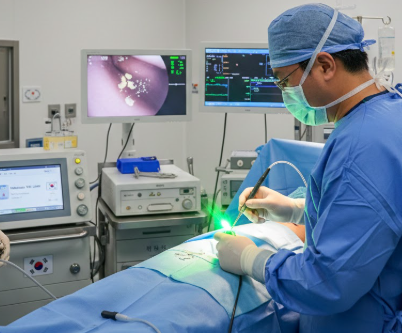
Treatment Overview
Holmium Laser Stone Clearance is a minimally invasive urological procedure designed to remove kidney and ureteral stones with high precision and safety. The technique uses a holmium:YAG laser to fragment stones into fine particles that can be flushed out naturally or removed endoscopically. It is widely used for stones of varying sizes and compositions, including hard and recurrent stones.
In Korea, holmium laser stone clearance is routinely performed in advanced urology centers using flexible ureteroscopy or retrograde intrarenal surgery (RIRS). Korean hospitals are equipped with modern laser platforms and high-definition endoscopic systems, allowing urologists to achieve excellent stone-free outcomes while minimizing trauma to the urinary tract.
Purpose & Benefits
The primary purpose of holmium laser stone clearance is to completely eliminate urinary stones while preserving kidney function and reducing postoperative discomfort. This approach allows precise targeting of stones under direct visualization.
Key benefits include high stone-free rates, minimal invasiveness, reduced bleeding, shorter hospital stays, faster recovery, and effectiveness across all stone types. The procedure minimizes the need for open surgery and repeat interventions, making it ideal for patients seeking reliable and efficient stone treatment in Korea.
Ideal Candidates
Ideal candidates for holmium laser stone clearance include patients with kidney or ureteral stones that require active removal. This includes individuals with moderate to large stones, hard stones resistant to shock wave lithotripsy, recurrent stone disease, or stones causing pain, infection, or obstruction.
Medical tourists who prefer minimally invasive treatment with predictable outcomes and short recovery periods are also suitable candidates. Final eligibility is confirmed after imaging studies and consultation with a Korean urology specialist.
Possible Risks & Complications
Holmium laser stone clearance is considered very safe when performed by experienced urologists. However, potential risks may include temporary blood in urine, mild postoperative pain, urinary tract infection, ureteral irritation, and discomfort related to ureteral stent placement.
Serious complications such as ureteral injury or significant bleeding are rare in Korean hospitals due to advanced technology and strict procedural protocols.
Techniques & Technology Used
Korean urology centers employ state-of-the-art technology to ensure effective stone clearance. This includes holmium:YAG laser systems with adjustable energy and frequency settings, digital flexible ureteroscopes, dusting and popcorning laser modes, pressure-controlled irrigation systems, and real-time fluoroscopic and endoscopic guidance.
These technologies allow precise stone fragmentation while protecting surrounding tissues and reducing operative time.
Treatment Process in Korea
The treatment process begins with a detailed preoperative evaluation, including CT imaging and laboratory tests. The procedure is usually performed under general or spinal anesthesia.
A flexible ureteroscope is inserted through the urinary tract to locate the stone. The holmium laser is used to fragment the stone into fine particles, which are either flushed out or removed endoscopically. A temporary ureteral stent may be placed if needed. Most patients are discharged on the same day or within one to two days.
International patient departments assist with appointment scheduling, translation, and follow-up coordination.
Recovery & After-Care
Recovery after holmium laser stone clearance is generally quick and uncomplicated. Patients may experience mild urinary discomfort or blood in urine for a short period.
After-care includes maintaining adequate hydration, taking prescribed medications, avoiding strenuous activity temporarily, and attending follow-up imaging to confirm stone clearance. If a stent is placed, it is usually removed within one to two weeks. Korean clinics often provide remote follow-up options for overseas patients.
Results & Longevity
Holmium laser stone clearance achieves high success and stone-free rates when performed by skilled urologists. The precise fragmentation and dusting techniques reduce the risk of residual fragments, leading to durable outcomes.
Long-term success depends on preventive measures such as dietary changes, hydration, and metabolic evaluation. Many Korean hospitals offer comprehensive stone prevention programs to reduce recurrence risk.
Why Korea Is a Top Destination
Korea is a leading destination for advanced kidney stone treatment due to its highly trained urologists, cutting-edge laser technology, high clinical success rates, transparent pricing, and well-developed medical tourism infrastructure.
Patients benefit from efficient care pathways, shorter waiting times, and excellent treatment quality at competitive costs.
Cost Range
The cost of holmium laser stone clearance in Korea typically ranges from USD 3,000 to USD 7,000. Costs vary based on stone size and complexity, hospital category, surgeon expertise, anesthesia requirements, and length of hospital stay.
This cost structure offers significant value compared to many Western healthcare systems.
Popular Clinics in Korea
Korea has many reputable facilities offering holmium laser stone clearance, including university-affiliated tertiary hospitals, specialized urology and stone centers, international patient-focused hospitals in Seoul and Gangnam, and multispecialty medical centers with advanced endourology units.
Patients should choose clinics based on surgeon experience, available technology, and international patient services.


