
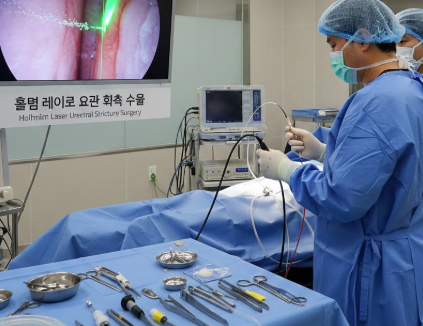
Treatment Overview
Holmium Laser Ureteral Stricture Surgery is a minimally invasive endoscopic procedure that uses a high-precision holmium:YAG laser to open blocked segments of the ureter. A ureteral stricture occurs when the ureter becomes narrowed due to inflammation, infection, stone disease, injury, or previous surgery. When a stricture obstructs urine flow from the kidney, it can lead to severe complications such as hydronephrosis, recurrent infections, flank pain, and progressive renal damage.
In Korea, this procedure is widely performed in advanced urology centers equipped with cutting-edge laser platforms, 3D ureteroscopy, and image-guided endourology systems. Korean hospitals are known for delivering highly effective outcomes with minimal tissue trauma, very short recovery times, and high patient satisfaction—making the country one of the top destinations for endoscopic stricture management.
Purpose & Benefits
Holmium Laser Ureteral Stricture Surgery aims to restore normal urine flow by precisely incising or vaporizing the scarred segment inside the ureter. Compared with traditional open or laparoscopic reconstruction, the holmium laser approach offers several benefits:
- Minimally invasive with no external incisions
- Reduced procedure time and quicker anesthesia recovery
- Lower risk of ureteral perforation due to the laser’s controlled penetration depth
- Ability to treat strictures in difficult anatomical locations
- Faster return to normal activities
- High success rate when used for short to medium-length strictures
- Often performed as a day-surgery or short inpatient stay
Because the holmium laser is highly effective at cutting fibrotic tissue while minimizing damage to surrounding structures, it is the preferred modality for endoscopic internal ureterotomy in Korea.
Ideal Candidates
Patients who benefit most from this procedure typically have:
- Short or moderate-length ureteral strictures
- Strictures caused by stones, infections, or instrumentation
- Congenital narrowings
- Recurrent flank pain due to obstructed urine flow
- Hydronephrosis detected through imaging
- Reduced kidney drainage on renal scans
- A history of prior ureteroscopy or abdominal surgery
- Strictures unsuitable for balloon dilation alone
It is also an excellent option for international patients seeking a safe, high-precision procedure with minimal downtime. However, extremely long strictures or those associated with severe tissue injury may require open or robotic reconstruction instead. Korean urologists perform comprehensive imaging and diagnostic evaluation before confirming candidacy.
Possible Risks & Complications
Although holmium laser ureteral stricture surgery is highly safe, it does carry some potential risks:
- Bleeding inside the ureter
- Temporary pain or discomfort during urination
- Ureteral perforation (rare due to laser precision)
- Recurrence of stricture in some cases
- Infection
- Need for temporary stent placement
- Scar tissue reformation requiring follow-up treatment
Korea’s urology departments maintain exceptionally low complication rates due to extensive surgeon experience, real-time imaging, and high-precision laser technology.
Techniques & Technology Used
Korean hospitals employ advanced techniques such as:
- Holmium:YAG laser internal ureterotomy
- Fiber-optic flexible and semi-rigid ureteroscopy
- High-definition endoscopic visualization
- Image-guided laser incision or vaporization
- Minimal-thermal damage laser modulation
- Intraoperative ureteral stent placement
The holmium laser is considered the gold standard because of its ability to deliver energy accurately to fibrotic tissue at shallow depth, preventing unintended injury. Korean centers often use modern systems such as the Moses Holmium Laser Platform, which provides improved precision, greater energy efficiency, and enhanced procedural safety.
Treatment Process in Korea
International patients undergo a streamlined and efficient care pathway:
- Initial Consultation and Evaluation
A urologist reviews history, symptoms, and prior medical imaging. CT scan, ultrasound, urography, or renal function tests may be performed. - Diagnostic Ureteroscopy
A small endoscope is inserted through the urethra to evaluate the stricture directly. - Laser Incision or Vaporization
Using the holmium laser, the surgeon precisely cuts or ablates the stricture tissue to widen the blocked area. - Stent Placement
A temporary ureteral stent is placed to maintain patency and promote proper healing. - Post-operative Observation
Patients usually recover quickly and may be discharged within 24 hours. - Follow-up and Stent Removal
Stents are typically removed after 2–4 weeks, depending on healing progress.
Korean medical institutions provide full international patient support, including translation services, transportation, and appointment coordination.
Recovery & After-Care
Recovery after holmium laser ureteral stricture surgery is relatively fast. Patients may return to normal activities within a few days, although strenuous exercise should be avoided until the stent is removed. Typical post-operative expectations include:
- Mild urinary frequency or discomfort
- Temporary hematuria (light blood in urine)
- Adequate hydration to promote healing
- Avoiding heavy lifting for 1–2 weeks
- Taking prescribed antibiotics or pain relievers
- Scheduled imaging to confirm restored urine flow
Korea’s follow-up protocols are strict and efficient. Remote consultations are often available for international patients after returning home.
Results & Longevity
Holmium laser ureteral stricture surgery has high success rates, particularly for short, benign strictures. In Korea, long-term outcomes are excellent due to advanced imaging systems, precision laser control, and surgeon expertise. Many patients experience:
- Immediate improvement in urine drainage
- Relief from flank pain
- Reduced infection risk
- Preservation of kidney function
- Long-lasting ureteral patency
However, recurrence is possible, especially in complex strictures. If recurrence occurs, Korea offers advanced secondary options such as repeat laser ureterotomy, balloon dilation, or robotic ureteral reconstruction.
Why Korea Is a Top Destination
Korea ranks among the leading global destinations for endourological treatments due to:
- State-of-the-art holmium laser systems
- Highly specialized urologists with extensive procedural volume
- Internationally accredited hospitals
- Seamless medical tourist support services
- Advanced postoperative monitoring systems
- Transparent cost structures
- Extremely low complication rates
Medical tourists consistently choose Korea for procedures requiring precision, minimal invasiveness, and rapid recovery.
Cost Range
The cost of Holmium Laser Ureteral Stricture Surgery in Korea typically ranges from:
USD 3,000 – 9,000
depending on the hospital grade, surgeon expertise, diagnostic tests, and whether inpatient admission is required. Premium international hospitals may charge slightly more, but the cost remains highly competitive compared with Western countries.
Popular Clinics in Korea
- Asan Medical Center Urology Department
- Seoul National University Hospital (SNUH)
- Samsung Medical Center
- Severance Hospital (Yonsei University Health System)
- Korea University Ansan Hospital
- Wooridul Urology Clinic
- Gangnam Severance International Clinic
- Eulji University Hospital
These centers are known for advanced endoscopic urology, high safety standards, and excellent outcomes for ureteral stricture management.


