
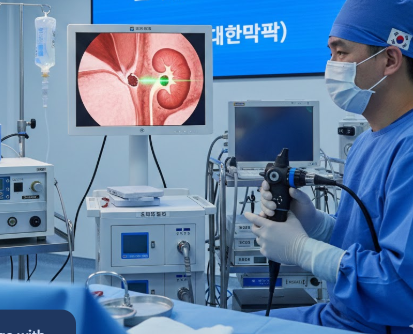
Treatment Overview
Holmium:YAG (Ho:YAG) Laser Stone Removal is one of the most advanced and effective treatments for urinary stones, including kidney stones, ureter stones, and bladder stones. Korea has become a global leader in minimally invasive urology, making this procedure highly sought-after by international patients.
This laser-based method uses high-energy holmium laser pulses to fragment stones into fine dust, allowing doctors to remove or flush them out with minimal trauma. Because the laser is precise and safe, it can treat stones of almost any size, shape, or hardness.
In Korea, the procedure is commonly performed through ureteroscopy or retrograde intrarenal surgery (RIRS), ensuring a scarless, fast-recovery experience for medical tourists.
Purpose & Benefits
The primary purpose of Ho:YAG Laser Stone Removal is to break stones into tiny particles that can be easily removed or naturally passed. Compared to traditional surgery, this technique offers significant advantages, especially for international patients seeking fast, reliable medical care.
Key Benefits:
- Highly effective for all stone types (including hard calcium oxalate stones)
- Minimally invasive with no external incision
- Extremely precise, reducing damage to surrounding tissues
- Short procedure time and fast recovery
- Lower complication rate compared to older techniques
- Useful when other stone treatments fail
- Safe for patients who cannot undergo shockwave therapy
- Allows treatment of multiple stones in one session
Overall, the Ho:YAG laser offers a high success rate and maximum comfort, making it one of the most preferred stone treatment methods globally.
Ideal Candidates
This treatment is suitable for a wide range of patients. Korean urologists commonly recommend Ho:YAG laser removal for:
- Patients with kidney, ureter, or bladder stones
- Those experiencing severe pain, fever, or obstruction
- Patients with stones resistant to medications or shockwave therapy (ESWL)
- People with recurrent stones
- Patients with stones larger than 6–7 mm
- Individuals who want a quick and minimally invasive procedure
- Those requiring precise treatment due to complex anatomy
- International patients seeking safe, same-day surgery options
It is also suitable for patients with medical conditions like obesity, bleeding disorders, or anatomical restrictions where other procedures are not recommended.
Possible Risks & Complications
Although Ho:YAG laser surgery is considered safe, it still carries some risks, like any medical procedure. However, Korean hospitals maintain extremely high safety standards, minimizing complications.
Potential risks include:
- Mild bleeding
- Temporary pain or burning sensation during urination
- Small ureteral injury
- Ureteral stricture (rare)
- Infection or fever
- Need for a temporary stent placement
- Stone fragments remaining, requiring additional treatment
Most side effects are mild and resolve quickly under the supervision of Korean urologists.
Techniques & Technology Used
Korea invests heavily in cutting-edge urological technology, making the procedure highly advanced and efficient.
Technologies commonly used:
- Holmium:YAG Laser Systems (20W–120W): Fragment stones into dust (“dusting mode”).
- Flexible & Rigid Ureteroscopes: Provide high-resolution visualization inside the urinary tract.
- RIRS (Retrograde Intrarenal Surgery): Ideal for stones deep inside the kidney.
- Digital Video Ureteroscopes: Improve accuracy during stone targeting.
- High-definition camera systems: Ensure safety and precision.
- Ureteral access sheaths: Reduce trauma and protect the ureter during the procedure.
- Stone baskets & retrieval devices: Remove larger stone fragments safely.
Korean hospitals are known for using the latest models from global brands like Olympus, Karl Storz, and Stryker.
Treatment Process in Korea
Medical tourists coming to Korea can expect a smooth, well-organized treatment journey. Here’s a typical step-by-step process:
1. Consultation & Imaging
You will undergo tests such as CT scan, KUB X-ray, or ultrasound to determine stone size and location.
2. Pre-Procedure Evaluation
Doctors review your medical history and check kidney function, urine culture, and blood tests.
3. Anesthesia
The procedure is performed under general or spinal anesthesia for comfort.
4. Laser Stone Removal
- A ureteroscope is inserted through the natural urinary pathway.
- The Ho:YAG laser is used to break the stone into tiny particles.
- Stone fragments are either extracted or left to pass naturally.
5. Stent Placement
A temporary stent (DJ stent) may be inserted to reduce swelling and ensure urine flow.
6. Discharge
Most patients can leave the hospital the same day or next morning.
7. Follow-Up
Stent removal usually happens after 1–2 weeks.
International patients can often complete follow-up within their travel schedule.
Korean clinics support foreign patients with translation services, airport pickups, and personalized care plans.
Recovery & After-Care
The recovery period after Ho:YAG laser stone removal in Korea is typically very fast. Most patients return to normal activities within 24–48 hours.
Recovery tips:
- Drink 2–3 liters of water daily
- Take prescribed painkillers or antibiotics
- Avoid heavy exercise for a few days
- Attend stent removal appointment if applicable
- Monitor for fever or severe pain
Mild discomfort, urinary frequency, or blood in urine is common for a short time. Korean urologists ensure close monitoring to avoid complications, especially for international travelers.
Results & Longevity
Ho:YAG laser treatment provides immediate results by removing stones during the procedure. Success rates in Korea are among the highest in the world—often above 90–95%.
Long-term expectations:
- Complete stone clearance
- Low recurrence rate with proper lifestyle changes
- Improved kidney function if obstruction was present
- Better overall urinary health
Korean clinics also provide dietary counseling and metabolic evaluations to prevent future stone formation.
Why Korea Is a Top Destination
South Korea is globally recognized for excellence in minimally invasive surgery and advanced urology. Medical tourists choose Korea because of:
- World-class laser and endoscopic technology
- Highly trained urologists with international certifications
- Transparent pricing and high treatment success rates
- Fast scheduling without long waiting lists
- English-speaking coordinators and tourist-friendly support
- Top-tier infection control and patient safety
These factors make Korea one of the best destinations for safe and reliable Ho:YAG laser stone treatment.
Cost Range
Compared to Western countries, Korea offers advanced laser stone removal at a more affordable cost.
Typical price range:
- Ho:YAG Laser Stone Removal: USD $2,500 – $6,000
(Cost varies by stone size, hospital grade, and anesthesia.)
Additional costs may include:
- CT scans
- Laboratory tests
- Stent placement and removal
Still, Korea remains cost-effective compared to the US, Australia, or the Middle East.
Popular Clinics in Korea
Here are some well-known urology centers frequently chosen by medical tourists:
- Seoul National University Hospital (SNUH)
- Asan Medical Center
- Samsung Medical Center
- Severance Hospital (Yonsei University)
- Wooridul Urology Clinic
- Sejong Urology Clinic
- Seoul Urology Clinic (SU Clinic)
- Bumin Hospital Urology Center


