
Treatment Overview
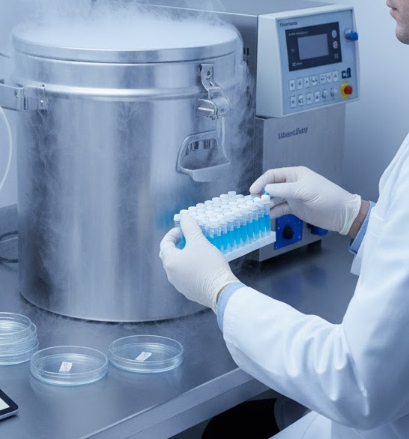
A Hybrid Sperm Freeze Protocol is an approach to sperm cryopreservation that blends aspects of controlled-rate freezing and ultra-rapid or vitrification techniques, aiming to capture the benefits of both methods. In essence, the protocol may employ an initial controlled cooling phase to moderate dehydration and prevent ice formation, followed by a rapid plunge or vitrification step to complete the transition to cryogenic temperatures. The hybrid approach seeks to reduce cryodamage, preserve motility and viability, and maximize post-thaw performance.
In Korea, fertility and reproductive medicine clinics using hybrid sperm freezing adapt the protocol for the specific characteristics of each semen sample. After baseline assessment (motility, concentration, morphology, DNA integrity), a hybrid protocol is tailored—perhaps slower cooling for the initial range (e.g. from ambient to –80 °C) and then faster vitrification into liquid nitrogen. Sperm is then stored in high-integrity cryobanks, monitored rigorously, and later thawed under carefully matched warming curves.
This kind of hybrid protocol is especially useful when dealing with samples of intermediate quality—neither robust enough to survive extreme cooling unscathed, nor fragile enough to require purely slow freezing. It aims to balance safety and speed.
Rationale & Benefits
By combining controlled-rate and rapid freezing elements, the hybrid protocol seeks to optimize the trade-offs:
- Better control of dehydration: The controlled cooling phase allows water to gradually exit the cell, reducing the chance of intracellular ice formation.
- Reduced ice crystallization risk in final stages: The rapid freeze component limits the time window in which ice nucleation could occur.
- Enhanced post-thaw motility and viability: Hybrid protocols may preserve more motile sperm than conventional controlled-rate only, especially in samples of intermediate quality.
- Adaptability: The protocol can be tuned to the sample’s response—aggressive cooling if the sample is resilient, gentler transitions if fragile.
- Time efficiency: It avoids extended freezing schedules by truncating the final cooling steps using rapid methods.
- Better preservation of structural integrity: Balancing osmotic stress and thermal gradients reduces membrane rupture or sublethal injury.
In sum, hybrid sperm freezing is intended to provide a “best of both worlds” option—improving survival without excessive procedural time.
Ideal Candidates & Use Cases
Hybrid sperm freeze protocols are particularly beneficial in scenarios such as:
- Samples with moderate motility and morphology, where pure vitrification might stress cells, but standard slow freezing might yield too much loss.
- Men whose sperm quality is declining—so each specimen must be maximally preserved.
- Donor sperm banks wishing to maximize yield from each donor sample.
- Clinical settings where multiple samples are frozen and uniform protocols are desirable, but sample heterogeneity exists.
- Clients anticipating future use in ICSI or IVF and demanding high motile recovery.
While pure vitrification or pure controlled-rate may suffice for extreme cases, the hybrid method offers flexibility and improved outcomes in many real-world situations.
Laboratory & Technical Protocol Structure
A hybrid sperm freezing protocol involves several carefully orchestrated steps:
1. Semen Assessment & Preprocessing
- Semen is collected under sterile conditions.
- Baseline analysis includes concentration, motility, morphology, and DNA fragmentation or oxidative stress markers if available.
- The sample is processed (density gradient, swim-up, or microfluidic sorting) to enrich motile sperm.
2. Cryoprotectant Addition & Equilibration
- A cryoprotectant medium (often combining permeating agents like glycerol or DMSO, along with non-permeating agents such as sucrose or trehalose) is introduced.
- Equilibration is performed in a stepwise gradient to ease osmotic transitions.
3. Controlled Cooling Phase
- The sample is cooled from ambient to an intermediate subzero temperature (e.g. –70 to –80 °C) at a controlled, moderate rate (e.g. a few degrees per minute).
- Hold or seeding steps may be included to initiate extracellular ice formation in a managed way.
4. Rapid Plunge / Vitrification Phase
- Once the sample reaches the intermediate temperature, the protocol switches to a rapid cooling or vitrification step—plunging into liquid nitrogen or vapor phase—locking in the state before further slow cooling could cause damage.
- The rapid phase reduces the window in which damaging ice nucleation or recrystallization may occur.
5. Cryogenic Storage
- The frozen sperm samples are stored in cryotanks under –196 °C, with redundant systems, environmental monitoring, backup nitrogen supply, and alarm systems, ensuring that storage remains stable.
6. Thawing / Warming Protocol
- Warming must mirror the hybrid nature: a controlled warming phase into moderate temperatures, then a rapid rehydration / dilution phase.
- Timed de-cryoprotectant removal and stabilization steps are critical to minimize osmotic shock.
7. Post-thaw Assessment
- After thawing, sperm are assessed for motility, viability, morphology, and DNA or viability markers.
- Motile sperm are selected and used in ART (ICSI, IVF).
8. Quality Control & Validation
- The hybrid protocol should be validated through pilot runs and quality benchmarking.
- Periodic audits, calibration of cooling equipment, and cryobank maintenance ensure repeatability and reliability.
Challenges & Limitations
Although promising, hybrid cooling protocols come with trade-offs and challenges:
- Need for precise equipment and calibration: Switching from controlled-rate to rapid cooling demands accurate, validated systems.
- Protocol sensitivity: Small errors in timing or rate transitions can negate the benefit or cause harm.
- Cost and training: More complex protocols require trained personnel and higher lab investment.
- Not always superior: For extremely robust sperm, hybrid methods may not outperform simpler protocols.
- Warming must match freezing: The warming curve must be carefully designed to match the hybrid freeze; mismatch may cause damage.
- Limited data in some settings: While hybrid protocols are promising, long-term comparative outcomes are still emerging in many clinical settings.
Clinics must weigh the incremental gain vs complexity when offering hybrid protocols.
Expected Outcomes & Longevity
When properly executed, hybrid sperm freezing can yield post-thaw motile recovery rates that outperform conventional freezing in borderline samples, sometimes restoring a higher percentage of usable motile sperm. Fertilization success in ART (especially ICSI) using such sperm often approximates that seen with fresh or vitrified sperm under favorable conditions.
If stored under stable cryogenic conditions, hybrid-frozen sperm can retain viability for many years—typically a decade or more—since sperm metabolic activity is halted at extreme cold. The hybrid approach mainly influences post-thaw quality rather than long-term viability.
Leading Clinics in Korea
Some Korean fertility and reproductive medicine centers known for advanced male fertility services and cryopreservation may offer or be able to support hybrid sperm freezing protocols:
- CHA Fertility Center — As a prominent fertility network with strong andrology and cryobank infrastructure, CHA is well positioned to innovate hybrid protocols.
- Hamchoon Women’s Clinic — Known for comprehensive fertility and genetic services, Hamchoon’s labs may support advanced freezing methods.
- MizMedi Women’s Hospital — A fertility-specialist hospital with male fertility and cryobanking services.
- University-affiliated reproductive medicine departments — Major university hospitals in Seoul or other regions often maintain research-level andrology labs.
- High-end private fertility clinics — Some boutique fertility clinics in Seoul or Gangnam invest in cutting-edge cryobiology and are likely to adopt hybrid protocols.


