
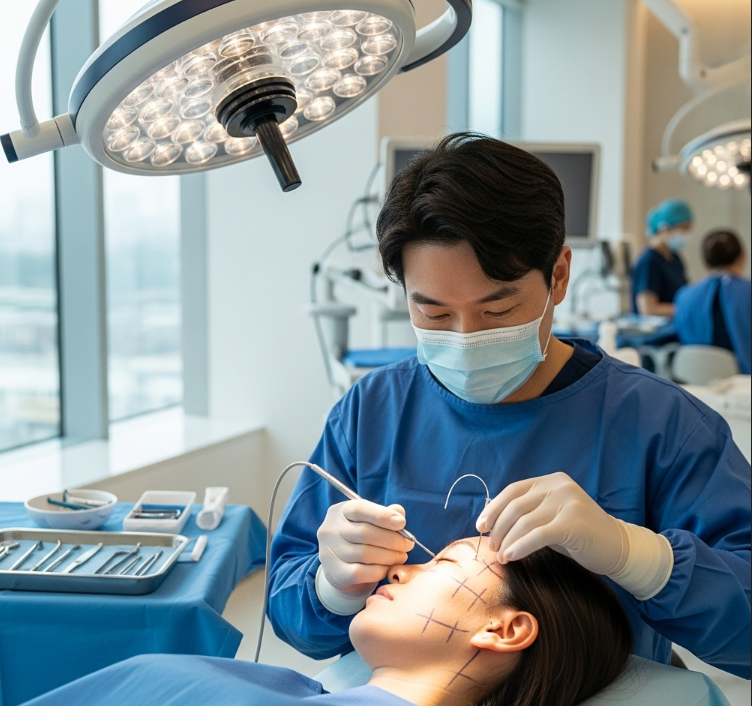
Treatment Overview
The Interdomal Suture is a precise rhinoplasty technique used to stabilize and refine the nasal tip. By placing sutures between the two domes of the lower lateral cartilages, this method helps improve symmetry, reduce tip bulbosity, and enhance definition.
Korean surgeons are highly skilled in cartilage-preserving suture methods such as Interdomal Suturing, offering patients a more balanced and naturally refined nasal tip without aggressive cartilage removal.
Purpose & Benefits
- Improves nasal tip definition and refinement
- Provides greater tip stability
- Corrects tip asymmetry
- Enhances projection and contour
- Preserves cartilage structure while reshaping the nose
- Works well in both primary and revision rhinoplasty
Ideal Candidates
- Patients with asymmetric or bulbous nasal tips
- Those seeking more tip definition without major cartilage removal
- Individuals with weakened nasal tips needing reinforcement
- Patients undergoing tip reconstruction or revision surgery
Possible Risks & Complications
- Temporary swelling and mild bruising
- Rare chance of over-tightening or asymmetry
- Possible loosening of sutures over time
- Minor risk of requiring additional support grafting in revision cases
Surgical Techniques Used
- Interdomal Suturing – sutures placed between the domes of the lower lateral cartilages to unify and stabilize the tip.
- Often combined with:
- Dome Binding Sutures for tip narrowing
- Columella Strut Graft for structural support
- Cephalic Trim for further refinement
- Typically performed via open rhinoplasty for precision, though closed approach may be used for simpler cases.
Recovery & Aftercare
- Downtime: 5–7 days for swelling reduction
- Stitch Removal: Within 5–7 days post-op
- Healing Time: Initial results appear in 2–3 weeks; final definition in 6–12 months
- Aftercare: Avoid nasal pressure, follow clinic instructions, attend scheduled checkups
Results & Longevity
- Creates a refined, symmetric, and stable nasal tip
- Enhances long-term nasal balance and shape
- Results are durable and natural-looking due to cartilage preservation
Treatment Process in Korea
Korean clinics ensure a personalized and precise approach for Interdomal Suture surgery:
- Pre-Consultation – Online/in-person photo review and medical evaluation
- Detailed Consultation – 3D simulation to design tip refinement plan
- Surgical Planning – Decision on whether to combine with dome binding or grafting
- Pre-Surgery Checkup – Health screening and anesthesia preparation
- Surgery (1–2 hours) – Interdomal Suture performed under local anesthesia with sedation or general anesthesia
- Immediate Recovery – Splint or taping applied for protection
- Follow-Up – Suture removal and monitoring of healing progress
- Final Results – Natural refinement visible within weeks, with full results in months
Cost Range in Korea
The cost of Interdomal Suture rhinoplasty depends on case complexity and whether combined with other techniques:
- Basic Interdomal Suture (Simple Refinement):
₩3,000,000 – ₩4,500,000 KRW ($2,300 – $3,500 USD) - Interdomal Suture + Tip Support Graft:
₩4,500,000 – ₩7,000,000 KRW ($3,500 – $5,400 USD) - Complex/Revision with Multiple Techniques:
₩7,000,000 – ₩10,000,000 KRW ($5,400 – $7,700 USD)
💡 Average Package for International Patients:
₩4,500,000 – ₩7,500,000 KRW ($3,500 – $5,800 USD), often includes translation, airport pickup, and accommodation support.
Popular Clinics for Interdomal Suture in Korea
- ID Hospital (Seoul, Gangnam) – highly specialized in tip reshaping techniques
- Banobagi Plastic Surgery – popular for natural refinement results
- View Plastic Surgery – advanced 3D planning for tip correction
- JW Plastic Surgery – strong focus on structural tip rhinoplasty and revisions
- April31 Plastic Surgery – recognized for elegant tip aesthetics
- DA Plastic Surgery – experienced with foreign patients and comprehensive care


