
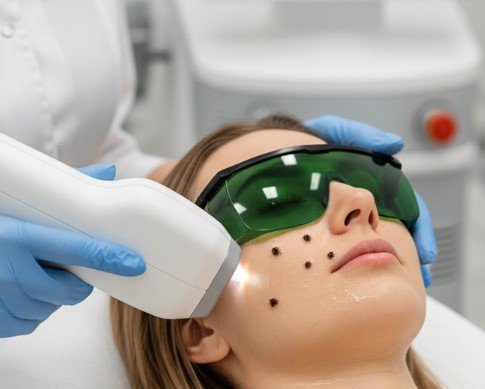
Treatment Overview
IPL Photofacial (Intense Pulsed Light) is a non-laser, light-based skin treatment widely offered in Korean dermatology clinics for sunspots, freckles, age spots, and diffuse pigmentation caused by UV damage.
Unlike a laser, which uses a single wavelength, IPL emits a broad spectrum of light (500–1200 nm) with filters to target melanin (pigment) in sunspots as well as hemoglobin (redness) in small vessels. This makes it an excellent option for patients with multiple sunspots or generalized photodamage across the face, hands, or décolleté.
Purpose & Benefits
- Sunspot Removal: Breaks down melanin clusters in solar lentigines and freckles.
- Skin Brightening: Evens skin tone and restores clarity.
- Dual Action: Improves both pigmentation and redness from sun damage.
- Non-Invasive: Minimal discomfort and no downtime.
- Comprehensive Photorejuvenation: Enhances overall skin texture and glow.
Ideal Candidates
IPL Photofacial in Korea is recommended for:
- Adults with multiple sunspots, freckles, or age spots caused by UV exposure.
- Patients with generalized sun damage and uneven tone.
- Individuals seeking a gentle, non-ablative option for pigment clearance.
- Those who want full-face or large-area brightening rather than isolated spot treatment.
Possible Risks & Complications
IPL is safe when performed under Korean dermatology protocols, but mild side effects may occur:
- Redness or Warmth: Temporary, fades in hours.
- Darkening of Spots: Pigmented lesions may darken before flaking off.
- Mild Swelling: Usually resolves within 1–2 days.
- Rare Risks: PIH rebound, blistering, or scarring if overly aggressive settings are used (minimized in Korea with low-fluence protocols).
Surgical Techniques Used
- Broad-Spectrum IPL (500–1200 nm): Filters chosen based on pigmentation depth.
- Multi-Pass Method: Gentle, repeated passes to clear pigment gradually.
- Combination Therapy: Often paired with lasers (Alexandrite, Pico) for stubborn spots.
Protocol: Typically 3–5 sessions, spaced 3–4 weeks apart.
Recovery & Aftercare
Immediately: Mild redness or warmth.
3–5 Days: Sunspots darken and form tiny scabs.
1–2 Weeks: Scabs fall off, revealing clearer skin.
Aftercare Tips:
- Use SPF 50+ sunscreen daily.
- Avoid hot baths, saunas, or strenuous workouts for 2–3 days.
- Keep skin hydrated with barrier creams.
- Do not pick at darkened spots.
Results & Longevity
- After 1 Session: Brighter skin, mild fading of sunspots.
- After 2–3 Sessions: Noticeable clearance of freckles and lentigines.
- After 4–5 Sessions: Significant reduction in pigmentation, even skin tone.
- Long-Term: Results last months to years; maintenance every 6–12 months recommended.
Treatment Process in Korea
Consultation & Skin Analysis
- Dermatologist evaluates type and depth of pigmentation.
- IPL chosen if multiple superficial sunspots are present.
Preparation
- Gentle cleansing and application of cooling gel.
- Protective eyewear provided.
IPL Session
- Step 1: Light pulses delivered across treatment area.
- Step 2: Filter adjusted for pigment vs redness targets.
- Step 3: Cooling mask or serum applied.
- Duration: 20–30 minutes.
Post-Treatment Care
- Sunscreen and hydrating creams applied.
- Patients resume daily life immediately.
Follow-Up
- 3–5 sessions for best results.
- Often combined with Alexandrite or Pico lasers for stubborn pigmentation.
Unique Korean Advantages
- Customized Filters: Korean clinics optimize IPL wavelengths for Asian skin.
- Combination Packages: IPL often paired with whitening drips or pigment lasers.
- Safe Low-Fluence Protocols: Reduce PIH rebound risk.
- Affordable Multi-Session Programs: More cost-effective compared to Western countries.
Cost Range (Estimated)
- Small Area (per session): USD 100 – 150
- Full Face (per session): USD 150 – 300
- 3–5 Session Package: USD 500 – 1,200
Additional Costs:
- Consultation: USD 20 – 50
- Add-ons (Glutathione drips, Vitamin C/TXA serums): USD 100 – 200
- Boosters (PRP, Rejuran, exosomes): USD 200 – 500
Example Korean Packages:
- Basic IPL Photofacial (3 sessions): USD 500–600
- Advanced Sunspot Program (IPL + Whitening Drips): USD 900–1,200
- Premium Package (IPL + Pico/Alexandrite + Boosters): USD 1,500–2,200
Popular Clinics in Seoul
- Oracle Dermatology: IPL + Nd:YAG for sunspots and freckles.
- Banobagi Dermatology: IPL + Pico for diffuse pigmentation.
- Renewme Skin Clinic: IPL Photofacial with brightening drips.
- View Plastic & Dermatology: IPL + Alexandrite for pigment correction.
- Chaum Anti-Aging Center: Premium IPL with regenerative boosters.


