
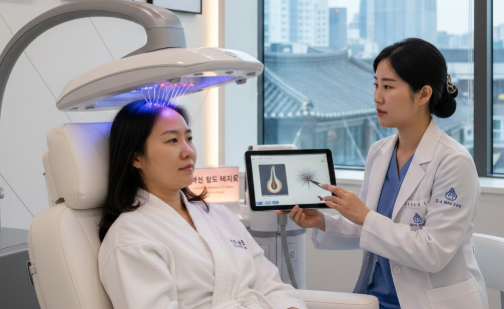
Treatment Overview
Laser therapy for female pattern thinning is a non-invasive hair restoration treatment that uses low-level laser therapy (LLLT) to stimulate hair follicles affected by diffuse thinning and androgenetic alopecia in women. Red and near-infrared laser wavelengths penetrate the scalp to increase cellular energy, enhance blood circulation, and activate dormant follicles.
In Korea, this treatment is widely used in dermatology and hair clinics to provide safe, effective, and painless hair regrowth solutions for women. Clinics utilize KFDA-approved lasers to ensure consistent results and patient safety.
Purpose & Benefits
The main purpose of laser therapy for female pattern thinning is to strengthen hair follicles, increase hair density, and slow further hair loss. Benefits include:
- Stimulates miniaturized and weakened follicles
- Improves scalp blood flow and nutrient delivery
- Enhances hair thickness and density
- Reduces shedding and slows progression of thinning
- Non-invasive, painless, and safe for long-term use
- Can be combined with other therapies like PRP, growth factor injections, or mesotherapy
- Improves overall scalp health and follicle vitality
Ideal Candidates
This therapy is ideal for:
- Women experiencing diffuse thinning or early-to-moderate androgenetic alopecia
- Individuals with weakened or miniaturized hair follicles
- Patients seeking non-surgical hair restoration
- Those wanting a safe, low-risk, and painless treatment
- Medical tourists looking for evidence-based hair regrowth solutions in Korea
It is less effective for patients with extensive bald areas or fully inactive follicles.
Possible Risks & Complications
Laser therapy for female pattern thinning is extremely safe with minimal risks. Possible side effects include:
- Mild warmth or tingling during sessions
- Temporary hair shedding as follicles reset their growth cycles
- Rare scalp sensitivity or irritation
Korean clinics conduct detailed scalp assessments to ensure suitability and safety.
Techniques & Technology Used
Korean clinics use advanced laser systems for female hair thinning treatment:
- Low-Level Laser Therapy (LLLT) using red light (630–650 nm) and near-infrared light (808–830 nm)
- Helmet or panel-type devices for uniform scalp coverage
- High-density diode lasers to stimulate all affected areas
- KFDA-approved devices with consistent energy output
- Scalp imaging tools to monitor follicle health and progress
This technology ensures optimal stimulation and improved hair regrowth outcomes.
Treatment Process in Korea
The procedure is structured, efficient, and patient-friendly:
- Consultation & Scalp Assessment
Dermatologists evaluate hair density, follicle health, and scalp condition using trichoscopy and high-definition imaging. - Preparation
The scalp is cleansed to remove oils and debris. - Laser Session
LLLT is applied for 15–25 minutes. Sessions are painless, and patients may feel mild warmth. - Optional Combination Treatments
Clinics may combine laser therapy with PRP, growth factor injections, or mesotherapy for enhanced results. - Post-Treatment Care
Minimal care is required, and patients can resume daily activities immediately. - Follow-Up Plan
Treatments are typically scheduled 2–3 times per week depending on hair loss severity.
Recovery & After-Care
Recovery is minimal with no downtime. Recommended after-care includes:
- Avoiding harsh shampoos or chemical hair treatments for 24–48 hours
- Using clinic-recommended scalp tonics or serums
- Staying hydrated and maintaining a healthy diet
- Regular follow-up sessions for optimal results
- Protecting the scalp from excessive sun exposure
Results & Longevity
Most patients notice improvements in hair thickness, density, and reduced shedding within 8–12 weeks. Full results are usually visible after 3–6 months. Expected outcomes include:
- Stronger, thicker hair strands
- Increased follicle activity and improved scalp health
- Reduced hair shedding and slowed thinning progression
- Long-term maintenance is achieved with periodic booster sessions
Why Korea Is a Top Destination
Korea is globally recognized for excellence in hair restoration and dermatology. Key advantages for medical tourists include:
- Highly skilled dermatologists specializing in female hair thinning
- KFDA-approved LLLT devices with advanced technology
- Combination therapy options for enhanced results
- Modern, clean clinics with international patient support
- Affordable pricing compared to Western countries
- Evidence-based protocols with consistently high success rates
Patients benefit from Korea’s reputation for safety, innovation, and professional hair restoration services.
Cost Range
Costs vary depending on clinic reputation, device type, and number of sessions:
- Per session: USD $30 – $80
- 10-session package: USD $250 – $600
- 20-session package: USD $450 – $1,000
Combination therapies (PRP, growth factors, mesotherapy) may increase costs.
Popular Clinics in Korea
Top clinics for female pattern thinning laser therapy include:
- Banobagi Hair Restoration Center
- CNP Dermatology
- Oracle Dermatology Clinic
- Wonjin Dermatology Clinic
- ID Hospital Hair Clinic
- ME Clinic Seoul
- Root Hair Clinic Gangnam
- Hair2U Dermatology
These clinics offer English consultation, personalized treatment plans, and professional follow-up for international patients.


