
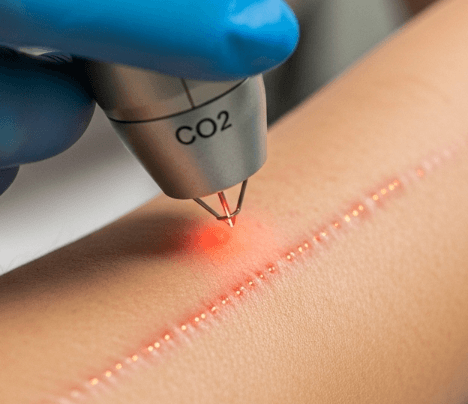
Treatment Overview
Laser Scar Therapy CO₂ is a fractional ablative CO₂ laser treatment widely offered in Korean dermatology clinics for the improvement of acne scars, surgical scars, and trauma-related skin irregularities. By creating controlled microthermal zones in the skin, the laser resurfaces scarred tissue, stimulates new collagen formation, and remodels the dermis to restore smoother, healthier skin.
Compared to superficial treatments, fractional CO₂ penetrates deeper layers, making it highly effective for rolling scars, boxcar scars, icepick scars, and hypertrophic scars. Korean clinics often enhance the results by combining CO₂ with regenerative boosters such as PRP, exosomes, or polynucleotides (PN).
It belongs to the Skin Concerns: Acne Scars, Surgical Scars, Enlarged Pores, Rough Texture family (Scar CO₂, UltraPulse CO₂, Subcision + CO₂, Pico + CO₂, MTS + Exosomes):
- Laser Scar CO₂: Best for acne + surgical scar remodeling.
- UltraPulse CO₂: Best for deep, resistant scars.
- Subcision + CO₂: Best for tethered rolling scars.
- Pico + CO₂: Best for scars + pigment correction.
- MTS + Exosomes: Best for scar healing + collagen induction.
Purpose & Benefits
- Scar Remodeling: Breaks down scar tissue and induces repair.
- Collagen Stimulation: Encourages dermal rebuilding.
- Texture Improvement: Smooths rough or uneven skin.
- Pore Refinement: Reduces enlarged, scar-associated pores.
- Pigment Reduction: Helps fade post-acne dark marks.
- Long-Lasting Renewal: Improves scars over multiple sessions.
Ideal Candidates
Laser Scar Therapy CO₂ in Korea is recommended for:
- Individuals with acne scars (rolling, boxcar, icepick).
- Patients with surgical or injury-related scars.
- Adults with thickened, textured, or pitted skin.
- Men and women seeking long-term scar improvement.
Comparison with Other Treatments
- Scar CO₂: Best for overall scar remodeling + resurfacing.
- UltraPulse CO₂: Best for deep, resistant scars + thick skin.
- Subcision + CO₂: Best for depressed or tethered scars.
- Pico + CO₂: Best for scars with pigmentation issues.
- MTS + Exosomes: Best for scar recovery + collagen boost.
Possible Risks & Complications
While safe in Korean expert hands, possible risks include:
- Redness & Swelling: Common, 5–10 days.
- Scabbing & Peeling: As resurfaced scar tissue sheds.
- Temporary Darkening (PIH): Prevented with sunscreen.
- Rare Risks: Infection, prolonged redness, or secondary scarring (extremely rare with skilled dermatologists).
Surgical Techniques Used
Laser Scar Therapy CO₂ uses fractional ablative resurfacing:
- Laser Device: Advanced CO₂ fractional systems (eCO₂, UltraPulse, Fraxel CO₂).
- Fractional Beams: Penetrate scar tissue and trigger regeneration.
- Dermal Remodeling: Promotes collagen and elastin synthesis.
- Combination Therapy: Often paired with subcision, PRP, or exosomes.
- Protocol: 3–6 sessions spaced 1–2 months apart for optimal results.
Recovery & Aftercare
- Immediately: Redness, swelling, pinpoint bleeding.
- 5–10 Days: Scabbing, crusting, and peeling of scarred areas.
- 2–4 Weeks: Visible scar smoothing begins.
- 3–6 Months: Ongoing collagen remodeling improves scar depth and texture.
Aftercare Tips:
- Apply SPF 50+ daily to prevent PIH.
- Avoid picking scabs or peeling skin.
- Use soothing creams and doctor-prescribed ointments.
- Avoid exfoliants, acids, and retinoids until cleared.
- Follow a scar-care program (PRP/exosomes) for best outcomes.
Results & Longevity
- Immediate: Fresher, smoother feel after healing.
- Short-Term (1–2 Months): Shallow scars fade, texture improves.
- Medium-Term (3–6 Months): Deep scars remodel with collagen growth.
- Long-Term: Results last permanently, though multiple sessions are required for severe scarring.
Treatment Process in Korea
- Consultation & Scar Mapping – Doctor assesses scar type (acne, surgical, trauma).
- Preparation – Cleansing + numbing cream or mild sedation.
- Laser Session – Fractional CO₂ beams applied to scarred zones.
- Optional Add-Ons – PRP, PN, or exosome boosters for healing.
- Post-Care – Cooling mask, LED therapy, scar serums.
- Follow-Up – Multi-session program ensures progressive scar remodeling.
Why Korea is a Top Destination
- Global leader in scar and acne-scar laser protocols.
- Dermatologists skilled in treating Asian skin prone to PIH.
- Combination therapy approach (CO₂ + subcision + PRP/exosomes).
- More cost-effective than Western scar laser packages.
- Korean clinics offer tailored scar-treatment programs.
Cost Range (Detailed Breakdown)
Pricing for Laser Scar CO₂ in Korea varies by severity and session plan:
- Single Session (scar-focused): USD 400 – 800
- 3–5 Session Package: USD 1,200 – 3,000
- CO₂ + PRP/Exosome/PN Boosters: USD 600 – 1,200 per session
- Premium Scar Package (Subcision + CO₂ + PRP/exosomes): USD 2,500 – 4,500
Additional Costs in Korea:
- Consultation: USD 20 – 50
- Add-ons (Exosomes, PN, PRP): USD 200 – 600
💡 Patients often call this the “CO₂ Scar Eraser”, as it resurfaces pitted scars and restores smoother skin.
Popular Clinics
- Oracle Dermatology (Seoul): CO₂ scar resurfacing + regenerative boosters.
- Renewme Skin Clinic (Seoul): Known for acne scar + PIH treatment.
- Banobagi Dermatology (Seoul): Scar CO₂ + subcision programs.
- View Plastic & Dermatology (Seoul): CO₂ + thread + filler for scar correction.
- Chaum Anti-Aging Center (Seoul): Premium scar care with exosomes & PN boosters.


