
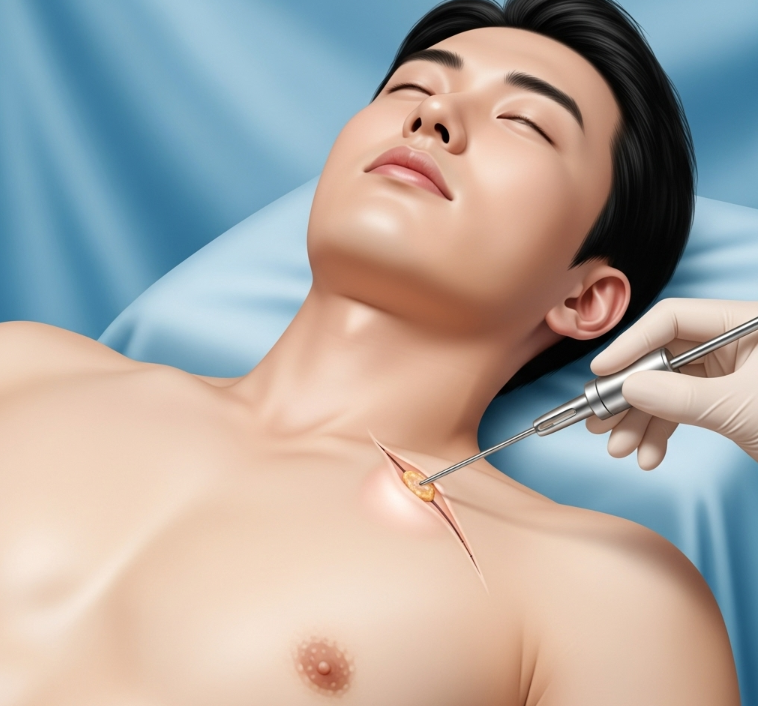
Treatment Overview
Liposuction-Assisted Chest Contouring is a minimally invasive surgical option for chest masculinization, often chosen by FTM (female-to-male) and non-binary patients with small chest sizes and good skin elasticity. Instead of large incisions, this procedure uses liposuction to remove breast tissue and fat, sculpting a flatter, more masculine chest while preserving natural nipples and minimizing visible scars.
In Korea, surgeons often combine high-definition (HD) liposuction, micro-cannula fat removal, and radiofrequency (RF) tightening to achieve smooth chest contours with minimal scarring. This approach is particularly popular among patients who want a subtle, natural-looking masculine chest without undergoing a full double-incision or nipple graft procedure.
Purpose & Benefits
- Chest Masculinization: Removes breast tissue and excess fat for a flatter chest.
- Minimally Invasive: Smaller incisions than double-incision or inverted-T.
- Natural Results: Maintains nipple position and skin elasticity.
- Scar Minimization: Tiny incisions hidden in natural chest folds.
- Faster Recovery: Shorter downtime compared to standard top surgery.
- Confidence Boost: Provides masculine chest definition with less invasive surgery.
Ideal Candidates
- Trans men, non-binary, or gender-diverse patients with small chest size (A–small B cup).
- Individuals with good skin elasticity and minimal sagging.
- Patients seeking scar-minimized masculinization.
- Adults in good overall health and stable weight.
- Non-smokers with realistic expectations (not suitable for larger chests with sagging).
Possible Risks & Complications
- Temporary swelling, bruising, or soreness.
- Small puncture scars at liposuction entry points.
- Uneven contour or residual tissue (rare if performed by skilled surgeon).
- Rare risks: fluid accumulation, infection, or asymmetry.
Techniques Used
- Micro-Cannula Liposuction: Removes fat with precision and minimal trauma.
- High-Definition Liposuction: Sculpts natural chest lines and definition.
- Ultrasound- or Laser-Assisted Lipo (Optional): Breaks down stubborn fat.
- RF Skin Tightening (Optional): Enhances firmness and prevents sagging.
- Scar-Minimizing Entry Points: Small, discreet incisions in natural folds.
Recovery & Aftercare
- 3–5 days: Mild soreness and swelling; return to light activities.
- 1–2 weeks: Resume desk work and light daily routines.
- 3–4 weeks: Begin light exercise (avoid chest-intensive workouts early).
- 2–3 months: Final chest contour becomes visible as swelling subsides.
Aftercare Guidelines:
- Wear a compression vest for 3–4 weeks to support chest contouring.
- Avoid heavy lifting or chest workouts until cleared.
- Massage or lymphatic drainage may help reduce swelling.
- Maintain stable weight for long-lasting results.
- Follow scar-care instructions for tiny incision points.
Results & Longevity
- Flatter, more masculine chest contour.
- Natural nipple placement and skin preservation.
- Minimal scarring with discreet entry points.
- Permanent fat removal in treated areas.
- Long-lasting results with healthy lifestyle and weight management.
Treatment Process in Korea
1. Consultation & Assessment
- Surgeons evaluate chest size, fat distribution, and skin elasticity.
- 3D imaging may be used to plan contour and expected results.
2. Surgery Day
- Performed under local anesthesia with sedation or general anesthesia.
- Small incisions made near chest folds or underarms.
- Fat and breast tissue removed with micro-cannula liposuction.
- RF tightening may be applied for skin contraction.
3. Post-Operative Monitoring
- Compression garment applied immediately.
- Patients usually discharged same day or after 1 night.
4. Follow-Up & Refinement
- Follow-ups at 1 week, 1 month, and 3–6 months.
- Minor touch-ups (liposuction or scar care) may be offered if needed.
Why Korea is a Top Destination
- Surgeons skilled in minimally invasive chest masculinization techniques.
- Clinics offer advanced liposuction technology (HD, RF-assisted, ultrasound).
- Customized treatment plans based on chest size and patient goals.
- Affordable compared to Western countries with world-class precision.
- International-friendly clinics with multilingual staff and discreet services.
Cost Range
The cost of Liposuction-Assisted Chest Contouring in Korea depends on chest size, technique, and clinic reputation.
Estimated Pricing:
- Small Chest (liposuction only): USD $6,000 – $8,500
- With RF or Laser-Assisted Tightening: USD $7,500 – $10,000
- With HD Chest Sculpting: USD $8,500 – $11,500
- Premium Clinics (3D imaging, scar-care, VIP aftercare): USD $10,000 – $13,000
Additional Costs:
- Consultation & imaging: USD $150 – $300
- Compression vests: USD $150 – $300
- Scar management programs: USD $300 – $600
- Medications & aftercare: USD $200 – $400
Popular Clinics
- Banobagi Plastic Surgery (Seoul): Known for minimally invasive body sculpting.
- ID Hospital (Seoul): Experts in liposuction-assisted top surgery with precision contouring.
- JK Plastic Surgery Center (Seoul): JCI-accredited, premium aftercare programs.
- View Plastic Surgery Clinic (Seoul): Leaders in chest sculpting with RF-assisted liposuction.
- JW Plastic Surgery (Seoul): Specializes in natural chest masculinization with minimal scars.


