
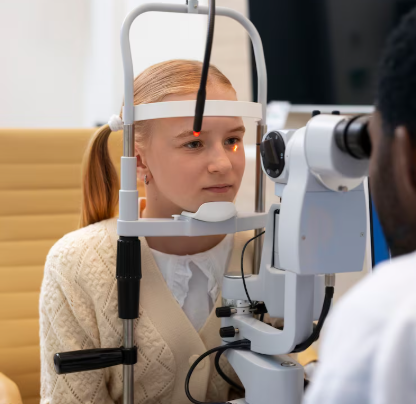
Treatment Overview
Low-Vision Rehabilitation (LVR) is a specialized program designed for patients with advanced Age-Related Macular Degeneration (AMD) who experience significant vision loss that cannot be corrected with standard glasses, contact lenses, or surgery. LVR focuses on maximizing remaining vision, enhancing daily functioning, and improving quality of life through a combination of assistive devices, vision training, and adaptive strategies.
In Korea, LVR programs are delivered with cutting-edge technology, personalized assessments, and interdisciplinary care:
- Comprehensive visual function evaluation including visual acuity, contrast sensitivity, and visual field mapping
- Assistive device prescription such as magnifiers, telescopic lenses, electronic readers, and screen magnification tools
- Vision training and rehabilitation exercises to optimize the use of remaining central and peripheral vision
- AI-assisted visual performance tracking to adjust strategies over time
- Occupational therapy and daily living adaptation training
- Integration with optical imaging and monitoring (OCT, FAF) to guide personalized care
- Multidisciplinary support, including low-vision specialists, ophthalmologists, and rehabilitation therapists
LVR is essential for AMD patients to maintain independence, read, navigate safely, and perform daily activities despite central vision loss.
Purpose & Benefits
Purpose
- Maximize use of residual vision in AMD patients
- Improve daily functioning and independence
- Train patients to adapt to central vision loss
- Enhance reading, mobility, and visual task performance
- Integrate assistive technologies with personalized strategies
- Provide psychological and occupational support for vision impairment
Benefits
- Personalized low-vision solutions tailored to individual needs
- Non-invasive and safe for all patients
- AI-assisted tracking improves outcome measurement
- Enhances quality of life and daily productivity
- Supports safe navigation and reduced risk of accidents
- Integration with ongoing AMD monitoring and treatment
- Provides practical skills for reading, writing, and mobility
Ideal Candidates
Low-Vision Rehabilitation for AMD in Korea is ideal for:
- Patients with advanced dry or wet AMD experiencing central vision loss
- Individuals struggling with daily tasks due to reduced visual acuity
- Patients with difficulties reading, recognizing faces, or navigating environments
- Those seeking assistive devices, adaptive strategies, and occupational training
- AMD patients requiring interdisciplinary rehabilitation support
- Individuals who want to maintain independence despite progressive vision loss
Possible Risks & Complications
Minor / Transient Issues
- Initial fatigue or eye strain from using magnifiers or training devices
- Temporary headaches during vision training exercises
- Adjustment period for new assistive devices
Rare / Serious Risks
- No serious risks; LVR is non-invasive
- Rare frustration or psychological distress due to adaptation challenges
How Korean Clinics Minimize Risks
- Gradual, personalized training programs
- Professional supervision by low-vision therapists
- Psychological support and counseling as part of the program
- AI-assisted monitoring to prevent overexertion
Related Diagnostic & Treatment Techniques
- Visual Function Testing – Visual acuity, contrast sensitivity, visual fields
- Optical Imaging (OCT, FAF, Fundus Photography) – Track AMD progression
- Assistive Devices – Magnifiers, telescopes, electronic readers, screen magnifiers
- Occupational Therapy – Daily living adaptation strategies
- Mobility Training – Safe navigation indoors and outdoors
- AI-based Vision Optimization – Track patient progress and adjust strategies
- Low-Vision Counseling – Psychological support and lifestyle adaptation
Treatment Process in Korea
Step 1 – Initial Assessment
- Comprehensive evaluation of visual function
- Assessment of daily activity limitations and lifestyle needs
- Baseline optical imaging to correlate functional and anatomical data
- Personalized rehabilitation plan development
Step 2 – Device Prescription & Training
- Prescription of optical or electronic assistive devices
- Training in proper use of magnifiers, telescopes, or electronic readers
- Vision exercises to enhance use of residual central and peripheral vision
- Occupational therapy for daily living adaptations
Step 3 – Ongoing Monitoring & Adjustment
- Regular follow-up to evaluate progress and device efficacy
- AI-assisted tracking of visual performance and adaptation
- Adjust rehabilitation strategies based on patient progress
- Integration with clinical monitoring of AMD progression
Duration: 1–2 hours per session (initial assessment and training), ongoing follow-ups 30–60 minutes
Setting: Outpatient low-vision rehabilitation center or ophthalmology clinic
Recovery & After-Care
After-Care Guidelines
- Consistent practice with prescribed devices and exercises
- Gradual adaptation to new visual strategies
- Attendance at all follow-up sessions to optimize outcomes
- Report any discomfort or difficulties with device use
Recovery Timeline
- Immediate: Initial orientation and device familiarization
- 1–4 Weeks: Progressive adaptation to devices and techniques
- 1–3 Months: Enhanced ability in reading, mobility, and daily activities
- Long-Term: Ongoing follow-up to adjust strategies as AMD progresses
Results & Longevity
Expected Results
- Improved functional vision in daily activities
- Increased reading speed and accuracy with assistive devices
- Better navigation and spatial awareness
- Enhanced independence and quality of life
- Tailored strategies that evolve with disease progression
Longevity
- Long-term benefits with continuous training and device use
- Adjustments over time based on AMD progression
- Integration with ongoing ophthalmic monitoring ensures sustained outcomes
Why Korea Is a Top Destination
- Experienced low-vision specialists integrated with retinal clinics
- Advanced assistive device options and AI-assisted tracking
- Multidisciplinary rehabilitation teams including occupational therapists
- Integration with optical imaging and AMD monitoring
- Structured, patient-centered programs with English-friendly support
- Innovative training methods and rehabilitation protocols
Unique Korean Innovations
- AI-assisted visual performance tracking
- Digital dashboards to monitor rehabilitation progress
- Integration of multimodal imaging with functional vision assessment
- Personalized device prescription and adaptive training
- Combination of occupational therapy, mobility training, and psychological support
- Low-vision rehabilitation packages tailored for AMD progression
Cost Range (Indicative Estimate)
| Package | Price (KRW) | Approx. USD | Inclusions |
|---|---|---|---|
| Initial Assessment & Training | ₩400,000 – ₩700,000 | ~$305 – $540 | Visual evaluation + device prescription + initial training |
| Follow-Up Rehabilitation Session | ₩150,000 – ₩300,000 | ~$115 – $230 | Ongoing training + device optimization + progress review |
| Comprehensive Annual Program | ₩1,000,000 – ₩2,500,000 | ~$765 – $1,900 | Initial assessment + 4–6 follow-ups + AI tracking + counseling |
Popular Clinics in Korea
- Kim’s Eye Hospital Low-Vision Center (Seoul)
- Gangnam Severance Hospital Low-Vision & Retina Clinic
- Seoul National University Hospital Ophthalmology & Rehabilitation Center
- B&VIIT Eye Center (Gangnam)
- BGN Eye Clinic (Seoul & Busan)
- NUNE Eye Hospital (Daegu)
- Glory Seoul Eye Clinic
- Dream Eye Center (Seoul)


