
Treatment Overview
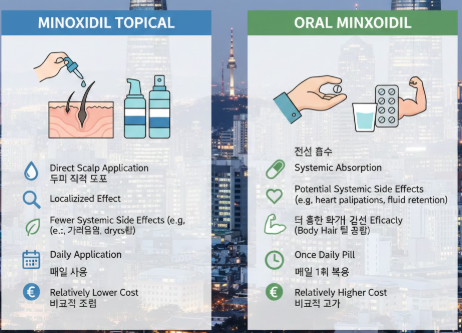
Minoxidil is a proven treatment for hair loss available in both topical and oral formulations. Topical Minoxidil is applied directly to the scalp, while oral Minoxidil is taken as a systemic medication under medical supervision. In Korea, both forms are widely used in hair restoration clinics for men and women experiencing androgenetic alopecia, thinning hair, or scalp conditions causing hair loss.
Korean dermatology clinics are known for their advanced technology and personalized treatment programs, often combining Minoxidil with other therapies such as PRP injections, laser therapy, or mesotherapy for optimal results. Medical tourists can access professional guidance to choose the most effective option based on their hair loss type, scalp condition, and lifestyle.
Purpose & Benefits
The purpose of both topical and oral Minoxidil is to stimulate hair regrowth, strengthen follicles, and slow down hair loss, but each method has its specific benefits:
Topical Minoxidil Benefits:
- Directly targets hair follicles for localized stimulation.
- Lower risk of systemic side effects.
- Easy to use and widely accessible.
- Can be combined with topical treatments like corticosteroids or serums.
Oral Minoxidil Benefits:
- Systemic treatment can be more effective for diffuse thinning across the scalp.
- Ideal for patients who cannot apply topical solutions consistently.
- May show faster results in some patients with extensive hair loss.
- Can be combined with topical Minoxidil for enhanced effects.
Ideal Candidates
Topical Minoxidil Candidates:
- Individuals with mild to moderate hair loss limited to the crown or frontal areas.
- Patients preferring a non-invasive, self-applied treatment.
- Those sensitive to systemic medications.
Oral Minoxidil Candidates:
- Patients with diffuse or extensive hair thinning.
- Individuals who cannot maintain consistent topical application.
- Patients under medical supervision who can tolerate systemic medication.
Korean clinics provide scalp assessments and medical consultations to determine the most suitable form for each patient.
Possible Risks & Complications
Topical Minoxidil Risks:
- Scalp irritation, redness, itching, or dryness.
- Temporary shedding during the first weeks.
- Rare allergic reactions.
Oral Minoxidil Risks:
- Systemic side effects such as dizziness, changes in blood pressure, or fluid retention.
- Possible unwanted hair growth in areas other than the scalp.
- Rare cardiovascular complications in sensitive individuals.
Korean dermatologists monitor patients closely, especially for oral Minoxidil, to minimize risks and ensure safe administration.
Techniques & Technology Used
Korean clinics use advanced techniques to enhance both topical and oral Minoxidil treatments:
- Topical Application: Foam or solution applied directly to the scalp.
- Oral Prescription: Administered under strict medical supervision.
- Combination Therapy: Integration with PRP injections, laser therapy, or mesotherapy.
- Scalp Analysis: Dermoscopy and imaging to track follicle health and hair density progress.
Treatment Process in Korea
Topical Minoxidil Process:
- Consultation and scalp analysis.
- Personalized concentration and application instructions.
- Daily home application with follow-up monitoring.
- Adjustments based on hair regrowth and tolerance.
Oral Minoxidil Process:
- Medical evaluation to ensure patient safety.
- Prescribed dosage based on hair loss severity and health status.
- Monitoring for side effects during treatment.
- Combination with other therapies if necessary.
Medical tourists in Korea benefit from translation services, treatment packages, and follow-up care tailored for international patients.
Recovery & After-Care
Topical Minoxidil:
- Minimal recovery; safe for daily home use.
- Avoid washing scalp for 2–4 hours after application.
- Use gentle hair care products.
Oral Minoxidil:
- Requires regular medical monitoring.
- Patients should report any side effects such as swelling, dizziness, or unusual hair growth.
- Maintain a healthy lifestyle to support hair regrowth.
Results & Longevity
Topical Minoxidil:
- Visible results in 3–6 months, optimal in 6–12 months.
- Continued use is essential to maintain results.
Oral Minoxidil:
- Can show faster improvement in diffuse thinning.
- Best outcomes when combined with topical treatments or other therapies.
- Discontinuation may result in gradual hair loss recurrence.
Why Korea Is a Top Destination
Korea is a leading hub for hair restoration due to:
- Advanced Dermatology Clinics: State-of-the-art technology and experienced specialists.
- Comprehensive Treatment Programs: Combining Minoxidil with PRP, laser therapy, and scalp care.
- High Medical Standards: Safety, hygiene, and patient-focused care.
- Medical Tourism Support: Travel assistance, accommodation, and translation services.
- Affordable Premium Care: Competitive pricing for high-quality hair loss solutions.
Cost Range
- Topical Minoxidil (monthly supply): $30–$70 USD
- Oral Minoxidil (monthly supply): $50–$100 USD
- Combination Packages (Topical + Oral + PRP/Laser): $500–$1,500 USD
International patients often receive comprehensive packages including consultation, treatment, and follow-up.
Popular Clinics in Korea
- Reviv Clinic, Seoul: PRP + Minoxidil combination therapy.
- K-Beauty Hair Clinic, Gangnam: Personalized hair regrowth programs.
- MediHair Clinic, Seoul: Specializes in topical and oral Minoxidil.
- Banobagi Plastic & Dermatology Clinic: Integrates Minoxidil with laser scalp therapy.
- JK Hair Clinic: Male and female hair loss treatment with medical tourism support.


