
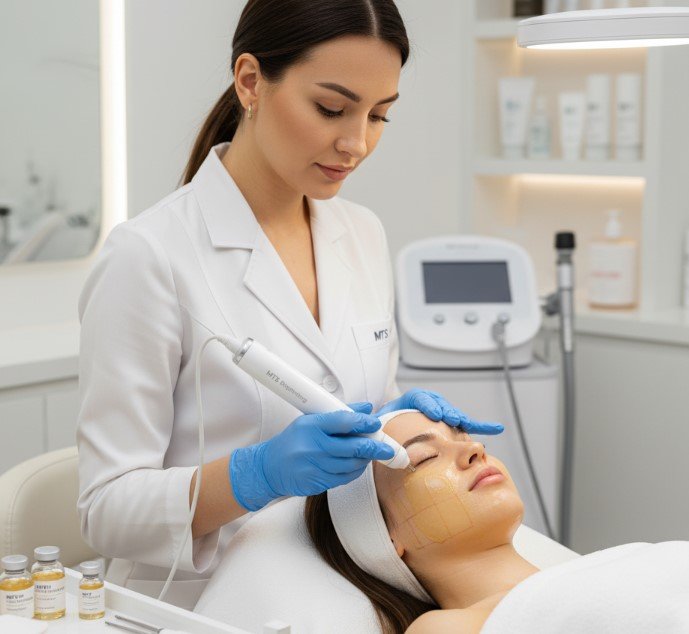
Treatment Overview
MTS Brightening Therapy refers to Microneedle Therapy System (MTS) combined with brightening agents (such as Vitamin C, Tranexamic Acid, Whitening Serums) to help reduce sunspots and pigmentation. In Korea, dermatology clinics use microneedling with small needle cartridges (0.5-2.5 mm depending on the skin area and sensitivity) to create micro-channels. These micro-injuries stimulate collagen production and enhance the skin’s uptake of topicals. For sunspot removal, this aids both in delivering brightening agents deep into the epidermis/upper dermis and promoting turnover of pigmented keratinocytes.
Purpose & Benefits
- Sunspot Fading: Improves uptake of brightening actives directly into pigmented areas.
- Skin Renewal: Boosts collagen, speeds up shedding of pigmented and damaged cells.
- Even Tone & Glow: Smooths skin surface and evens out skin texture.
- Low Downtime: Less intense than ablative lasers; mild redness/swelling that resolves quickly.
- Synergistic Effects: When used with topicals or post-laser, enhances overall pigment clearance.
Ideal Candidates
- Individuals with superficial sunspots/freckles that respond partially to topicals but haven’t fully cleared.
- Patients who prefer gentler treatments with lower risk of PIH.
- People looking for brightening + texture improvement simultaneously.
- Those who are okay with multiple sessions and follow-up topical care.
Possible Risks & Complications
- Redness & Mild Swelling: Common immediately after treatment.
- Micropuncture Pinpoint Bleeding: Minor, resolves quickly.
- Dryness or Mild Flaking: As skin renews.
- Temporary Darkening: Pigment may look darker before fading.
- Risk of Infection: If not done under sterile conditions.
- Possible PIH: If needles are too deep or brighteners are too strong, or poor sun protection.
Techniques & Procedure Details
- Needle Depth: Typically 0.5-1.5 mm for face depending on spot depth and skin sensitivity; deeper (2.0-2.5 mm) rarely applied if needed and if skin tolerates.
- Brightening Agents Used: Vitamin C, Tranexamic Acid, Kojic Acid, Glutathione, Whitening Serums, possibly peptides.
- Session Steps:
- Numbing cream (optional, especially for higher needle depths).
- Clean skin, disinfect area.
- Microneedling passes across target sunspot areas (or entire face if multiple spots).
- Application of brightening serum or ampoule over the micro-channels for absorption.
- Soothing mask / serum / barrier cream.
- Session Frequency: Usually every 2-4 weeks, for 4-6 sessions.
Recovery & Aftercare
- Immediately: Redness, slight swelling, possibly minor pinpoint bleeding.
- Days 1-2: Mild sensitivity or tightness; some serums may cause mild tingling.
- Days 3-5: Skin may flake lightly; pigmented cells start to shed.
- Aftercare Tips:
• Strict SPF 50+ sunscreen daily <br>
• Gentle cleansers and barrier repair moisturizers <br>
• Avoid harsh exfoliants/peels for at least a week after treatment <br>
• No makeup or irritants on treated area for initial 24 hours <br>
• Stay out of direct sun or heat sources
Results & Longevity
- After 1 Session: Brighter appearance; may notice subtle fading of lighter freckles.
- After 2-3 Sessions: More visible reduction in sunspots; tone becomes more even.
- After 4-6 Sessions: Significant lightening of sunspots, smoother skin, more radiance.
- Long-Term: With proper sun protection and maintenance session(s), results can last many months; new sun damage can cause recurrence.
Treatment Process in Korea
Consultation & Skin Analysis
- Dermatologist assesses sunspot characteristics (color, depth, number), skin type, history of pigmentation or reactions.
- Determines needle depth and brightening agent selection.
Preparation
- Pre-treatment skincare; possibly pre-conditioning with brightening creams or sun avoidance.
- Cleanse and optionally numbing cream if needle depth is high.
MTS Brightening Session
- Microneedling passes over spots / surface area.
- Brightening serum applied immediately to absorb through micro-channels.
- Soothing or calming agent applied post procedure.
- Duration: ~30 minutes (more if many spots or full face).
Follow-Up
- Regular sessions every 2-4 weeks usually 4-6 in total.
- Use of topical brighteners in between sessions (Vitamin C, arbutin, TXA, etc.).
- Strong sun protection always emphasized.
Unique Korean Advantages
- Clinics often combine microneedling with advanced brightening serums of high quality.
- Korean dermatologists have fine-tuned needle depths and protocol to reduce PIH risk in pigmented skin.
- Package deals often include aftercare kits (serums, sunscreen) and monitoring.
- Good international reputation; many clinics experienced in pigmentation disorders.
Cost Range (Estimated, Korea)
| Treatment Scope | Price per Session | Package for 4-6 Sessions |
|---|---|---|
| Small area / few sunspots | USD 80 – 150 | — |
| Full face or several spots | USD 150 – 300 | — |
| 4-6 Session Package (full face + serums) | — | USD 500 – 1,200 |
Additional Costs:
- Consultation: USD 20 – 50
- Premium brightening serums / ampoules: USD 80 – 200 per session or as add-on
- Boosters (e.g. light lasers or peels for stubborn spots): USD 200 – 500
Conclusion
MTS Brightening Therapy is a solid mid-to-low-intensity option for sunspot removal when:
- spots are superficial or moderate in pigmentation
- patient desires lower downtime and more natural, gradual improvement
- committed to multiple sessions + good aftercare + sun protection
If spots are deeply pigmented, raised, or stubborn, combining MTS Brightening with laser treatments (e.g. Alexandrite, Pico) or stronger pigment lasers might give better results.


