
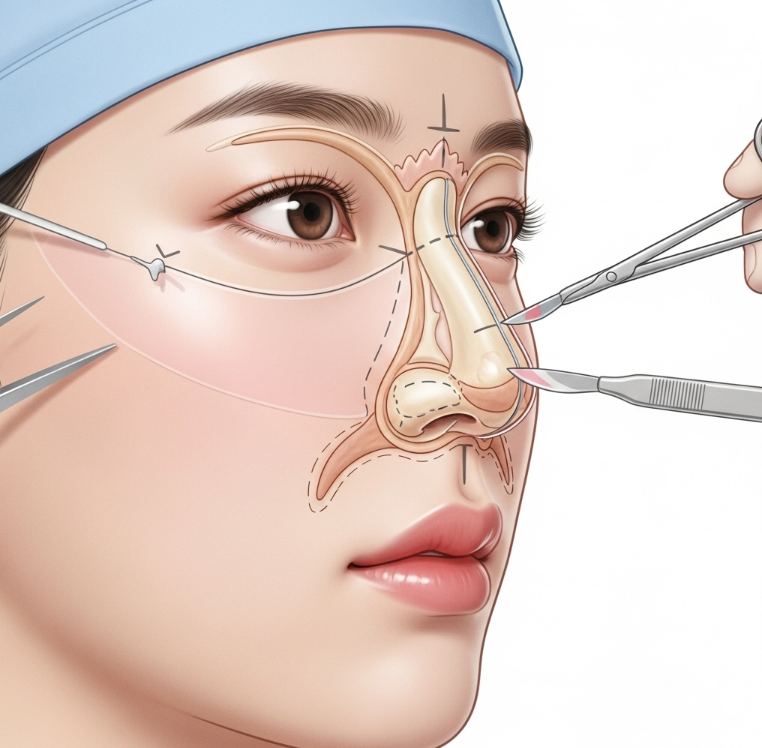
Treatment Overview
Nasal Tip Refinement in Korea is a specialized rhinoplasty procedure focused on reshaping, projecting, or narrowing the nasal tip to achieve a more balanced and aesthetically pleasing appearance. This procedure addresses issues such as bulbous tips, drooping tips, asymmetry, or over-projection. Korean surgeons are recognized globally for their precision in tip refinement, using advanced cartilage manipulation, suturing techniques, and sometimes grafting to create natural, masculine, and proportionate nasal tips.
Purpose & Benefits
- Refines the shape, projection, and symmetry of the nasal tip.
- Corrects bulbous, drooping, or wide nasal tips.
- Enhances overall facial harmony and masculinity.
- Can improve breathing function if combined with functional rhinoplasty.
- Uses advanced techniques to ensure minimal scarring and long-lasting results.
- Complements other rhinoplasty procedures, such as bridge augmentation or alar base reduction.
Ideal Candidates
- Men with a wide, bulbous, drooping, or asymmetrical nasal tip.
- Patients seeking a more refined or projected tip without altering other nasal structures.
- Those who want natural, masculine enhancements.
- Candidates for revision tip rhinoplasty after previous surgery.
- Individuals seeking subtle adjustments or major tip remodeling.
Possible Risks & Complications
- Temporary swelling, bruising, or mild tenderness around the nasal tip.
- Minor asymmetry, especially in complex cases (often correctable).
- Rare risk of cartilage warping or graft resorption.
- Infection or bleeding is uncommon when performed by skilled surgeons.
- Slight stiffness in the tip during early recovery.
Surgical Techniques Used
- Transdomal Sutures: Refines tip width and projection.
- Columellar Strut Grafts: Provides structural support for projection and rotation.
- Tip Grafts (Extended or Shield): Adds definition or corrects asymmetry.
- Cartilage Manipulation: Reshaping native cartilage for optimal aesthetics.
- Closed or Open Approach: Selected based on complexity; both can achieve natural results.
- Korean Advanced Techniques: Micro-suturing, 3D preoperative planning, and precision cartilage sculpting for optimal masculine contour.
Recovery & Aftercare
- Initial healing: 5–7 days for swelling and minor bruising to subside.
- Splints or internal supports: Usually removed after 5–7 days.
- Return to work: Light activities after 7–10 days; avoid strenuous activity for 3–4 weeks.
- Aftercare in Korea:
- Cold compresses to reduce swelling
- Saline irrigation to maintain nasal hygiene
- Regular in-person and virtual follow-ups, especially for international patients
- Scarless healing protocols and cartilage stabilization techniques
Results & Longevity
- Refined, natural, and masculine nasal tip.
- Long-lasting symmetry and projection.
- Can complement functional improvements if combined with septoplasty or spreader grafts.
- Minimal risk of visible scars or irregularities when performed with advanced Korean techniques.
- Enhances overall facial balance and profile aesthetics.
Treatment Process in Korea
Korea is a leading destination for Nasal Tip Refinement due to:
- Expertise in precision tip surgery, combining aesthetics and function.
- 3D imaging and preoperative simulation for accurate planning.
- Minimally invasive cartilage manipulation and scarless suturing for natural results.
- Medical tourism support: multilingual staff, accommodation, and personalized post-op care.
- Integration of functional and aesthetic goals, ensuring symmetry, projection, and proper tip support.
Why Korea is a Top Destination:
- Surgeons have extensive experience with male rhinoplasty and tip refinement.
- Advanced surgical instruments and techniques for micro-adjustments.
- High patient satisfaction due to natural, masculine results.
- Comprehensive post-operative programs, including virtual follow-ups for international patients.
Cost Range
The cost of Nasal Tip Refinement in Korea depends on the techniques used and complexity:
- Basic Tip Refinement (Transdomal Sutures or Minor Reshaping): ₩3,500,000 – ₩5,500,000 KRW ($2,700 – $4,200 USD)
- Tip Refinement with Columellar or Shield Grafts: ₩6,000,000 – ₩9,000,000 KRW ($4,600 – $6,900 USD)
- Revision or Complex Tip Refinement: ₩10,000,000 – ₩13,000,000 KRW ($7,600 – $10,000 USD)
Inclusions:
- Surgeon and anesthesia fees
- Cartilage grafting if required
- Hospital/clinic facilities
- Post-operative care and follow-ups
- Optional medical tourism support for international patients
Popular Clinics in Korea
- ID Hospital (Gangnam, Seoul): Renowned for precise nasal tip refinement and revision cases.
- Banobagi Plastic Surgery (Seoul): Specializes in masculine tip shaping and natural outcomes.
- View Plastic Surgery (Seoul): Uses 3D imaging-assisted planning for tip projection and symmetry.
- JW Plastic Surgery (Seoul): High success rates in scarless and functional tip refinement.
- The PLUS Plastic Surgery (Seoul): Popular with international patients for male tip refinement with natural aesthetics.


