
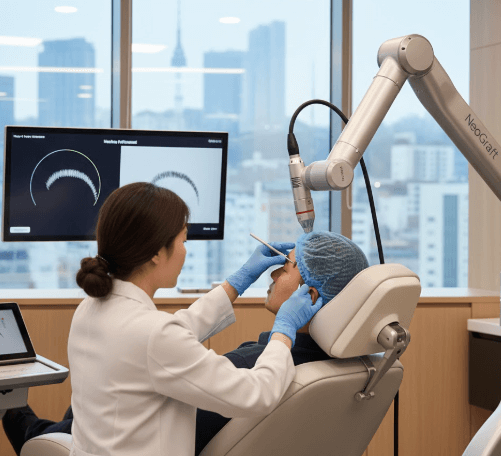
Treatment Overview
The NeoGraft Robotic Hair Transplant + Follow-up Density Boost Session is a two-stage hair restoration program designed for patients who want both immediate improvement and long-term enhanced density.
The initial NeoGraft robotic FUE procedure restores the primary hairline, crown, or thinning areas, while the scheduled Density Boost Session adds extra grafts several months later to refine coverage, correct any thin zones, and improve overall fullness.
This combination approach is highly popular in Korea, where clinics specialize in artistic design and high-density refinement using robotic precision.
Purpose & Benefits
This treatment aims to achieve maximum hair density, improved naturalness, and long-lasting volume.
Key benefits include:
- Two-stage approach ensures fuller, more even hair coverage.
- Ideal for patients wanting ultra-dense, natural-looking results.
- Robotic FUE extraction ensures consistent graft quality.
- Density Boost Session targets any areas needing refinement.
- Faster healing thanks to minimally invasive NeoGraft technology.
- Perfect for hairlines, temples, crown areas, and general density improvement.
Ideal Candidates
You may be an ideal candidate if you:
- Want maximum density and natural thickness after your initial transplant.
- Have moderate to advanced hair loss requiring multiple stages.
- Want to refine or enhance specific areas like temples or mid-scalp.
- Prefer a minimally invasive, gentle robotic method with no linear scarring.
- Are an overseas patient looking for a predictable and planned treatment progression.
- Previously had a transplant and want more density added later.
Possible Risks & Complications
NeoGraft is safe, but minor side effects may include:
- Temporary redness or swelling.
- Slight soreness or tightness for a few days.
- Temporary shedding of transplanted hairs (“shock loss”).
- Minor unevenness if donor density is limited.
- Very rare inflammation if post-care is ignored.
Techniques & Technology Used
- NeoGraft Robotic FUE System: Uses pneumatic extraction for gentle follicle removal.
- Precise Implantation: Grafts are placed at exact angles for natural flow and direction.
- Density Mapping: Korean clinics use digital imaging to identify areas needing boost sessions.
- Follow-Up Density Boost: A second transplant (usually smaller) enhances coverage and blends transitions.
- Optional PRP Therapy: Improves graft survival and accelerates growth.
Treatment Process in Korea
- Initial Consultation: Donor evaluation, density planning, and personalized hairline design.
- First Session (NeoGraft FUE): Robot-assisted extraction and implantation restore primary thinning areas.
- Recovery Phase: Mild downtime with rapid healing due to gentle robotic harvesting.
- Assessment Period (3–6 months): Surgeons evaluate early growth and density patterns.
- Density Boost Session: Additional grafts are implanted to refine thickness and fill any areas needing extra support.
- Long-Term Care: Clinics offer PRP, scalp programs, and growth boosters for enhanced long-term success.
Recovery & After-Care
- Mild swelling or redness for 2–3 days.
- Avoid washing for 48 hours; gentle washing from day 3.
- Avoid sunlight, gyms, and sweating for 1 week.
- Scabs fall off naturally within 7–10 days.
- Growth from both sessions starts around 3–4 months after each procedure.
- Full combined results appear around 12–15 months.
- Routine follow-ups keep progress on track.
Results & Longevity
- Early growth visible by 3–6 months after the first session.
- Density Boost Session ensures premium fullness and natural look.
- Overall results mature within 12–15 months.
- Transplanted hair is permanent and blends seamlessly with existing hair.
- Thicker density and refined placement create long-lasting, natural aesthetic balance.
Why Korea Is a Top Destination
- Korea excels in multi-stage density planning and refined robotic FUE.
- Surgeons specialize in high-density design, temple detailing, and natural pattern flow.
- Clinics use digital density mapping for precision targeting of boost sessions.
- International patients receive structured schedules and smooth follow-up coordination.
- Costs are competitive while offering extremely high aesthetic standards.
- Proven success rates for dense, natural, long-term hair restoration.
Cost Range
The cost of a NeoGraft Robotic Transplant + Density Boost Session in Korea varies by graft count and complexity:
First Session (Main Transplant):
- ₩6,000,000 – ₩9,000,000 (≈ USD 4,800 – 7,500)
Follow-Up Density Boost Session:
- ₩3,000,000 – ₩5,000,000 (≈ USD 2,400 – 4,000)
Full Two-Stage Package:
- ₩9,000,000 – ₩13,000,000 (≈ USD 7,500 – 10,800)
Packages usually include anesthesia, medications, after-care instructions, and translation support for overseas patients.
Popular Clinics in Korea
- Dream Hairline Clinic (Seoul): Experts in two-stage high-density restoration using NeoGraft.
- Moaman Hair Transplant Clinic (Seoul): Known for precise density refinement and multi-session planning.
- Woomchan Hair Transplant Clinic (Gangnam): Specializes in density boost programs for international clients.


