
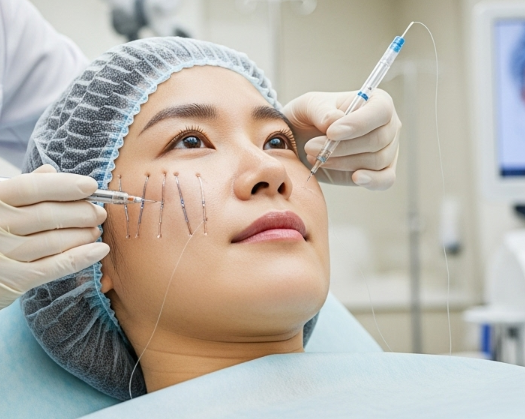
Treatment Overview
The Non-Surgical Face Lift Threads treatment is one of the most popular anti-aging solutions in Korea, designed to lift and tighten sagging skin without invasive surgery. Using dissolvable threads such as PDO (Polydioxanone) or PCL (Polycaprolactone), Korean dermatologists elevate drooping tissues, restore facial contours, and stimulate collagen regeneration for natural, long-term rejuvenation.
Unlike surgical facelifts, thread lifts require minimal downtime and leave no scars, making them an excellent option for patients seeking a refreshed and youthful look with safe, subtle, and natural results.
Purpose and Benefits
- Instant Lift: Elevates sagging cheeks, jawline, brows, and neck.
- Collagen Stimulation: Activates fibroblasts for long-term skin tightening.
- Wrinkle Reduction: Smooths folds, marionette lines, and fine wrinkles.
- Facial Contour Refinement: Creates a sharper jawline and natural V-line.
- Non-Surgical Solution: No scars, general anesthesia, or long downtime.
- Customizable Results: PDO threads (6–12 months) or PCL threads (18–24 months).
- Natural Youthful Look: Progressive improvement without overcorrection.
Ideal Candidates
Non-Surgical Face Lift Threads are recommended for:
- Adults in their 30s–60s with mild-to-moderate sagging.
- Patients with jowls, drooping cheeks, or neck laxity.
- Men and women who want a facelift effect without surgery.
- Younger individuals seeking preventive tightening treatments.
- Patients who want natural and subtle anti-aging results.
Possible Risks and Complications
Thread lifts are safe when performed by experienced Korean dermatologists, but minor side effects may include:
- Swelling or Redness: Usually fades in 2–3 days.
- Tenderness or Bruising: May last 1–2 weeks.
- Minor Asymmetry: Rare, corrected with thread adjustments.
- Very Rare Risks: Thread visibility, dimpling, or infection (minimized with advanced protocols).
Surgical Techniques Used
Although this is a non-surgical treatment, thread lifts employ advanced lifting techniques:
- PDO Threads: Provide immediate lift and short-term collagen stimulation (6–12 months).
- PCL Threads: Longer-lasting support and stronger collagen regeneration (18–24 months).
- Vector Mapping: Threads placed strategically along jawline, mid-face, and brows.
- Dermal Scaffold: Threads form a supportive framework under the skin.
- Combination Care: Often paired with Shurink HIFU, Thermage FLX, or fillers for optimal results.
Recovery and Aftercare
- Immediately After: Mild tightness, swelling, or redness.
- 1–3 Days: Temporary bruising or tenderness may appear.
- 1–2 Weeks: Threads settle, lift looks more natural.
- 2–6 Months: Maximum skin tightening as collagen regeneration peaks.
- Downtime: Minimal—patients return to daily activities within 2–3 days.
Aftercare Tips:
- Avoid chewing hard foods and strong facial movements for 1 week.
- No alcohol, saunas, or strenuous workouts for 7–10 days.
- Sleep on your back to prevent thread displacement.
- Apply hydrating serums and firming creams daily.
- Use SPF sunscreen to protect new collagen.
Results and Longevity
- Immediate: Noticeable lift and contour improvement.
- Short-Term (1–2 Months): Skin tightens, wrinkles soften.
- Medium-Term (3–6 Months): Peak collagen production enhances results.
- Long-Term: PDO threads last 6–12 months; PCL threads last 18–24 months.
- Maintenance: Touch-ups recommended every 12–18 months.
Treatment Process in Korea
- Consultation & Skin Analysis
- Dermatologist evaluates sagging and lifting needs.
- Thread type (PDO or PCL) chosen for best results.
- Preparation
- Skin cleansing and local anesthesia or numbing cream.
- Lifting vectors mapped out.
- Thread Lift Procedure
- Threads inserted beneath the skin using fine cannulas.
- Lift applied to reposition sagging tissues.
- Adjustment & Symmetry Check
- Dermatologist ensures even, natural lifting.
- Soothing Care
- Cooling mask or LED light therapy applied.
- Follow-Up
- Post-treatment review within 1–2 weeks.
- Maintenance every 12–18 months suggested.
Why Korea is the Best Destination
- Thread Lift Leaders: Korea pioneered PDO and PCL lifting protocols.
- Precision Mapping: Customized treatment plans ensure natural results.
- K-Beauty Integration: Often paired with HIFU or Thermage for synergy.
- Affordable Yet Premium: Lower costs than Western clinics with world-class outcomes.
- Medical Tourism Hub: Seoul is globally famous for non-surgical facelifts and anti-aging treatments.
Cost Range
The cost of Non-Surgical Face Lift Threads in Korea depends on clinic reputation, thread type, and treatment scope:
- Small Area Lift (PDO Threads): USD 500 – 1,000
- Mid-Face or Jawline Lift (PDO/PCL): USD 1,200 – 2,800
- Full-Face Thread Lift (PDO + PCL Combination): USD 2,500 – 4,500
- Full Face + Neck Lift (Advanced PCL Threads): USD 3,800 – 6,000
- Luxury Anti-Aging Packages (Threads + Shurink HIFU / Thermage FLX / Fillers): USD 5,000 – 8,500
Additional Costs in Korea:
- Consultation Fee: USD 30 – 100
- Local Anesthesia (optional): USD 50 – 200
- Aftercare Skincare (firming creams, collagen serums, SPF): USD 50 – 200
💡 For patients seeking stronger, longer-lasting effects, Korean dermatologists often recommend PCL threads, which provide results for up to 2 years.
Popular Clinics in Korea for Non-Surgical Face Lift Threads
- Banobagi Dermatology (Seoul): Experts in PDO/PCL thread lifting and anti-aging care.
- Oracle Skin Clinic (Nationwide): Accessible facelift alternatives across Korea.
- View Clinic (Seoul): Known for thread lifts combined with HIFU and Thermage.
- ID Dermatology (Seoul): Leaders in V-line lifting and facial contour refinement.
- Chaum Wellness Center (Seoul): Luxury holistic face lift and collagen care.


