
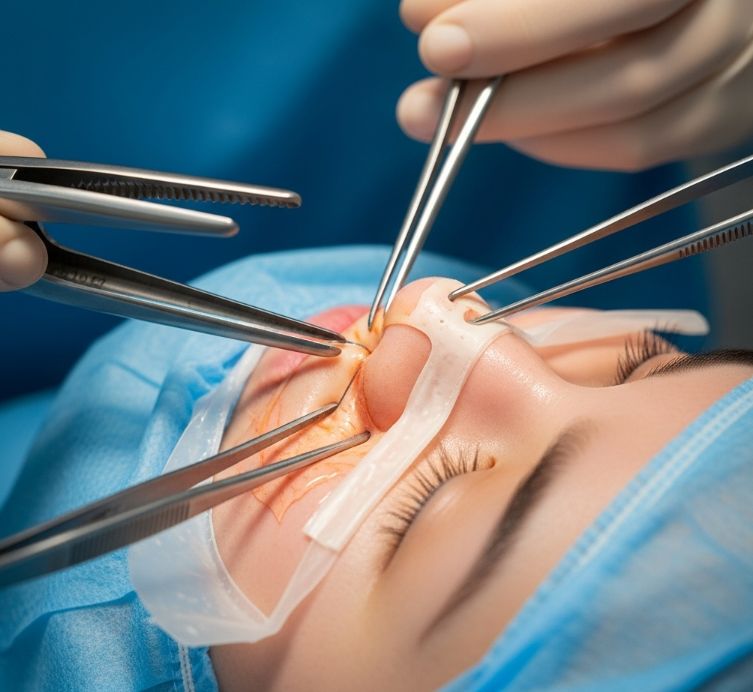
Treatment Overview
Open-Loop Tip Closed Rhinoplasty in Korea is an advanced minimally invasive procedure that focuses on refining the nasal tip while using a closed, scarless approach. This technique involves an “open-loop” suturing method internally to adjust the tip projection, rotation, and shape without making external incisions. The procedure is highly popular in Korea for patients who want precise tip refinement with minimal downtime and natural-looking results.
Purpose & Benefits
- Corrects a drooping, bulbous, or under-projected nasal tip.
- Enhances tip definition, projection, and symmetry.
- Uses scarless internal incisions, leaving no external marks.
- Shorter recovery time compared to open tip rhinoplasty.
- Preserves natural nasal structure while improving aesthetics.
- Can be combined with bridge adjustments or cartilage grafts for overall harmony.
Ideal Candidates
- Patients with wide, droopy, or poorly defined nasal tips.
- Individuals preferring scarless, closed rhinoplasty techniques.
- Men and women seeking subtle or moderate tip refinement.
- Candidates for primary rhinoplasty or minor revision procedures.
- Those who want enhanced tip aesthetics without altering other nasal structures.
Possible Risks & Complications
- Temporary swelling and bruising at the nasal tip.
- Minor asymmetry in tip shape or projection.
- Over- or under-correction requiring adjustment.
- Rare infection or internal scarring.
- Cartilage shifting if sutures are not properly maintained.
Surgical Techniques Used
- Closed Internal Incisions: Access through nostrils for a scarless approach.
- Open-Loop Tip Suturing: Innovative suturing technique that reshapes and repositions tip cartilage.
- Cartilage Trimming or Grafting (Optional): Refines tip and ensures long-term support.
- Tip Rotation & Projection Adjustment: Achieves balanced and natural tip angle.
- Combination Techniques: Can be paired with bridge augmentation or dorsal adjustments.
Recovery & Aftercare
- Downtime: 7–10 days for initial swelling and bruising to subside.
- Stitches: Internal, absorbable, leaving no visible scars.
- Postoperative care in Korea includes:
- Swelling reduction therapies (laser or ultrasound)
- Nasal care and tip support guidance
- Regular follow-ups to ensure symmetry and healing
- Support from English-speaking coordinators for international patients
Results & Longevity
- Creates a sharper, more defined nasal tip that complements facial features.
- Natural-looking results with no visible scarring.
- Long-lasting tip support when combined with cartilage grafts.
- Maintains nasal function and structural integrity.
- Subtle refinements that enhance overall nasal aesthetics and balance.
Treatment Process in Korea
- Consultation & 3D Analysis:
- Assessment of nasal tip anatomy and desired projection.
- Personalized plan using open-loop suturing to refine tip shape.
- Pre-Surgery Assessment:
- Blood tests, nasal endoscopy, and cartilage evaluation for optimal grafting.
- Closed Rhinoplasty Procedure:
- Performed under general anesthesia.
- Internal incisions allow access to tip cartilage.
- Open-loop sutures adjust tip projection, rotation, and contour.
- Optional cartilage grafts or minor bridge adjustments performed as needed.
- Immediate Postoperative Care:
- Soft splints or internal support to maintain tip structure.
- Short-term observation to monitor healing and stability.
- Follow-Up & Aftercare:
- Regular clinic visits for monitoring and swelling control.
- Swelling reduction therapy and cleaning guidance.
- Remote consultations available for international patients.
Why Korea is a Top Destination:
- Surgeons are skilled in advanced closed tip techniques for precise, natural results.
- Clinics use state-of-the-art equipment and provide comprehensive postoperative care.
- International patients benefit from translation services, personalized programs, and follow-up care.
Cost Range
- Basic open-loop tip closed rhinoplasty: ₩4,000,000 – ₩6,000,000 KRW ($3,000 – $4,500 USD)
- With cartilage grafting for tip support: ₩6,500,000 – ₩8,500,000 KRW ($4,900 – $6,500 USD)
- Complex or revision tip procedures: ₩9,000,000 – ₩12,000,000 KRW ($6,900 – $9,200 USD)
Packages include:
- Surgeon and anesthesia fees
- Operating room & hospital charges
- Swelling management therapy
- English/Chinese interpreter and patient support services
Popular Clinics in Korea
- ID Hospital (Seoul): Expert in closed tip refinement with open-loop techniques.
- Banobagi Plastic Surgery (Seoul): Specializes in scarless tip projection and shaping.
- JW Plastic Surgery (Seoul): Advanced suturing and cartilage grafting for tip support.
- View Plastic Surgery (Seoul): Known for natural, harmonious nasal tip results.
- The PLUS Plastic Surgery (Seoul): Internationally trusted for subtle and precise tip correction.


