
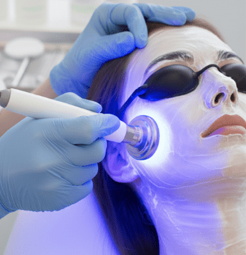
Treatment Overview
Photodynamic Therapy (PDT) is an advanced acne treatment widely performed in Korean dermatology clinics. It combines a photosensitizing agent (commonly aminolevulinic acid – ALA, or methyl aminolevulinate – MAL) with a light or laser source (blue light, red light, or IPL) to selectively destroy overactive sebaceous glands and acne-causing bacteria (Cutibacterium acnes).
In Korea, PDT is especially recommended for severe, persistent, or cystic acne that does not respond well to topical or oral medications. By directly targeting the root causes of acne—oil production and bacterial growth—PDT offers long-term improvements beyond surface treatments.
Purpose & Benefits
- Sebaceous Gland Suppression: Reduces oil activity and acne recurrence.
- Antibacterial Action: Destroys C. acnes bacteria.
- Inflammation Reduction: Calms red, swollen cystic pimples.
- Scar Prevention: Reduces the risk of deep scarring from chronic acne.
- Dual Action: Improves active acne and post-acne pigmentation.
Ideal Candidates
PDT in Korea is recommended for:
- Patients with moderate to severe inflammatory or cystic acne.
- Individuals with acne unresponsive to topical/oral medication.
- Those seeking an alternative to isotretinoin (Accutane).
- Patients prone to frequent, scarring acne flare-ups.
Possible Risks & Complications
While highly effective, PDT requires careful dermatology protocols. Side effects may include:
- Redness & Swelling: Common, lasts 1–3 days.
- Peeling or Crusting: Skin sheds over 5–7 days.
- Photosensitivity: Treated skin is very sensitive to light for 1–2 days.
- PIH (Post-Inflammatory Hyperpigmentation): Possible in Asian skin if high-energy light is used (minimized in Korean clinics with safe settings).
Surgical Techniques Used
- Application of Photosensitizer (ALA/MAL): Absorbed into sebaceous glands.
- Incubation Period: 30–90 minutes for optimal uptake.
- Light Activation: Blue light, red light, or IPL activates the photosensitizer, destroying targeted glands and bacteria.
- Protocol: Typically 2–4 sessions spaced 3–4 weeks apart.
Recovery & Aftercare
Immediately: Redness, warmth, and possible stinging.
1–3 Days: Swelling and sensitivity, sometimes mild crusting.
5–7 Days: Peeling and renewal of treated skin.
1–2 Weeks: Clearer skin with reduced oil activity.
Aftercare Tips:
- Strictly avoid sun exposure for 48 hours post-treatment.
- Apply SPF 50+ daily and use wide-brimmed hats outdoors.
- Use gentle cleansers and barrier creams to support healing.
- Avoid retinoids, acids, or harsh skincare for 1–2 weeks.
Results & Longevity
- After 1 Session: Noticeable reduction in active acne.
- After 2 Sessions: Clearer skin with fewer new breakouts.
- After 3–4 Sessions: Long-term reduction in cystic acne and oil production.
Results may last 6–12 months or longer, with some patients experiencing permanent improvement.
Treatment Process in Korea
Consultation & Skin Analysis
Dermatologist evaluates acne severity and determines if PDT is appropriate.
Preparation
Cleansing, application of photosensitizing solution.
PDT Session
- Step 1: Photosensitizer incubates in sebaceous glands.
- Step 2: Light source (blue/red light or IPL) activates the agent.
- Step 3: Cooling mask or serum applied to calm skin.
Duration: 60–90 minutes including incubation.
Post-Treatment Care
Healing ointments and sunscreen applied; strict light avoidance advised.
Follow-Up
2–4 sessions recommended for maximum effectiveness.
Unique Korean Advantages
- Low-Fluence, Safe Protocols: Reduce risk of PIH in Asian skin.
- Combination Packages: Often paired with extraction, laser, or LED therapy.
- Photosensitizer Upgrades: Korean clinics use improved formulas for better uptake and reduced downtime.
- Cost-Effective Advanced Care: PDT in Korea is more affordable than in Western countries.
Cost Range (Estimated)
- Single PDT Session: USD 200 – 400
- PDT + Extraction/Peel: USD 300 – 500
- Premium Package (PDT + Laser + Boosters/LED): USD 700 – 1,200
Example Korean Packages:
- Standard PDT (per session): USD 200–400
- Acne Program (PDT + Extraction): USD 600–900 (3 sessions)
- Premium Program (PDT + Rejuran/Exosome + Laser): USD 1,500–2,200
Popular Clinics in Seoul
- Oracle Dermatology: PDT programs for resistant acne.
- Banobagi Dermatology: PDT + laser combination for cystic acne.
- Renewme Skin Clinic: PDT with LED therapy and acne peels.
- View Dermatology: Acne protocols combining PDT with scar prevention care.
- Chaum Anti-Aging Center: Premium PDT with regenerative boosters.


