
Treatment Overview
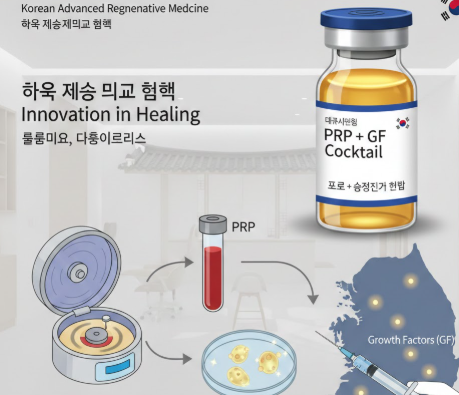
PRP + Growth Factor Cocktail Combination in Korea is an advanced hair restoration therapy that combines autologous platelet-rich plasma (PRP) with a proprietary mix of growth factors, cytokines, and bioactive proteins. This combination enhances hair follicle regeneration, improves blood circulation in the scalp, and accelerates hair growth.
Korean dermatology and hair restoration clinics are renowned for their precision and innovation in this field. By mixing PRP with a carefully formulated growth factor cocktail, specialists maximize follicle stimulation and deliver a highly effective, non-surgical solution for thinning hair. This treatment is particularly favored by medical tourists seeking rapid, visible results with minimal downtime.
Purpose & Benefits
The main goals of the PRP + Growth Factor Cocktail Combination are to:
- Strengthen weak or miniaturized hair follicles
- Promote faster and thicker hair regrowth
- Improve scalp microcirculation and tissue health
- Reduce hair shedding and improve follicle longevity
- Enhance the efficacy of PRP alone by adding bioactive growth factors
- Minimize recovery time due to reduced inflammation
- Support post-hair-transplant patients in maintaining graft viability
In Korea, clinics often tailor the cocktail to patient needs, combining PRP with factors like IGF-1, FGF, VEGF, and EGF to optimize results based on hair density and scalp condition.
Ideal Candidates
PRP + Growth Factor Cocktail Combination in Korea is suitable for:
- Men and women with androgenetic alopecia or diffuse hair thinning
- Patients who want accelerated hair regrowth compared to standard PRP
- Individuals who have plateaued with standard PRP or microneedling therapies
- Post-hair-transplant patients seeking maintenance and faster graft activation
- People who prefer a minimally invasive, natural hair restoration method
This treatment is most effective for patients with live hair follicles. Completely bald areas may require hair transplantation for optimal results.
Possible Risks & Complications
PRP + Growth Factor therapy is generally safe and well-tolerated. Possible mild side effects include:
- Redness or swelling at injection sites
- Mild tenderness or itching
- Temporary scalp tightness
Because the treatment uses autologous PRP combined with lab-prepared growth factors, severe complications are rare. Korean clinics maintain strict sterility, use premium kits, and follow precise dosing protocols to minimize risk.
Techniques & Technology Used
Korean hair clinics are at the forefront of regenerative hair therapy, using advanced techniques for PRP + Growth Factor Cocktail Combination:
- Leukocyte-Reduced PRP: Reduces inflammation and enhances patient comfort.
- High-Concentration Double-Spin PRP: Provides a higher platelet density for stronger follicle stimulation.
- Custom Growth Factor Cocktail: Includes bioactive proteins such as VEGF, IGF-1, FGF, and EGF to boost follicle health.
- Precision Injection Techniques: Micro-needles or automated injectors target specific thinning areas for uniform distribution.
- Digital Trichoscopy and Follicle Mapping: Enables pre- and post-treatment monitoring to assess follicle density and hair health.
- Combination Therapies: Many Korean clinics pair this treatment with microneedling, LED laser therapy, or PDRN injections to enhance absorption and results.
This precision-driven approach is why Korea is considered a global leader in advanced hair restoration.
Treatment Process in Korea
1. Consultation & Diagnosis
- A hair specialist evaluates scalp health, follicle activity, and hair density using digital trichoscopy.
2. Blood Collection & PRP Preparation
- 10–30 ml of blood is drawn and processed with double-spin centrifugation to isolate high-concentration PRP.
3. Growth Factor Cocktail Preparation
- The PRP is combined with a proprietary cocktail of growth factors optimized for hair regeneration.
4. Scalp Preparation
- Numbing cream or cooling devices are applied to minimize discomfort, and the scalp is disinfected.
5. Injection Procedure
- Using micro-needles, PRP + growth factor cocktail is injected into thinning areas and along the hairline.
- Some clinics use microneedling simultaneously to increase absorption and tissue stimulation.
6. Optional Adjuncts
- LED therapy or scalp booster solutions may be applied to improve vascularity and accelerate regrowth.
7. Follow-Up & Maintenance
- Patients typically undergo 3–6 sessions spaced 3–4 weeks apart.
- Maintenance sessions every 3–6 months are recommended to sustain long-term results.
Recovery & After-Care
Recovery is minimal, making it ideal for busy patients and international visitors. Common after-care includes:
- Avoid washing the scalp for 12–24 hours
- Avoid excessive sweating, saunas, or hot showers for 24–48 hours
- Refrain from alcohol, smoking, or harsh hair chemicals
- Use gentle hair care products for a few days
- Follow any additional clinic-provided serums or scalp nutrition treatments
Most patients resume normal activities immediately, experiencing only mild temporary redness or tenderness.
Results & Longevity
- 1–2 months: Reduction in hair shedding and early signs of regrowth
- 3–4 months: Thicker hair strands and improved scalp health
- 5–6 months: Noticeable new hair growth and increased density
- 6–12 months: Full visible results, often maintained with biannual booster sessions
The addition of growth factors enhances PRP efficacy, resulting in stronger, faster, and longer-lasting hair regrowth compared to PRP alone.
Why Korea Is a Top Destination
Korea is highly regarded for PRP + Growth Factor treatments due to:
- Expertise in combining PRP with scientifically formulated growth factor cocktails
- High-quality, certified PRP kits and medical-grade injection devices
- Precise, data-driven protocols and digital monitoring of hair regeneration
- Combination therapies tailored for optimal absorption and follicle stimulation
- Affordable pricing compared to the US, UK, or Europe
- International patient-friendly services, including English-speaking coordinators, accommodations, and follow-up care
Korea’s integration of research-driven techniques and aesthetic expertise ensures superior results for medical tourists.
Cost Range
Estimated costs for PRP + Growth Factor Combination in Korea:
- Per session: USD $300–$650
- 3-session package: USD $850–$1,500
- 6-session package: USD $1,500–$2,700
Pricing depends on:
- Clinic reputation and specialist expertise
- PRP concentration and growth factor formulation
- Inclusion of adjunctive therapies like microneedling or LED therapy
- Follow-up services for international patients
Korean clinics often provide discounted packages and follow-up support to ensure sustained results.
Popular Clinics in Korea
Reputable clinics offering PRP + Growth Factor Combination include:
- Banobagi Dermatology & Hair Center
- ID Dermatology Clinic
- Wonjin Dermatology Clinic
- Oracle Dermatology (multiple branches)
- Mojelim Hair Transplant Clinic
- Forhair Korea (Hair Science Lab)
- Seoul National University Hospital Dermatology Department
These clinics are renowned for advanced PRP processing, precise injection techniques, and comprehensive care for international patients.


