
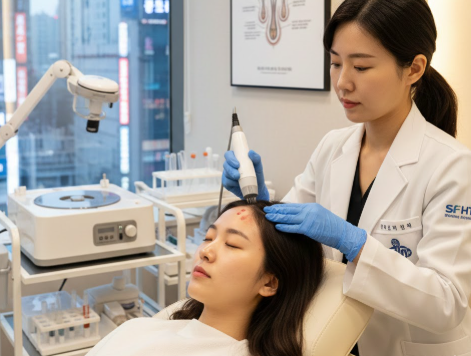
Treatment Overview
PRP + Microneedling Hair Regeneration in Korea is an advanced combination therapy designed to maximize hair restoration results. PRP (Platelet-Rich Plasma) provides growth factors and regenerative proteins, while microneedling creates controlled micro-injuries on the scalp that enhance PRP absorption and stimulate collagen production. Together, these therapies promote stronger, thicker hair growth and improved follicle activity.
Korean clinics are recognized globally for their precision, sterile protocols, and integration of advanced technologies, making this combined approach highly effective and safe for patients seeking non-surgical hair restoration. This treatment is especially popular among medical tourists due to the sophisticated techniques and fast recovery offered in Korean dermatology centers.
Purpose & Benefits
The PRP + Microneedling combination targets multiple aspects of hair loss:
- Activates dormant or miniaturized hair follicles
- Enhances hair density and thickness
- Reduces hair shedding and promotes new growth
- Improves scalp circulation and oxygenation
- Strengthens the scalp’s extracellular matrix for healthier hair growth
- Accelerates results compared to standard PRP alone
- Minimally invasive with no downtime
Korean specialists often tailor the treatment by adjusting needle depth, PRP concentration, and session frequency to match the patient’s hair condition and desired results.
Ideal Candidates
PRP + Microneedling in Korea is suitable for:
- Individuals with early to moderate androgenetic alopecia (male or female pattern hair loss)
- Patients experiencing diffuse thinning or patchy hair loss
- Post-hair-transplant patients seeking faster recovery and stronger graft growth
- People who have plateaued with standard PRP therapy
- Those seeking a natural, non-surgical method with minimal side effects
Patients with fully bald areas, severe scarring alopecia, or chronic scalp disease may require additional interventions or surgical procedures to achieve optimal results.
Possible Risks & Complications
This treatment is generally safe and well-tolerated, with most side effects being temporary and mild:
- Minor redness, swelling, or pinpoint bleeding at injection sites
- Temporary scalp tenderness or mild discomfort
- Slight bruising that typically resolves within a few days
Compared to standard PRP, microneedling may cause minimal scalp irritation, but leukocyte-reduced PRP is often used to minimize inflammation. Korean clinics ensure rigorous sterility and precise injection techniques, reducing risk of infection or complications.
Techniques & Technology Used
Korean hair clinics use state-of-the-art technology and refined protocols for PRP + Microneedling:
- Leukocyte-Reduced PRP
- Concentrated PRP with minimal inflammatory cells to reduce irritation.
- Precision Microneedling Devices
- Automated dermarollers or pen systems with adjustable needle depths (0.5–2.5mm).
- Combination Delivery
- PRP is applied topically and injected simultaneously with microneedling to enhance follicular penetration.
- Digital Trichoscopy Monitoring
- Scalp imaging evaluates hair density and follicle activity before and after sessions.
- Adjunctive Therapies
- Some clinics pair PRP + microneedling with LED low-level laser therapy or growth factor boosters for faster and stronger results.
This combination is especially effective in Korea because specialists adjust treatment parameters based on scalp condition and hair thinning patterns.
Treatment Process in Korea
- Consultation & Assessment
- Dermatologists perform scalp analysis using high-resolution trichoscopy, follicle count, and scalp thickness measurement.
- Blood Collection & PRP Preparation
- 10–30 ml of blood is drawn, processed via double-spin centrifugation, and leukocyte-reduced to produce high-concentration PRP.
- Scalp Preparation
- The scalp is disinfected and numbing cream or scalp-cooling devices are applied to reduce discomfort.
- Microneedling Procedure
- A microneedling device creates controlled microchannels in the scalp.
- Needle depth and speed are adjusted to the patient’s hair thinning severity.
- PRP Application
- PRP is applied topically and injected into microchannels created by the microneedling process.
- This dual action enhances growth factor delivery and accelerates follicle regeneration.
- Post-Treatment
- Optional LED light therapy may be applied immediately to further stimulate hair follicles.
- Patients are given after-care instructions to maximize results.
- Follow-Up Schedule
- Typically, 3–6 sessions spaced 3–4 weeks apart, with maintenance every 3–6 months depending on progress.
Recovery & After-Care
Recovery from PRP + Microneedling is minimal:
- Minor redness, swelling, or pinpoint bleeding for a few hours to a day
- Avoid washing hair for 12–24 hours
- Refrain from saunas, hot showers, and vigorous exercise for 24–48 hours
- Use gentle hair care products for a few days
- Avoid alcohol, smoking, and harsh chemicals to optimize healing
Most patients resume normal daily activities immediately after treatment, making it ideal for busy international visitors.
Results & Longevity
Results typically appear gradually:
- 1 month: Reduced hair shedding
- 2–3 months: Early new hair growth
- 4–6 months: Noticeable thickening and improved density
- 6–12 months: Optimal hair restoration
The combination of PRP and microneedling offers stronger and longer-lasting results than standard PRP alone. Maintenance sessions 1–2 times per year help sustain improvements.
Why Korea Is a Top Destination
Korea has become a preferred destination for hair regeneration treatments due to:
- Advanced dermatology clinics with precise PRP and microneedling protocols
- Experienced hair specialists who tailor treatments based on individual scalp conditions
- Integration of multiple modalities such as PRP, microneedling, LED therapy, and growth factor boosters
- Use of high-quality, certified PRP kits and medical-grade microneedling devices
- Affordable treatment packages with world-class standards
- Strong infrastructure for medical tourism, including international coordinators, translation services, and follow-up support
Patients can combine treatment with other hair restoration therapies or aesthetic procedures in Korea for comprehensive care.
Cost Range
PRP + Microneedling Hair Regeneration in Korea typically costs:
- Per session: USD $250–$500
- 3-session package: USD $700–$1,200
- 6-session package: USD $1,200–$2,200
Price varies based on:
- Clinic reputation and specialist experience
- PRP concentration and preparation method
- Use of adjunctive therapies (LED, growth factors)
- Follow-up care and international patient services
Korean clinics offer competitive pricing relative to the advanced technology and high success rates.
Popular Clinics in Korea
Some reputable clinics offering PRP + Microneedling include:
- Banobagi Dermatology & Hair Center
- ID Dermatology Clinic
- Wonjin Dermatology Clinic
- Oracle Dermatology (multiple branches)
- Mojelim Hair Transplant Clinic
- Forhair Korea (Hair Science Lab)
- Seoul National University Hospital Dermatology Department
These clinics are known for precision PRP protocols, modern microneedling systems, and experience treating international patients.


