
Treatment Overview
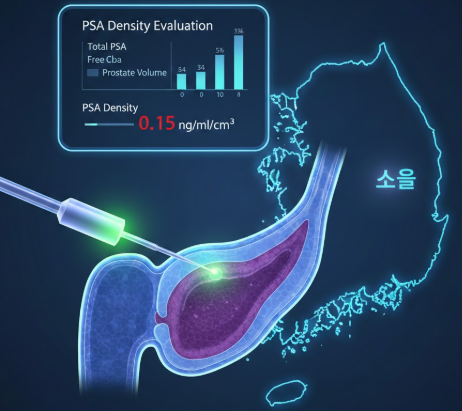
PSA density evaluation is an advanced diagnostic method that measures the ratio of total PSA levels to prostate volume. This assessment helps distinguish benign prostate enlargement from clinically significant prostate cancer, providing a more accurate risk evaluation than PSA alone.
In Korea, PSA density is calculated using transrectal ultrasound (TRUS), MRI, or 3D prostate imaging combined with precise PSA blood tests, offering reliable results for both local and international patients.
Purpose & Benefits
The purpose of PSA density evaluation is to:
- Improve diagnostic accuracy for prostate cancer
- Reduce unnecessary biopsies in men with enlarged prostates
- Guide personalized management and treatment decisions
Benefits include:
- Minimally invasive and safe
- Combines PSA levels with prostate volume for precise risk stratification
- Supports biopsy planning and active surveillance
- Reduces false positives associated with PSA testing alone
- Enhances early detection of clinically significant prostate cancer
Ideal Candidates
PSA density evaluation is recommended for men who:
- Have borderline or elevated PSA levels
- Show prostate enlargement on imaging
- Are at higher risk for prostate cancer due to age, genetics, or family history
- Require advanced assessment before biopsy or treatment
- Are seeking international-standard prostate diagnostics
Korean urologists determine PSA density using PSA results and prostate imaging to guide risk assessment.
Possible Risks & Complications
PSA density evaluation is generally safe. Considerations include:
- Mild discomfort from blood draw or imaging
- Rare anxiety while awaiting results
- Minimal risks associated with TRUS or MRI imaging
- Slight variability in PSA levels due to infection, ejaculation, or recent prostate manipulation
Techniques & Technology Used
Korean hospitals use advanced technology for PSA density evaluation:
- Total PSA measurement via high-precision immunoassays
- Prostate volume assessment using TRUS, mpMRI, or 3D ultrasound
- Integration with Free PSA, PHI, and 4Kscore for comprehensive risk stratification
- Certified laboratories and imaging centers adhering to international quality standards
- Electronic reporting systems for international patients
This ensures precise calculation and accurate interpretation of PSA density.
Treatment Process in Korea
- Consultation & Assessment – Review PSA levels, prior tests, and symptoms
- Blood Test – High-precision total PSA measurement
- Imaging – TRUS, MRI, or 3D ultrasound to measure prostate volume
- PSA Density Calculation – PSA level divided by prostate volume
- Result Interpretation & Recommendations – Guide biopsy decisions, active surveillance, or treatment
Medical tourism coordinators assist international patients with scheduling, translation, and follow-up care.
Recovery & After-Care
- Minimal recovery required
- Resume normal activities immediately
- Minor discomfort after imaging may occur
- Maintain a record of PSA and prostate volume for follow-up
Results & Interpretation
PSA density evaluation provides:
- A more precise risk assessment than PSA alone
- Early detection of clinically significant prostate cancer
- Support for biopsy decisions and active surveillance
- Guidance for personalized treatment planning
Accurate PSA density evaluation improves diagnostic confidence and patient outcomes.
Why Korea Is a Top Destination
- Advanced imaging technologies (TRUS, mpMRI, 3D ultrasound)
- Experienced urologists specializing in PSA density and prostate diagnostics
- Fast, accurate, and internationally-friendly service
- Integration with PSA, Free PSA, PHI, 4Kscore, and biopsy planning
- English-language support and medical tourism coordination
- Cost-effective and high-quality care compared to Western countries
Cost Range
Typical costs for PSA density evaluation in Korea:
₩200,000 – ₩800,000 KRW (~$150–$600 USD)
Costs vary depending on:
- Imaging method used (TRUS, 3D ultrasound, MRI)
- Hospital or clinic grade
- Consultation and follow-up services
Popular Clinics in Korea
- Seoul National University Hospital – PSA Density & Prostate Assessment
- Samsung Medical Center – Advanced Urology Diagnostics
- Asan Medical Center – Comprehensive Prostate Evaluation
- Gangnam Severance Hospital – International Patient Prostate Services
- Korea University Anam Hospital – PSA Density & Risk Assessment
- JK Urology & Men’s Health Clinics – Personalized Prostate Diagnostics


