
Treatment Overview
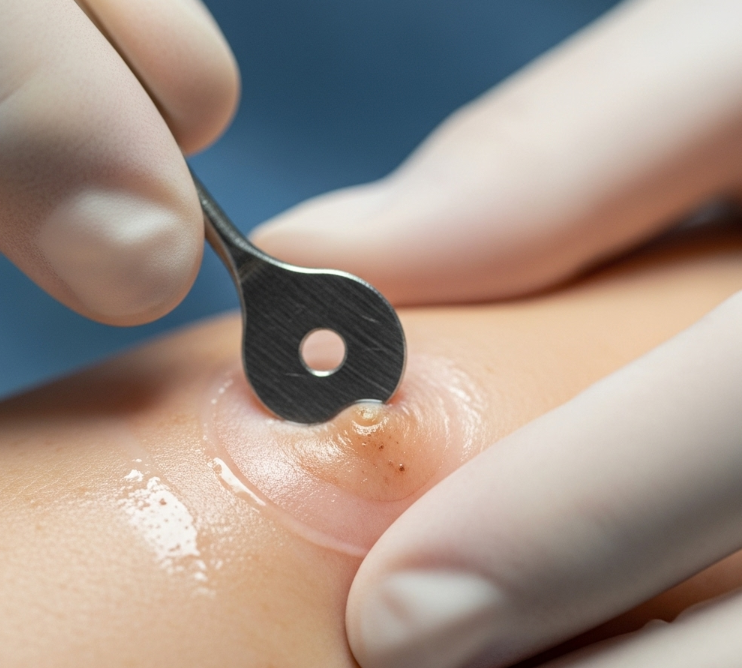
Punch Excision is a minor surgical dermatology procedure used to treat deep, well-defined acne scars, especially ice-pick scars and small boxcar scars.
The procedure involves using a punch tool (similar to a tiny cookie cutter) to precisely remove the scar tissue. The resulting wound is then closed with a fine suture or allowed to heal naturally. Over time, this replaces the deep scar with a smoother, flatter surface that blends better with the surrounding skin.
In Korea, punch excision is often performed as part of a comprehensive acne scar repair protocol, combined with laser resurfacing, subcision, microneedling RF, or fillers to improve overall texture and pigmentation.
Purpose & Benefits
- Removes Deep Scars: Especially effective for ice-pick scars that do not respond well to lasers.
- Scar Replacement: Converts a pitted scar into a flatter, less noticeable mark.
- Permanent Results: Scar tissue is surgically removed, not just resurfaced.
- Combination Friendly: Enhances results of CO₂ fractional laser or Fraxel.
- Precise Targeting: Treats individual scars without affecting healthy surrounding skin.
Ideal Candidates
Punch Excision in Korea for acne scars is recommended for:
- Patients with ice-pick scars or small, deep boxcar scars.
- Individuals who did not achieve full improvement with lasers or peels alone.
- Adults seeking a permanent solution for stubborn scars.
- Those comfortable with a minor surgical procedure and stitches.
Comparison with Other Treatments:
- Punch Excision: Best for individual ice-pick scars.
- Punch Elevation: Best for deep boxcar scars (scar tissue lifted instead of removed).
- CO₂ Fractional Laser: Best for texture and widespread scarring.
- Subcision + Fillers: Best for tethered rolling scars.
- Fraxel Dual: Best for pigmentation + shallow scarring.
Possible Risks & Complications
When performed by skilled Korean dermatologists, punch excision is very safe. Possible risks include:
- Redness & Swelling: Common, resolves in 3–7 days.
- Suture Marks: Minimal, usually fade with time or with laser treatment.
- Mild PIH (Post-Inflammatory Hyperpigmentation): More common in darker skin types, but managed with aftercare.
- Infection (rare): Prevented with sterile techniques and proper wound care.
Treatment Techniques Used
- Punch Excision with Sutures: Scar tissue removed, wound closed with fine stitches.
- Punch Excision with Grafting (rare): Tiny skin graft placed for larger scars.
- Punch Elevation: Scar tissue cut loose and lifted to skin surface.
- Session Protocol: Usually 1–2 sessions; multiple scars can be treated in one sitting.
- Combination Therapy: Lasers or peels are used later for surface refinement.
Recovery & Aftercare
- Immediately: Redness and swelling around treated areas.
- 3–7 Days: Sutures removed (if used), mild scabbing may occur.
- 2–4 Weeks: Skin heals with flatter appearance.
- 2–3 Months: Final blending of treated area with surrounding skin.
Aftercare Tips:
- Keep treated areas clean and apply antibiotic ointment as prescribed.
- Avoid scratching or touching sutures/scabs.
- Use SPF 50+ sunscreen to prevent pigmentation.
- Follow up with dermatologist for suture removal and scar monitoring.
Results & Longevity
- Short-Term (2–4 Weeks): Treated scar is less deep, appears smoother.
- Medium-Term (2–3 Months): Blending improves with skin healing.
- Long-Term: Permanent scar removal, though additional resurfacing (laser/peel) may enhance results.
Treatment Process in Korea
- Consultation & Scar Mapping – Doctor identifies scars suitable for punch excision.
- Preparation – Local anesthesia applied to treatment sites.
- Punch Excision Procedure – Scar tissue precisely removed with punch tool.
- Closure – Wound sutured or left to heal depending on size.
- Post-Care – Antibiotic ointment, protective dressing if needed.
- Follow-Up – Stitches removed after 5–7 days; laser resurfacing may follow for polishing.
Why Korea is a Top Destination
- Korean dermatologists excel in multi-modal scar protocols, tailoring punch excision to individual scar types.
- Clinics combine punch excision with lasers, subcision, PRP, or skin boosters for optimal outcomes.
- Use of refined surgical tools and micro-sutures ensures minimal marks.
- More affordable compared to Western clinics with package-based pricing.
- Seoul is internationally recognized for innovative acne scar treatment programs.
Cost Range (Detailed Breakdown)
Pricing for Punch Excision in Korea for acne scars:
- Single Scar: USD 80 – 150
- Multiple Scars (per session, 5–10 scars): USD 300 – 600
- Punch Excision + CO₂ Laser Combo: USD 600 – 1,200
- Premium Scar Package (Punch Excision + Laser + PRP/Rejuran): USD 1,500 – 3,000
Additional Costs in Korea:
- Consultation: USD 20 – 50
- Add-ons (PRP, Rejuran, Exosomes, Subcision): USD 150 – 600
💡 Many patients call punch excision the “precise scar eraser”, as it permanently removes deep scars that are resistant to other treatments.
Popular Clinics in Seoul
- Banobagi Dermatology – Punch excision + CO₂ laser scar packages.
- Oracle Dermatology – Punch excision with PRP/exosome healing support.
- Renewme Skin Clinic – Punch excision + fractional laser for combination scars.
- View Plastic & Dermatology – Multi-step acne scar removal with punch + subcision.
- Chaum Anti-Aging Center – Luxury acne scar repair with punch excision + regenerative boosters.


