
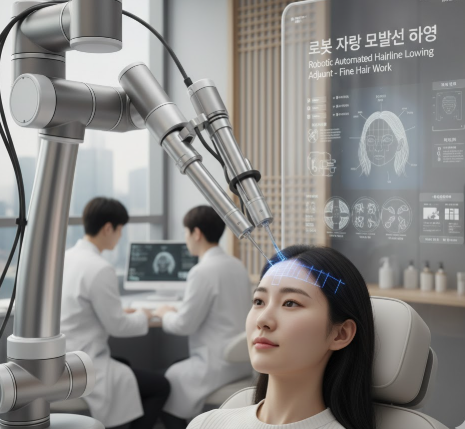
Treatment Overview
The Robotic/Automated Hairline Lowering Adjunct in Korea is an advanced, technology-driven procedure designed to enhance precision in fine hairline work. Utilizing robotic-assisted or automated systems, surgeons can perform ultra-precise incisions, graft placement, and hairline design, ensuring optimal density, symmetry, and natural aesthetics. This adjunct is particularly useful for patients seeking delicate refinements, temple adjustments, or subtle contouring of their hairline. Korea’s clinics are globally recognized for integrating robotic technology with traditional hairline surgery, offering patients superior accuracy, reduced tissue trauma, and consistent results.
Purpose & Benefits
The main purpose of the Robotic/Automated Hairline Lowering Adjunct is to achieve high-precision hairline lowering with minimal human error, focusing on delicate, fine hairline work.
Key Benefits
- Ultra-precise hairline refinement with robotic-assisted technology
- Enhances natural density and symmetry
- Minimally invasive with reduced tissue trauma
- Camouflages incision lines for invisible scarring
- Reduces surgical variability for consistent results
- Speeds up procedure time and enhances recovery outcomes
Ideal Candidates
This adjunct is ideal for patients who require precision in hairline lowering and refinement.
Best-Suited Candidates
- Men and women with fine hair or delicate hairline structures
- Individuals seeking precise temple or side-hairline adjustments
- Patients with previous hairline surgeries requiring touch-ups
- Candidates desiring minimal visible scarring and natural aesthetics
- People looking for cutting-edge technology combined with surgical expertise
Patients with previous scalp surgeries or scarring can also benefit, as robotic systems enhance accuracy in complex areas.
Possible Risks & Complications
Although robotic-assisted procedures are highly precise, they carry similar risks as conventional hairline surgery.
Potential Risks
- Mild swelling or tenderness along the hairline
- Temporary numbness or altered sensation
- Minor redness, scabbing, or bruising
- Temporary shock hair shedding in transplanted areas
- Slight asymmetry, usually correctable
- Rare infection or hypersensitivity reaction to anesthesia
Korean clinics minimize risks through careful planning, precision technology, and post-operative care.
Techniques & Technology Used
Korean clinics combine surgical expertise with robotic and automated technology for optimal fine hairline results.
Main Techniques
- Micro-incision hairline lowering for minimal trauma
- High-density graft placement guided by robotic systems
- Temple and side-hairline refinement for symmetry
- Multi-layered suturing to reduce tension and optimize healing
- Fine contouring and customization using automated precision tools
Technology Highlights
- Robotic-assisted micro-incision systems for accuracy
- 3D imaging and facial mapping for precise hairline design
- Trichoscopy to evaluate donor hair quality and density
- Microscopic surgical instruments integrated with automation
- Low-thermal devices to protect follicles
- LED therapy and cooling treatments for accelerated recovery
These technologies ensure highly refined, natural, and dense hairline results with minimal downtime.
Treatment Process in Korea
The Robotic/Automated Hairline Lowering Adjunct in Korea offers a structured and patient-friendly process.
Step-by-Step Procedure
- Consultation and facial analysis with 3D imaging
- Custom hairline design with robotic planning for fine work
- Local anesthesia or mild sedation for comfort
- Robotic-assisted micro-incisions and high-density graft placement
- Temple and side-hairline refinement for symmetry and natural aesthetics
- Post-operative care including cooling, anti-inflammatory treatment, and follow-up
- Optional telemedicine follow-up for international patients
International patients receive full support including translation, accommodation, and transport services.
Recovery & After-Care
Recovery is generally smooth due to minimally invasive robotic-assisted techniques.
Recovery Timeline
- Days 1–3: mild swelling and tenderness
- 1 week: initial hair growth begins, minor redness reduces
- 2–3 weeks: swelling and scabbing significantly decrease
- 3–6 months: grafted hair blends naturally with existing hair
- 6–12 months: final refined hairline with natural density and contour
After-Care Tips
- Avoid pressure on hairline and treated areas
- Follow prescribed medications and topical treatments
- Sleep with head elevated for the first few nights
- Avoid smoking, alcohol, and high-heat styling
- Attend follow-up appointments to monitor healing and hair growth
PRP therapy or hair-growth boosters may be recommended to optimize results and density.
Results & Longevity
Robotic/Automated Hairline Lowering Adjunct in Korea delivers precise, natural, and long-lasting results.
Expected Outcomes
- Refined hairline with optimal density and symmetry
- Smooth transition along temples and side-hairline
- Camouflaged incision lines for invisible scarring
- Balanced and aesthetically pleasing facial proportions
- Stable, long-lasting results with proper aftercare
Results remain effective for years with consistent maintenance, though natural aging may slightly affect hairline density.
Why Korea Is a Top Destination
Korea is a world leader in hairline surgery, combining surgical expertise, advanced robotics, and medical tourism infrastructure.
Key Advantages
- Surgeons skilled in robotic-assisted and automated hairline techniques
- Advanced micro-incision and high-density grafting technology
- Natural, precise, and aesthetically refined results
- Accredited clinics meeting international safety standards
- Full support for international patients including translation, accommodation, and transport
- Post-operative care and optional telemedicine follow-up
These factors make Korea the preferred destination for fine, technology-enhanced hairline lowering.
Cost Range in Korea
The cost of Robotic/Automated Hairline Lowering Adjunct varies depending on clinic reputation and procedure complexity.
Estimated Cost
USD $6,500 – $13,000
This typically includes consultation, surgery, robotic-assisted procedure, anesthesia, medications, post-operative care, and optional international patient support.
Popular Clinics in Korea
- ID Hospital
- Banobagi Plastic Surgery
- Motion Clinic
- View Plastic Surgery
- Dr. For Hair Clinic
- The LINE Plastic Surgery
These clinics are recognized for combining robotic-assisted hairline refinement with natural aesthetics and full support for medical tourists.


