
Treatment Overview
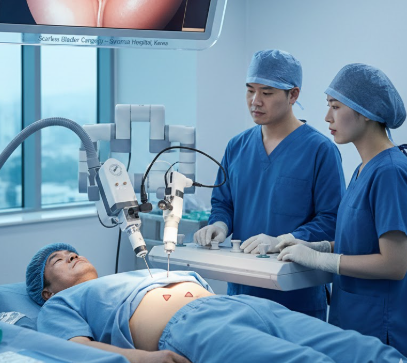
Scar-Minimizing Bladder Cancer Surgery in Korea focuses on advanced surgical approaches designed to reduce visible scarring while ensuring safe and effective tumor removal. Korean hospitals use the latest minimally invasive technologies, including robotic-assisted surgery, laparoscopic resections, micro-incision TURBT, and high-precision laser systems. These techniques enable surgeons to remove bladder tumors through very small incisions—or entirely through the urethra—resulting in almost no external scars. Combined with enhanced imaging and real-time navigation tools, Korea’s scar-minimizing methods provide high oncological success rates with excellent cosmetic and functional outcomes.
Purpose & Benefits
The objective of scar-minimizing bladder cancer surgery is to treat cancer effectively while preserving cosmetic appearance and reducing recovery burden. Key benefits include:
– Minimal or no visible scarring
– Reduced postoperative pain compared to open surgery
– Lower infection risk due to small incisions
– Faster recovery and shorter hospital stay
– Less damage to surrounding tissues
– Enhanced precision with robotic and laser technologies
– Improved bladder function preservation when feasible
International patients often choose scar-minimizing options for both medical effectiveness and superior cosmetic outcomes.
Ideal Candidates
Individuals who may benefit from scar-minimizing bladder cancer surgery include:
– Patients with early-stage (Ta, T1) or non-muscle-invasive bladder cancer
– Individuals with tumors requiring precise removal but minimal tissue disruption
– Patients prioritizing cosmetic outcomes
– Those suitable for robotic-assisted or laparoscopic partial cystectomy
– Individuals eligible for laser-assisted TURBT
– Patients seeking faster recovery due to work or travel schedules
Final eligibility is determined through imaging, cystoscopy, biopsy, and evaluation by a multidisciplinary urology-oncology team.
Possible Risks & Complications
Although minimally invasive, scar-minimizing bladder cancer surgery may still involve potential risks:
– Mild bleeding or hematuria
– Urinary tract infection
– Temporary urinary urgency or discomfort
– Incomplete tumor removal in complex cases
– Recurrence requiring follow-up procedures
– Rare injury to surrounding structures
– Anesthesia-related risks
Korean hospitals maintain very low complication rates due to advanced intraoperative imaging and highly trained surgical teams.
Techniques & Technology Used
Scar-minimizing bladder cancer surgery in Korea integrates some of the most advanced medical technologies in the world, including:
– Robotic-Assisted Partial or Radical Cystectomy: Small incisions with superior precision and minimal tissue disruption
– Laparoscopic Bladder Tumor Surgery: Micro-incisions for access with minimal scarring
– Laser-Assisted TURBT (Holmium, Thulium, Green-Light): No external incisions; complete tumor removal through the urethra
– High-Definition and 4K Cystoscopy: Enhanced visualization of tumor margins
– Blue-Light & Narrow-Band Imaging: Superior detection of small or flat lesions
– AI-Assisted Surgical Navigation (in top-tier hospitals): Provides real-time decision support
– Micro-Incision Approaches: Reduces scarring and accelerates recovery
Korea’s integration of precision tools ensures excellent cosmetic and oncologic outcomes.
Treatment Process in Korea
Patients who choose Korea for scar-minimizing bladder cancer surgery follow a streamlined, patient-focused treatment pathway:
- Pre-Arrival Coordination: Hospitals review medical records and provide cost and treatment plans.
- Comprehensive Diagnostics: Includes CT/MRI, urine cytology, and flexible cystoscopy.
- Surgical Planning: A multidisciplinary team determines the least invasive method that still ensures complete tumor removal.
- Surgery: Performed via robotic assistance, laparoscopy, laser TURBT, or hybrid precision techniques, depending on tumor characteristics.
- Immediate Recovery: Monitoring of urinary function, pain levels, and bladder integrity.
- Discharge: Typically within 24–72 hours depending on the surgical method.
- Adjuvant Therapy: Intravesical therapy, chemotherapy, or immunotherapy if clinically indicated.
- Long-Term Surveillance: Regular cystoscopy to prevent or detect recurrence early.
Korean hospitals provide full medical tourism support including translation, airport pickup, and accommodation assistance.
Recovery & After-Care
Recovery from scar-minimizing bladder cancer surgery is notably faster than traditional open methods:
– Return to light activities within a few days after TURBT or 1–2 weeks after robotic surgery
– Minimal postoperative pain due to small or no external incisions
– Catheter use for a short period, depending on procedure type
– Adequate hydration to reduce bladder irritation
– Avoiding strenuous activity for 1–3 weeks
– Regular follow-up cystoscopies to ensure long-term success
Hospitals offer structured after-care programs, digital monitoring systems, and patient-friendly recovery plans.
Results & Longevity
Scar-minimizing bladder cancer surgery in Korea demonstrates excellent long-term outcomes:
– High complete tumor removal rates
– Low complication and infection rates
– Minimal to no visible scarring
– Better preservation of bladder structure and function
– Low recurrence rates when combined with appropriate follow-up therapy
– High patient satisfaction, especially among international medical tourists
Precision-focused techniques contribute to durable oncologic success and improved quality of life.
Why Korea Is a Top Destination
Korea has become a global leader in scar-minimizing bladder cancer surgery for several reasons:
– Surgeons with extensive expertise in minimally invasive and robotic bladder cancer procedures
– National investment in next-generation surgical technologies
– Consistently high success rates with low recurrence
– Multilingual medical tourism centers offering full logistical support
– Affordable treatment costs compared to the US, Europe, Singapore, and Japan
– Comprehensive postoperative management and enhanced patient safety systems
These strengths make Korea a preferred destination for patients seeking both advanced cancer treatment and superior cosmetic outcomes.
Cost Range
Costs for scar-minimizing bladder cancer surgery in Korea depend on the technique used:
– Laser-Assisted TURBT: USD 4,000 – 9,000
– Robotic Partial Cystectomy: USD 12,000 – 20,000
– Robotic Radical Cystectomy: USD 18,000 – 35,000
– Laparoscopic Bladder Tumor Resection: USD 8,000 – 15,000
– Diagnostics and Preoperative Tests: USD 800 – 2,000
– Follow-Up and Intravesical Therapy: USD 500 – 2,500
Korea offers highly competitive pricing without compromising medical sophistication or patient safety.
Popular Clinics in Korea
Leading hospitals offering scar-minimizing bladder cancer surgery include:
– Samsung Medical Center
– Asan Medical Center
– Seoul National University Hospital
– Severance Hospital (Yonsei University Health System)
– St. Mary’s Hospital
– CHA Bundang Medical Center
– Korea University Anam Hospital
– Specialized urology centers with advanced robotic and laser programs
These institutions are internationally recognized for pioneering minimally invasive techniques.


