
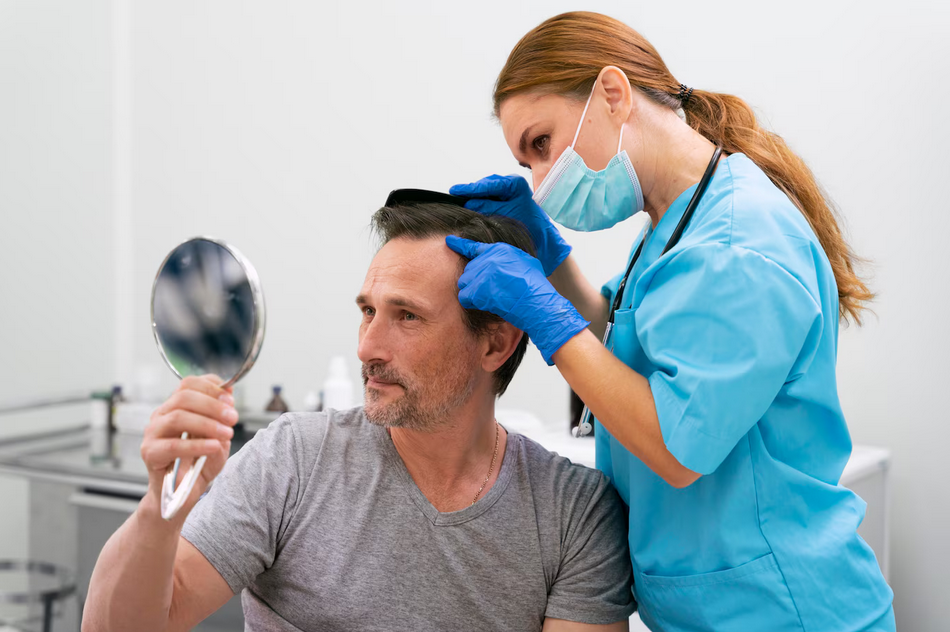
A Non-Surgical Solution to Enhance or Refine Your Hairline
South Korea is globally respected for its meticulous and artistic approach to cosmetic procedures—and scalp micropigmentation (SMP) is no exception. While hairline correction surgery involves grafting or advancing the scalp, SMP offers a non-surgical, highly precise option for creating the appearance of a fuller, more defined hairline.
Whether used as a standalone treatment or a complement to hairline correction surgery, SMP is an increasingly popular choice among both local and international clients seeking natural-looking results with minimal downtime.
🧠 What Is Scalp Micropigmentation?
Scalp Micropigmentation is a cosmetic tattooing technique that uses micro-needles to deposit pigment into the scalp to mimic the look of natural hair follicles.
Unlike traditional tattooing:
- SMP uses specialized pigments designed for scalp tones
- The needles are ultra-fine and penetrate only the upper dermis
- Techniques are adapted to replicate hair follicle size, spacing, and direction
💡 In Korea, this procedure is also known as Hairline Tattoo or Hairline Embroidery, especially in the context of women’s beauty treatments.
🧰 Types of Hairline Issues SMP Can Correct or Enhance
| Concern | How SMP Helps |
|---|---|
| Receding or uneven hairline | Recreates the look of a lower, symmetrical hairline |
| Post-surgical graft gaps | Fills in sparse areas between transplanted follicles |
| Baby hair loss or soft frontal thinning | Soft shading to mimic baby hairs |
| Low-density frontal scalp | Adds the illusion of volume without grafting |
| Scarring from past surgeries or injuries | Camouflages linear or patchy scars |
Why Korean Clinics Excel in SMP Techniques
Korean SMP specialists are known for their artistic detail, color-matching expertise, and patient-specific designs. Key innovations include:
1. 3D Micro-Dotting Technique
- Mimics hair follicle depth and natural irregularities
- Avoids “flat ink dot” appearance common in amateur SMP
2. Gradient Blending
- Fades pigment from strong central zones into lighter edges
- Especially useful in replicating soft or curved feminine hairlines
3. Pigment Customization
- Custom-blended ink tones to match East Asian and other ethnic skin tones
- Clinics use hypoallergenic, semi-permanent pigments with lower risk of discoloration
🧑⚕️ When Do Korean Clinics Recommend SMP?
Korean hair restoration clinics often recommend SMP in the following scenarios:
✔️ Post-Surgery Enhancement
- After a hairline correction surgery, SMP can fill in fine gaps and enhance density
- Especially useful for patients with limited donor hair availability
✔️ Non-Surgical Alternative
- Ideal for those not eligible for hairline surgery (e.g., thin donor hair, medical issues)
- Popular among young adults and women seeking aesthetic improvements without downtime
✔️ Scar Camouflage
- SMP effectively hides FUT linear scars or FUE punch marks
- Also used for patients with traction alopecia scars
🩺 Step-by-Step SMP Procedure in Korean Clinics
- Design Consultation
- Digital imaging used to simulate results
- Custom hairline design is sketched and approved
- Pigment Testing
- Patch test to confirm color match and allergy safety
- First SMP Session
- Micro-needles implant pigment into the scalp
- Takes 2–3 hours depending on coverage area
- Healing Phase
- Mild redness for 24–48 hours
- No exercise, shampoo, or sun exposure for 4–5 days
- Touch-Up Sessions
- Usually 1–2 sessions spaced 2–4 weeks apart
- Ensures pigment evenness and depth
✨ Benefits of SMP in Hairline Correction
| Benefit | Why It’s Valuable in Korea |
|---|---|
| Non-invasive | No incisions, sutures, or donor area needed |
| Immediate visible results | Results appear within days after healing |
| Gender-inclusive | Popular among both men and women |
| Long-lasting (2–5 years) | Pigments fade gradually, offering flexibility |
| Cost-effective | Often cheaper than surgery or transplants |
🔄 SMP vs. Hairline Correction Surgery: A Comparison
| Feature | SMP | Hairline Correction Surgery |
|---|---|---|
| Invasiveness | Non-surgical | Surgical (FUE, FUT, or scalp advancement) |
| Recovery Time | 1–3 days | 7–14 days |
| Longevity | 2–5 years (may need touch-ups) | Permanent (but may thin with aging) |
| Ideal For | Cosmetic fill-in, baby hairs, surgery aftercare | Severe recession or restructuring |
| Cost (avg. in Korea) | ₩800,000–₩2,000,000 KRW | ₩3,000,000–₩8,000,000 KRW |
🧠 Combination therapy (SMP + surgery) often gives the most natural and dense result.
🌍 Is SMP Suitable for International Patients?
Yes. Korean clinics provide:
- Same-day consultations and treatment planning
- English-speaking SMP artists and staff
- Aftercare kits and follow-up instructions tailored for travelers
Some clinics offer SMP-only packages specifically for medical tourists, which include airport pickup, accommodation, and sightseeing options.
💬 Real-World Insight from Korean SMP Experts
“SMP is not about just adding dots. It’s about designing a hairline that flatters the face, using pigment the right way—soft in the front, fuller in the back. We treat each scalp like a canvas.”
— Master SMP Artist, Seoul


