
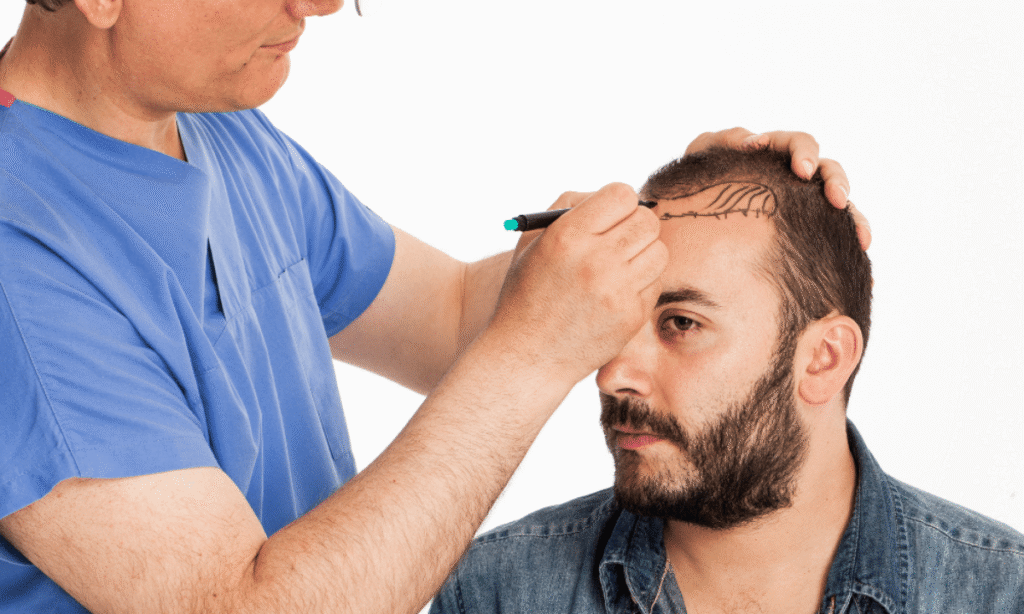
Your hairline plays a crucial role in framing your face and defining your overall appearance. Different hairline shapes can influence how youthful, balanced, or attractive your face looks. Korean clinics, with their deep expertise in facial aesthetics, emphasize customizing hairline correction surgeries to each individual’s unique hairline shape and facial structure.
Here’s a comprehensive guide to common hairline shapes and how specialized surgical approaches in Korea can help enhance or correct them.
1. Common Hairline Shapes
- Rounded Hairline:
A smooth, gently curved hairline that creates a soft and natural frame around the forehead. This shape is often seen as youthful and feminine. - M-Shaped Hairline:
Characterized by two receding points at the temples, forming an “M” shape. This is common in male pattern baldness but can appear in females as well. - Widow’s Peak:
A prominent V-shaped point at the center of the forehead. While unique and stylish for some, others seek to soften or reshape it for a more balanced look. - Straight Hairline:
A flat, horizontal hairline without curves or peaks. It often gives a strong, defined facial frame but can appear harsh depending on face shape. - Asymmetrical Hairline:
Uneven height or shape on one side of the forehead, often due to genetics or previous hair loss. - High Hairline:
A hairline positioned farther back from the eyebrows, making the forehead appear larger. This can affect facial proportions, especially in women.
2. How Surgery Can Help Different Hairline Shapes
Lowering a High Hairline
Korean clinics perform hairline lowering or advancement surgery to reduce the forehead height by moving the hair-bearing scalp forward. This balances facial proportions and creates a more harmonious look.
Correcting M-Shaped or Receding Hairlines
Hairline correction surgery combined with hair transplantation is often recommended to fill in receded temple areas, smoothing out the “M” shape and restoring a natural, youthful contour.
Softening or Reshaping Widow’s Peak
Surgical revision or strategic hair transplantation can soften the pronounced V-shape, making the hairline appear more rounded or straightened depending on patient preference.
Balancing Asymmetrical Hairlines
Surgeons carefully analyze asymmetry and use a combination of scalp advancement and follicular unit transplantation to create a balanced, even hairline.
Refining the Rounded or Straight Hairline
For patients desiring subtle refinements, Korean surgeons use minimally invasive techniques to reshape the hairline curve or edge, enhancing facial aesthetics without drastic changes.
3. Why Personalization Matters
Korean clinics emphasize a personalized approach. Surgeons evaluate:
- Facial shape and bone structure
- Hair density and texture
- Scalp elasticity
- Gender-specific aesthetic ideals
- Patient preferences and lifestyle
This ensures that hairline correction surgery complements each patient’s unique features, resulting in natural and flattering outcomes.
4. Techniques Used in Korean Clinics
- Scalp Advancement (Hairline Lowering) Surgery: Carefully releasing and repositioning the scalp forward with minimal scarring.
- Follicular Unit Transplantation (FUT) or Extraction (FUE): Transplanting hair follicles to reshape or densify the hairline.
- Trichophytic Closure: A scar-minimizing technique used during surgery for smoother edges.
- Micropigmentation: For patients who want to add the illusion of hair density without surgery.
5. Consultation and Visualization
Korean clinics often use digital imaging and 3D simulations to help patients visualize how different hairline shapes will look post-surgery. This collaborative planning reduces surprises and aligns expectations.
6. Patient Satisfaction and Natural Results
Because of this tailored approach, patients in Korea typically experience high satisfaction rates with hairline correction surgery. The results appear natural, enhancing beauty without looking “overdone.”
🏁 Final Thoughts
Understanding your hairline shape and how it affects your overall appearance is the first step toward achieving an ideal look. Korean clinics combine artistic skill with advanced surgical technology to customize hairline correction, addressing diverse hairline types with precision and care.


